Readings and interpretations
Critical writings
Twenty-seven contributions on Sandro Visca’s work, from 1964 to 2026. Different voices explore his imagery, materials, landscape and theatre.
Select an author to open the full text. The essays are presented in chronological order.
They call me a researcher. I do not seek, I find.
They call me a researcher. I do not seek, I find.
“They call me a researcher. I do not seek, I find.” — Pablo Picasso (conversation with Zervos, in Cahiers d’art, 1935)
But how can one find without seeking, if research is not based on a precise programme of work? Only the great Spanish artist truly knows what he meant. What is certain, however, is that chance is excluded when discovery occurs in the finished work, and it matters little whether it originates in elements that sometimes emerge from the subconscious: the result will always express continuity, development and consistency with a particular poetic formulation. It is equally true that an artist’s research is more fruitful the more open it is, and the more vigorously problems can be addressed. In the artist as a human being, this situation coincides with youth. The instability, restlessness and uncertainty that follow are sometimes the result of rash choices informed by a truth insufficiently understood and explained, choices that reflect the passage from carefree living to responsibility. Such difficulties fundamentally influence an individual’s future activity, because a choice must be made: accepting life within a specific historical moment — the existential moment in which one must work — or death, withdrawing into silence and incomprehension and responding to problems from the past that return. Many objections could be raised here, showing how those who “withdraw” live their century even more fully than others, appearances notwithstanding. The artist must therefore embody and bring into focus the problems of his own time; he has all the more reason not to escape society by taking refuge in the dawn of the past. Sandro Visca is a young artist. His mind and his work are crowded with images that appear, overlap and dissolve: problems elude him within a particular atmosphere in which choosing becomes difficult. Yet this should not be taken as a lack of personality or character. If we look at the world around him, the society in which he works and the historical moment he inhabits, we find an answer that justifies, indeed reinforces, the work accomplished. Time races past; events — human moments — are so numerous that he cannot gather all the material needed to resolve their problems.
To gain an approximate idea of the rhythm of our century and the succession of events, we should think of the speed of frames in a motion picture, taking care to place in every frame a problem affecting people today. Although unable to distinguish the individual images, the retina would retain an impression of movement and raise a question. Now consider the artist’s position before the infinite problems posed by the society of which he is an integral part. From his earliest experiences, undertaken as an ordinary person, he faces the alternative of giving up because he cannot keep pace, or accepting a compromise through a choice directed towards framing and resolving specific problems. Here, choice overcomes uncertainty, and confidence in that choice is the courage of one’s actions — a courage that finds in youth the most fertile ground for challenging traditional moral, religious, intellectual or material frameworks. Sandro Visca is precisely the young man who accepts the choice, woven along the thread of a search for human values. His pictorial language has emerged unmistakably since 1961: an Expressionist vision. The human figure is deliberately broken apart, decomposed into its elements; broad patches of colour release raw sensations. These are mostly reactions expressed through ceaseless gestures, yet always related to a narrative, a situation, a human moment or a bloody disaster. Naturalism with its shapeless edges dissolves into a print that the eye fails to grasp, until a communicative order emerges, reworking the theme through the presence of a great question: the question that motivated — but did not explain — the disaster or tragedy. If reality has been reflected in the black ink of a photograph printed on the glossy coated paper of a mass-circulation weekly, it is the photographic cutting that will play its part in the picture. Nothing will make the problem more vibrant, more burning — and therefore more accessible. One photograph rather than another, then, and the subjective re-presentation of the event in the completed work. In a sense, the artist acts as a trait d’union between the original event and the reactions it provokes in people. Tom Wesselmann behaves no differently when he extracts and re-presents elements of advertising signs. The experience of collage — born of a need for a narrative anchored as closely as possible to reality — acquired a more distinctly material substance in early 1963, opening possibilities for research in a Neo-Dada direction. This work recalls Schwitters and the great Merz collages, but here material does not have the status of refuse that it has in Merz; rather, it indicates an inability to act in the face of the evidence. Rags, nylon and wood appear in the cycles, each focused on a single problem: a “road accident”, an “air disaster”, a “mining tragedy”, and so on. In the group devoted to “mining tragedy” — six enormous sheets of cardboard into which windows have been cut — collage recounts, in a stifled voice and moment by moment, the human tragedy. It is the product of news arriving swiftly from every corner of the earth, the wave of human breath that fills the air and makes it breathable only through the desperate cries of people crushed by the industrial society they themselves wanted and created. A man with broken legs struggles in the dark: 336 hours imprisoned in the bowels of the earth, fourteen harrowing days without light, food or hope; an interminable time suspended between life and death… Throughout the world, the gnawing fever… the last farewell of the living. The analysis is pitiless; time seems to stop, moments become immortal in time, hope grows strong among those buried alive in the darkness, while on the surface there is the anxiety of relatives, acquaintances, the nation and the world. But for how long? Once the living have been freed and the bodies recovered and buried, everything will be forgotten. Life will resume as before; other tragedies and disasters will come to attract people’s attention once again. It is an expression of the artist’s distrust towards a crisis troubling society, a crisis affecting contemporary humanity. Visca realises that the battle must be fought with humanity. This is the cycle of the “Crucifixions”: each work becomes a synthesis of one of the preceding cycles; a moment is translated into the inward fragmentation and outward reconstruction of guilty humanity. A new narrative, a new figurative reality unfolds in this latest production. The religious theme is secondary: the fourteen stations of Christ’s Calvary are “fourteen human moments” charged with pain, sensations and chain reactions — a new human presence. This remains research pursued through collage: the story is made from the very elements that give rise to it. Colour is alive, like the problems; it runs or spreads into patches. The mark is clean and brilliant and tangibly inscribes a human story relived to the point of anguish. Finally, the figure — burned, torn apart, crystallised — seems to begin dissolving. It is the attraction of material, contemplation of its plasticity — a new question before reality? — of the need for a new spatial component, of composition. Visca listens in silence and senses a human pulse: it is his own presence that communicates and emerges from the work he has himself forged with the materials he has chosen. Unconsciously, a new search begins.
Emidio Di Carlo · 1964
What interests me in Visca’s work…
What interests me in Visca’s work…
For my part, I appreciate it for its figurative inventiveness and the extreme precision of its execution—a quality that enlivens the invention even as it conceals it, allowing it to reveal itself gradually to the lingering eye. Indeed, these are variations on a given theme—I have photographs here on my desk of variations on the theme of the Queen of Hearts—where the invention lies in the detail (a pupil takes the shape of a heart; the heart’s colour shifts from red to green, like a traffic light; the embroidery on a bodice arranges itself so that the garment comes to resemble the face of the person wearing it), and the detail, by its very nature, seeks to be discovered.
Thus, the clarity of execution is the necessary path here for a slow, stealthy discovery. But wait—I am already stating what interests me. This slow, stealthy discovery is simply a matter of focusing one’s attention; as attention focuses, a detail becomes more important than the whole. And that is precisely what one seeks in a set of variations on a theme. To borrow a famous phrase from Picasso, I would say that here, one finds things before even looking for them. One finds—now this detail, now that—the elements that form the shifting fabric of the metamorphosis; one finds them without searching, simply through the persistence of the gaze. Meanwhile, this Matisse-esque Queen of Hearts—who sometimes appears amidst the oversized blades of a cigar cutter (a sort of guillotine poised to sever her spool-like neck)—is an object: she is a doll.
(No more of a doll, for that matter, than certain women painted by Picasso: do you recall the one wearing a plate with dishes on it as a hat?) As a modern artist, Visca knows that man today (and by “man”—needless to say—we mean woman as well) is “reified”; that is, he has become interchangeable with the objects he uses. (This interchangeability of man and object found its first visual chronicler—forgive my insistence—in Picasso.) Yet Visca also knows that, in the past, a figurative artist was considered a maker of objects, and that the journey to being regarded—on a par with poets—as an imitator (and thus, upon reflection, an interpreter) of human action (which requires development and movement) was a long one.
It is, then, on the basis of this dual awareness that Visca comes to conceive of painting—which is vision (and aspires to be a vision of human actions)—as theatre; for theatre is, and has always been, vision (as the very word implies), setting out from its inception to render present and visible human actions that have already taken place. Thus, at a certain point, the variations of the “heart-queen” figure transform into actual cloth dolls; “staged” in various poses and amidst diverse objects—advertising photos, furniture, and their own original images—they are photographed and subsequently displayed, one after another.
The result can be a caricatural and hallucinatory effect, reminiscent of Godard (the filmmaker closest to the origins of theatre). No, I would not cite Bay as a model: Bay is mischievous, not theatrical. However, I would advise Visca to devote greater care to the choice of furniture (especially the chairs), which—in my view—must be as authentic as possible and ready for everyday use, yet so authentic that they appear as mysterious fictions; meanwhile, the dolls—weary like acrobats at rest—grow increasingly charged with a hyperbolic sense of their own reality.
L’Aquila, March 1970
Nicola Ciarletta
From a tendency for linear and synthetic representation, Visca no longer gives an aesthetic content to his ‘figures’ that are now the product of a mature, ironic and complex language, whose colours and signs, decorations and flowers (these two terms must come as no surprise) are nothing more than an eccentric alphabet. The evidence of this artist’s maturity lies in the fact that he has managed to liberate himself from those “inventions”, and continual “trasformations”, that are the limitations of those (and there are many) who cannot say anything without first having listened to other voices, or write anything without first having read a page of other people’s writing, or paint without having absorbed – almost always mentally – the solutions of those who really work within art and clearly understand the importance of its dynamic function for civilization. It seems to me that the hallmarks of Visca, in their repetition and variation (but in varying they are only enrichened, they become more and more themselves) are truly exemplary because they poke fun at the world, and make the spectator feel embarassed – others would say the “consumer”, but since we are concerned with characters the term spectator seems more fitting – and function as a revulsion from conformism – and from the conformist – that sometimes goes as far as to show off the faded symbols of the avant-garde bourgeoisie.
The truth is that these “puppets” do not want to be taken seriously and continually threaten to rebel against their own creator as a result of the powerful irony they possess: therefore, they also become extremely serious and dramatic, though indirectly, after they have completely wiped out all sign of an aesthetic mythology. Because, finally, the “puppet” is an anti-myth which occupies an empty niche in order to show us that there has never been a divinity or that it is something that can be substituted, or even found elsewhere, perhaps behind a frank and amused sexual boast or the cold heart of golden tinfoil.
Pescara, June 1971
Benito Sablone
“a character, a male character or a female character that are and remain so, not the ideal abstract that perhaps chases an evanescent past, but points more or less to the present task, like an emotional urge. This is the theme of Sandro Visca’s work which along the way carries out within that process of visual arrangement where the current paintings remain images and emblems of the arabesque of life: the figures that stand out against the opaque backgrounds and that entwine like words in the deceptive tracks of space seem to provoke the tides of time until taking on the cadence of the unnerving existential experience.
Is this not the whirling graphic style that winds and unwinds the character distracted on the canvas like the shadow of silence? Are they not leaves that make heart shapes on imaginary trunks? The heart; a strange dream of sweat and salt is like a ruined watercolour. In the colour that varies you can sense the renewal of the weaker appearance. The space is reduced to just a watermark. The material fabric mimes rhythmic waves against the shining vivacious tone. The exhibit however, focuses on the character and that which is: a bride with far off thoughts (an orientalized bride struttering with silver flowers), noted by Giammario Sgattoni). Even a female figure can maintain her vividness, hopefully falling among the symbols of modern technological mechanisms, in an ironic mixture, if ever, but blackmailed by chaotic mysteries of that perfect life, towards a cold poetic beauty.”
Aleardo Rubini · 1971
Visca’s magical metalanguageThe journey through the alchemy of the inner self
Visca’s magical metalanguageThe journey through the alchemy of the inner self
While it is true that certain recent interdisciplinary experiments could offer useful lessons for interpreting the contextual meaning of a figurative artwork, opportunities to subject them to comparison with current methods of verification remain scarce. Why, then, does Visca’s work seem to offer just such an opportunity? Under what near-future conditions might Visca’s work capture the attention of experts from diverse fields? In fact, this choice of the painter—and of figurative works—as a privileged site for rediscovery and experimentation by new sciences has already occurred once before.
At the dawn of psychoanalysis, Freud discovered the human inner world precisely within the artist—going so far as to imagine hypothetical dreams of Leonardo’s, which he would then interpret through a psychoanalytic lens. A significant distinction emerges from the parallel—however hypothetical—between research into the evolving contemporary socio-cultural landscape and research within figurative art. This distinction lies between painters who, today, signal “merely” the end of a socio-cultural era and the “others”: those who pursue a line of inquiry aimed either at uncovering the hidden, implicit patterns of language and translating experiences into codes for transmission to a future human system, or at foreseeing—and anticipating in the present—future systems of experience and knowledge.
Visca appears to belong to the latter group—or, rather, to the first subset of these “others.” 2. It would be beyond the scope of this discussion to construct an interpretation of the contextual significance of Visca’s work (an interpretation derived from its relationship to contemporary socio-cultural evolution and the role of figurative art). Yet, the artist Visca likely intends to present his work within the context of today’s “shopping centre”—almost as if his work originated from the extreme periphery of an empire whose vertical technology was powerful enough to cause the detachment of neo-medieval islands at its inner margins. Personal islands, that is, where the concentration of semi-isolation is partly forced and partly a matter of vocation.
Finally, a semi-isolation in which the psycho-cultural condition is, in a sense, akin to a specific kind of parapsychology and magic: the sort born of the self-implosive return of the most occult “regional” subconscious (originally not peripheral), stirred to its depths by the upheavals that “civil” epicenters trigger in the collective substratum. In this sense, then, it is highly significant to evaluate Visca’s work in light of the socio-cultural context of figurative art. For Visca appears almost as a “barbarian” waging his conquest—his own work—precisely at the centre of the seismic event where the work must be enacted and proclaimed as a conquest.
3. In contemporary painting, the evolutionary path along which the “return to magic” unfolds is the very same one that might perhaps be termed the discovery of the inner world of man. The moment Freud theorized the “discontent in civilization” coincided in painting with a flight from reality—a movement that led certain painters, through progressive abstraction, toward other realms. With Mondrian, figures representing objects and situations from the real world disappear. With De Chirico, the appearance—the discovery—of figures from the inner world begins. From that point on, mastery of the new language used to represent the world of the individual and collective unconscious grows; by 1943, there is talk of a “magical vision of life,” and painters such as Pollock, Rothko, Tobey, and others associated with American Abstract Expressionism are fully aware of the origins that predate their own themes by twenty-five years.
4. Visca’s magical language betrays origins that are more remote and harder to date—and thus more subterranean and less self-conscious. Yet Visca’s cultural medium is more direct and consistent with its own origins than was the Abstract Expressionists’ lineage stemming from European culture. Moreover, Visca’s work compels numerous “learned” references to the contemporary Western system of knowledge. Indeed, one can observe a complex recombination of elements that are—so to speak—mythic (the female, the biological body, the underworld, etc.) with ritual elements (decomposition and composition; the miniaturization of certain coded signs driven by a kind of horror vacui; a process of progressive abstraction applied to individual objects, almost to the point of elemental distillation; etc.).
Visca’s work ultimately reveals a new model of cultic expression: the objects depicted are simultaneously and reciprocally both “internal” and “external.” In the world presented in these works, elements such as the head, the heart, the autonomic nervous system, the womb, the cloud, the underground, fire, gold, silver, and the colour red acquire a complex syntactic value. This value stems from the alchemical process—that is, the transformation of the researcher-observer’s deep Self through the act of research itself. Jung (psychology and alchemy); Klee, Klimt, Hundertwasser, and others; the Dadaist techniques of collage and “assemblage”—later adopted in the post-war period by practitioners of Art Informel focused on materiality (e.g.,
Burri)—as well as the technique of object “tracing” (also of Dada origin, later adopted in the late 1950s by US Pop artists like Warhol): these are the artists and movements that immediately come to mind when drawing parallels with Visca’s work. Admittedly, such references may seem superfluous in a presentation that does not aim for an in-depth exegetical analysis. Nevertheless, it seemed appropriate to propose them as hypotheses to be tested in a future (and desirable) study of Visca’s work—an oeuvre certainly worthy of continued attention—that would aim to fully explore its more complex meanings.
Torino, 3 January 1973
Lucio Fraccacreta
Art as memory, celebration, and the recovery of life; art that challenges memory through devices and operations belonging to the silent rituals of making—repeating, through ancient tautologies, tributes and rites that evolve yet establish themselves as “primary” precisely through the assertive nature of their own epiphany. These are the first and most enduring impressions that come to mind regarding Sandro Visca—a man deeply rooted in Abruzzo and, specifically, in L’Aquila. It is in Abruzzo that one most clearly discerns the many Islamic influences that endowed Romanesque art with transposed codes and substances, geometric and heraldic motifs, structural layouts, abstract forms, and hosts of monsters and chimeras.
The principles governing the surfaces and spaces of L’Aquila inevitably evoke mosques and Arab buildings: the space develops upon a numerical structure—an elaboration of the square—where the association of morphologically distinct sections (squares) creates the expressive space’s significant tension. Indeed, it is precisely this cross-pollination of abstract and chimerical codes that animates Visca’s work. Traces are reassembled through processes defined by the association of fragments—groups that allude to the schemata of Eastern algebraists and geometers. It is a composite dimension built upon ancestral structures, formed by adding episodes drawn from memory within a “tragically naive” theatre for performances of profound bitterness.
These are elevations of mnemonic rituals whose origins hint at the demonic-angelic duality inherent in the very substance of life. Fetishes and taboos emerge and manifest, alongside the pristine revival of highly sophisticated spells and fierce, passionate, paradoxical fables—propitiatory explorations of the emotional landscapes of an ethnic collective that reaches beyond the Gran Sasso toward the desert. Driven by the urge to seek out deeper meanings—meanings rooted in the profound—we might view the artist as a seeker of ideologies and ideograms. Yet, the enchantment surrounding these rituals constitutes the truest, most inviolable realm of that “doing-as-being” or “being-as-doing” that defines a painter’s work.
Thus, the Saracen—that enchanter and exorcist Sandro Visca, a man privileged yet embittered in his role as a decipherer of arcane and distant thought-mechanisms—bestows splendor upon his own existence, with the soul of a true poet.
Roma, March 1974
Gino Marotta
Visca’s heart is certainly polysemic: it is red and travels across the Gran Sasso. It might even be a famous title. The future has an ancient heart—an echo of Levi. Viewed in this light, the sequence’s object-images seem to take shape in a post-atomic-conflagration setting. Cupio dissolvi, dissolution, disappearance, pain. A constellation of categories within which a procession moves toward the mountain with a melancholic, fateful kineticism—a pathological procession, for it lacks a myth. In this landscape, only the body’s vitality seems to survive, with its obsessive, meta-historical, artisanal manual activity. The signs of survival are explicit: man, his symbolic act of drawing, his demarcation of protected space, his strivings toward formalization (the heart, precisely), his forced sociality (even if merely in the village square), his adorning himself before departure, his arranging himself into a procession, the ascent “as a trial,” the ritual climb, the resolution at the summit, and the final fixing of the heart.
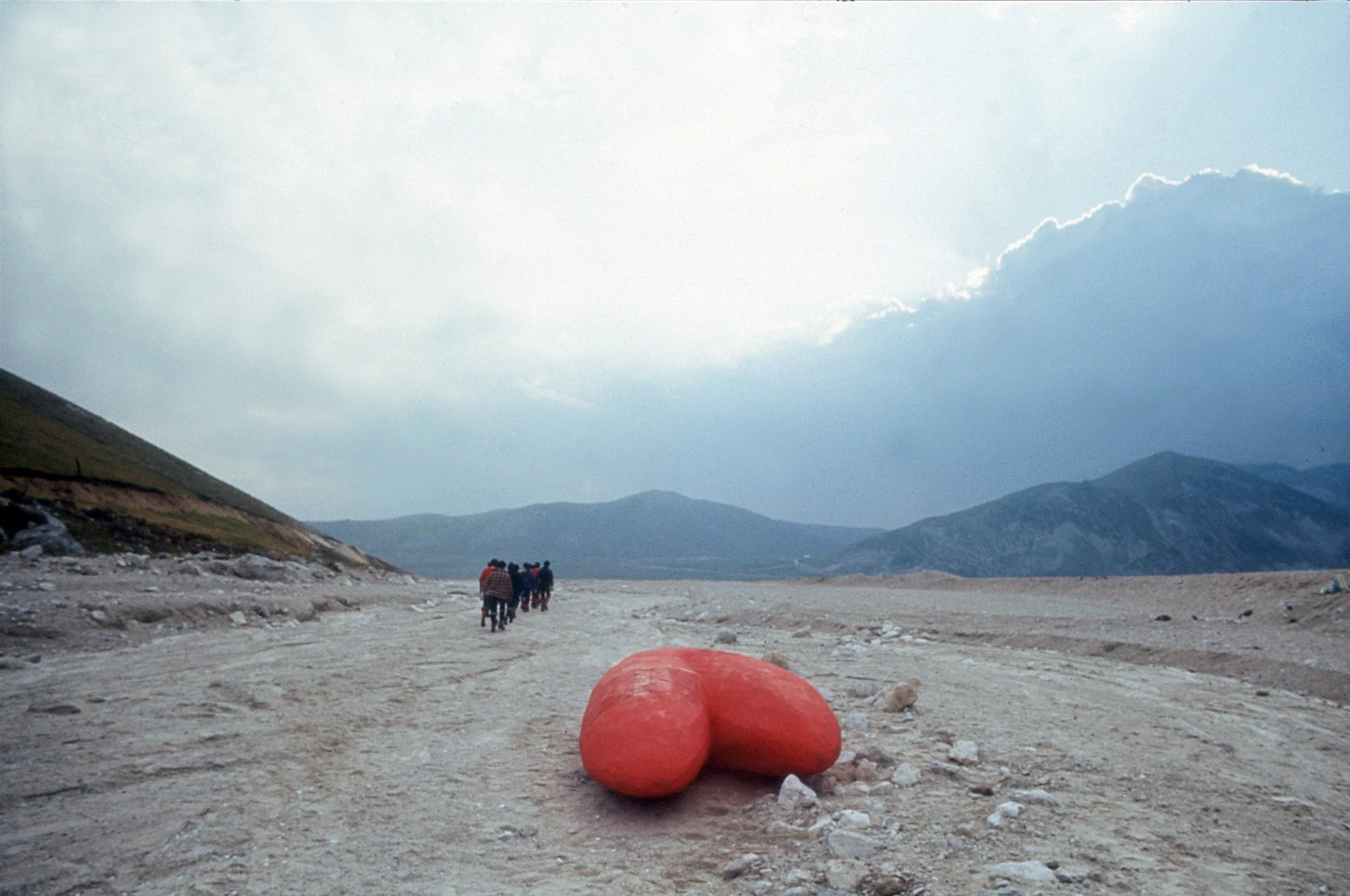
It resembles the structural lexicon of any traditional folk pilgrimage—one Visca knows well, having partly experienced it firsthand and partly re-experienced it critically through his art. All of this is accompanied by a magical, reassuring glossolalia; …invented: At dawn on a feast day, ascend to an altitude of at least one thousand meters above sea level. At cockcrow, sew a red cloth heart—roughly two canne in length—quilting it with genuine nettle twine. Tie a small red silk band around the foreheads of the bearers. At nightfall, lay it carefully upon a makeshift litter constructed from flowering ash rods and raffia twine. Carry the heart up to an altitude of approximately three thousand meters above sea level and leave it exposed to the elements for three days and three nights. On the third day, slowly bring it down to the valley and abandon it, never once looking back. The meaning of this procession will be clearer to those familiar with the variations on Visca’s heart: a mixed-media creation—surprising, naive, artisanal, sophisticated, poignant, silken, paper-based, childlike, fantastical, repetitive, handmade, and so on.
With a heart—like those worn down in the laboratories of Barnard or Houston—that seeks to appear in its persistent symbolic continuity. To me, the journey of Visca’s images seems truly desperate, suspended even more precariously than the hopes we contemporaries harbor. It appears all the more stark and pallid in the black-and-white tones of Lammarrone—now a classic of anthropological photography. A portrait of man, then, with his little garments and scapulars reminiscent of peasant life, clinging to a body that is at once automatic and vital.
Roma, November 1979
Diego Carpitella
His imaginary world
His imaginary world
Sandro Visca is one of those “secret” artists who elude the critical yardsticks of art consumption—or rather, of consumerist art (viewed through the lens of an aesthetic not unfairly described as “sporting”). For twenty years, he has worked in solitude, guided by a coherence rooted in a deeply personal imagery. This imagery exists not “outside of history,” but rather within a history that is—first and foremost—his own (since history is ultimately shaped by each individual’s creative dimension), as well as within a “parallel” history belonging to a culturally and anthropologically distinct region; it is from the distant springs of this culture that his imagery draws sustenance, plumbing its deepest recesses.
(I recall him as a very young, restless witness to the era of the Alternative Attuali exhibitions in L’Aquila during the 1960s—events that have since become legendary, not least for the independence they demonstrated, which has arguably never been matched.) Let us be clear: Visca is by no means a “folkloric” painter. On the contrary, he explores and updates that anthropological heritage, reinventing it to suit his own imagery—an imagery driven by potent symbolic evocation and a constant oscillation between symbolic narrative and “Ionic” synthesis, the latter at times almost aggressive in the way it seizes the viewer’s emotions and imagination. His profound anthropological dialogue is, moreover, one of cultivated naturalness. Visca works with symbols of striking graphic power; their assembly—and the resulting narrative flow, pared down like the Romanesque friezes found in the churches of Abruzzo—achieves a remarkable, vivid, and arresting clarity. …provocative in their own way—terrifying, one might almost say (though certainly anagogic)—were it not for the fact that this imagery is evidently composed of evocative sweetness, sensuous lyricism, and distant echoes of amorous encounters.
It unfolds, moreover, through a sumptuous visual language—seemingly laden with the indefinable allure of the East (does it perhaps reveal a glimpse of a magical, distant realm from the high horizons of the Abruzzo coast?)—and through a dense imagery that charges everything, symbol and context alike, with an extraordinary intensity of visual texture. This interplay of symbolic signs and textural micro-signs is all the richer for being perceived across a variety of materials (having experimented with—and always retaining the echo of, even on the “painterly” surface—the extraordinarily vivid construction of totemic figures and symbols possessing a compelling, uncanny magical charge).
The narrative structure of his paintings is enriched as symbols articulate themselves into ever-new and original solutions, amidst a proliferation of ideas that constantly renew his imaginative approach. Yet, for years, the central theme of his work has revolved around a nexus of magical amorous connections. Ten years ago, he exhibited “paintings” in Rome on the theme of Ligamenti d’amore (Love Bindings), and this year, in Pescara, he presented Fuochi d’amore (Fires of Love). In 1979–80, he executed the performance piece Un cuore rosso sul Gran Sasso (A Red Heart on Gran Sasso), scaling that majestic massif with a large red heart—a lost symbol of human memory set against the immensity of sovereign nature. Her world is magical; thus, every element, symbolic image, and context within the “painting”—or rather, within those captivating, seductive, and lavish mixed-media constructions I call “totemic” (though they might also be viewed as grand, emotionally charged ex-votos)—serves a function of pure magical symbolism, rich in density and evocative ambiguity.
It is almost as if magical evocations of possible behaviors were taking shape—where the human element, both ancient and contemporary, serves as the point of reference, yet where the transition from the natural to the artificial (or, more precisely, the magical) is seamless. One sees this, for instance, in the interplay between fire as fire (lightning, a flame) and—precisely—artificial fire. Naturally, her work probes the inner depths of the perennial anthropological structure of humanity; yet she interprets this not through the lens of archaeology, but through a living, present-day dialogue. I mean to say she is keenly aware of our era’s clamorous extroversion and its overpowering mass-media imagery (hence her use of “comic-book-style” schematizations, so to speak).
The result is a festive, playful horizon of images (and indeed, Visca speaks to me of reclaiming a “lost festivity”), where play is not a form of otherwise alienating liberation, but rather an act of evocation, invention, and the probing of possible, vitally significant connections. The goal is imagination as a force capable of constructing a richer world—one distinct in its animistic density—where every sign is therefore something other than itself. Just as every element within the composition alludes to a deliberate symbolic figure, it is also charged with further layers of imagery, thanks to the intensity—I would call it the expressive “decorum”—of its own texture; this texture is always sumptuously rendered, and thus never inert, never merely descriptive (even amidst the expansive simplicity of an extreme figurative synthesis).
An iconology of everyday objects—since the foundation of the magical lies in the proximity of the domestic realm—comes to life (in a truly animistic sense) and asserts itself through symbolic capacity and unpredictability. From this springs the genesis of his characteristic narrative syncopation. These images are lucidly unsettling precisely because of their crisp clarity, a quality that greatly enhances their symbolic articulation. The symbol serves as both the instrument and the goal of narrative enrichment; it facilitates an interpenetration of the everyday with the imagery of remote, possible “elsewheres.” This process imbues every presence, every tangible fact, and every detail—not only of the central image but also of the context in which it declares itself (or, if you will, appears to us)—with magic. It speaks of an inalienable reality of (and right to) the fantasy of the “elsewhere” and the “otherwise,” and of distant meanings that charge life with an unstoppable allure and a rich heritage of memories.
Roma, December 1985
Enrico Crispolti
Sewn worksAnthropology and art
Sewn worksAnthropology and art
Sandro Visca’s path of languages is marked by mythic events, stony realities, festive processions, and metaphysical discoveries; it is a “cultural tratturo” (ancient transhumance trail) that records migrations from the Adriatic Ocean to the “Tibet” of the Gran Sasso massif. The Saracens who landed at Ortona, the Slavic horse traders of Lanciano, and the Albanian warriors of Villa Badessa carry—upon their steeds’ caparisons—echoes of Byzantium and the Scythians, the opulence and bloodshed of the empires and wars that forged them. Visca’s lens focuses on these images and transforms them—from exogenous factors—into iconographic history; he turns them into suffering and celebration, presenting them anew through the filter of layering and juxtaposition.
Only in this way can one enter this “stitching”—and it is no coincidence that Visca calls this intense process of tearing and construction “stitching.” He stitches together the monastic art of Benedictine abbeys, the shadows and fires enclosed within the naves of San Liberatore, and the Chronicon Casauriense with its Carolingian counterpoints. These are shadows and fires not of places, but of clashing cultures. The banners of violence brought from France by the Duke of Guise, confronted by the gold and red of the Duke of Alba, form the strips of “fabric-history” that wrap Abruzzo in both its wretchedness and its splendor. Villages are traversed by these flashes of madness, by these striking, vivid dominations.
Yet, within secret homes, the community’s fabrics are woven—emblems of a pastoral and peasant culture that has infused Catholic iconography with elements of its own ancient heritage. Through the districts walk the saints, the serpents of Angizia draped around their necks; oxen bow—and defecate—inside the church; naked Gypsies, wounded yet triumphant, tumble down the cliffs of Pacentro to be clothed in sacred cloth. Embroidered banners adorned with miraculous teeth; wolf skins worn by actors in the eternal enactment of the wild-versus-cultivated drama; maidens laden with lace and gold; tablecloths and coverlets spread along the processional routes—these are the “fabrics of history” that the people draw from their past to trace a path of languages, a path from which Sandro Visca gathers artifacts to incorporate into his own sphere of work and ethnicity.
The path does not merely wind through cultural and human landscapes; it traverses natural phenomena: boulders and waters, storms and rainbows, rain- and lightning-swollen storm clouds and cirrus clouds suspended in mountain skies, sheets of snow and golden trees, forest leaves and nocturnal fires. I do not mean to limit the scope of what is depicted, yet nowhere else—save for this Abruzzo of past and present, of soaring peaks and deep chasms, of seas of water and seas of wool—could Sandro Visca have become the artisan and chronicler of such depth and wisdom, of such mature contemplation and emotional resonance. This hermeneutic endeavor might seem to conflict with the impulse to infuse history with myth, and reality with fantasy.
Yet, in truth, does it not align with the very reality glimpsed during the Good Friday processions in Chieti or the Resurrection rites in Sulmona? As an interpreter, Sandro Visca does not seek to historicize events; rather, he interprets and stitches them together for us upon a canvas prepared over millennia. These stitches are part of a genetic fabric that explains both continuity and change, reflecting a conscious, systematic sharing of the transitions that govern the mysterious laws of psychological reconciliation between present and past. I recall—as a splendid testament to his commitment to forging and living out his own tribal identity—the procession Visca devised in 1975 to carry a large red cloth heart from S.
Stefano di Sessanio to the summit of Gran Sasso: an initiatory test of body and mind, a challenge to silence and indifference. I have recorded that ritual journey as a movement of recovery that, starting from the domestic sphere—and through an emblematic act of forcing—annulled the temporal space of myth. It was an attempt to impose, beyond ossified logic, the awakening of a place in the South by tracing its own gestural practices—almost as if to engage with a non-materialist reading of social facts—and a desperate attempt to break free from the frameworks of written anthropology. I wish to annex Visca’s work—his “fieldwork”—to the open world of visual anthropology, doing so neither by force nor out of a desire for controversy.
There has always been suspicion toward those who wrote anthropological texts well, and later toward those who provided beautiful images for visual anthropology; who knows what will be said today about someone who seeks to situate this undertaking within the fabric of anthropological inquiry and synthesis? When Lévi-Strauss wrote Tristes Tropiques, he created not merely a document but a subtle, permeable text—a fabric of understanding for the socio-cultural situation being depicted and for the acknowledgment of his own role as a witness. When Joris Ivens filmed China, his stunning images shattered stereotypes and invaded the realms of research and scientific communication.
Visca’s personality undergoes a process of doubling rather than splitting: narrating and interpreting, re-reading and proposing. It is a complex intervention that moves away from mere folkloric craft, renewing canons and parameters to assert an explicit aesthetic of folk art. The work aims to sweep away the fleeting trends of a mercantile bourgeoisie that creates its own primitive fetishes and celebrates its rituals around ex-votos, Neapolitan nativity scenes, and folk songs. These stitched works—knowledgeable about everything that has passed over the “Abruzzo Continent,” composed of news clippings and containing various relics—open up a microcosm of universal dimensions and place the active moments of the common people along the central axis of History.
And history is all of this: history impaled on the swords of armies, the scythes of peasants, and the shepherds’ crooks; history woven into linen tablecloths, the lace of Pescocostanzo, and the coarse wool of transhumant herders. In them, one reads of fury, oppression, courage, joy, imagination, waste, and poverty. Sandro Visca’s stitched works are the banners of this nobility, embroidered pages from the vocabulary of social strata, and maps of complex cultural territories. The aim is to engage in visual anthropology through an artistic intervention—to explore and reveal these microcosms just as historians like Duby and Le Goff do—for therein lie the seeds of the world tree. “Birth of an Asparagus” (Nascita di un asparago), one of the most recent stitched pieces, is not an act of self-destructive overstatement but rather an emblematic indication of a trail of riches that explode outward from a mere clump of matter into a continuity akin to the changing seasons.
The lesson lies not merely in the cultural aspect but also in the manual act itself. By virtue of its repetitive nature, sewing is not a solitary gesture; in peasant communities, it has always shaped the scope of one’s network of relationships. People sew in doorways, on threshing floors, and in courtyards; sewing carries the spoken word—it is a medium of communication through which Visca conveys archaic techniques of ecstasy from the realm of folk culture. Like a shaman, he stitches together words and fabrics, crafting ritual objects for “flight,” and—from the heights he attains—peers into the folds of history to glimpse the future.
25 April 1986
Tito Spini
The tapestries
The tapestries
Since the mid-1970s, Visca has been creating hand-sewn tapestries—or rather, “assemblages”—comprising not only fabrics but also a variety of other objects. He is exhibiting them for the first time now and has gathered them in this publication, Cuciti (1986). In reality, these are true fabric paintings, certainly not mere decorative exercises. The contemporary tapestry tradition is, as is well known, remarkably rich, unfolding along two somewhat opposing paths. The first involves the revival—and, to an extent, the provocation—of the high art of tapestry-making (from Lurçat to Cagli). The second is defined by experimental approaches, employing techniques that increasingly mix and add materials beyond just textiles—while simultaneously pushing textile elements to the limits of their flexibility and articulation (from Depero to the recent success of avant-garde weaving).
Naturally, Visca’s work falls into this second category—one characterized by illustrious precedents within the Italian avant-garde, starting with the Futurists. While Balla painted his tapestries on canvas—certainly a shortcut dictated by economic constraints, yet one that in no way diminished the allure of those large-scale creations—and while Prampolini (like Pizzo Rizzo) designed and commissioned high-warp tapestries (at least in the former’s case), Nizzoli preferred to embroider his; Depero, meanwhile, envisioned a technique of assembling brightly coloured wool fabrics, reflecting the vivid, bold colour palette of his paintings (using what we would today call a “patchwork” technique).
The tapestry thus became, in essence, a picture painted with different materials—specifically, textiles. It asserted a distinct visual presence—provocative and proselytizing (in the Futurist spirit)—within the domestic, everyday environment; it encroached upon and shaped that space, while simultaneously presenting itself through a materiality that was far less abstract—far more immediate and tangible—than the traditional medium of painting. It represented, in short, a different kind of painting. However, I do not believe that the underlying motivation for Visca’s interest in sewn, assembled tapestries stems from the avant-garde tradition. Instead, it strikes me as clearly anthropological in nature—meaning that at its core lies not some clamorous assertion of the image or figurative language based on an ideological premise, but rather a passionate re-examination (fueled by intense emotional engagement and memory) of a heritage of domestic craftsmanship and its ancestrally transmitted wisdom. It delves into layers of childhood emotional impressions, developing a wholly autonomous adventure of intimate dialogue—at once iconic and object-based—spanning the dimensions of image, material, fabric, and object, no less than that of the stitch itself.
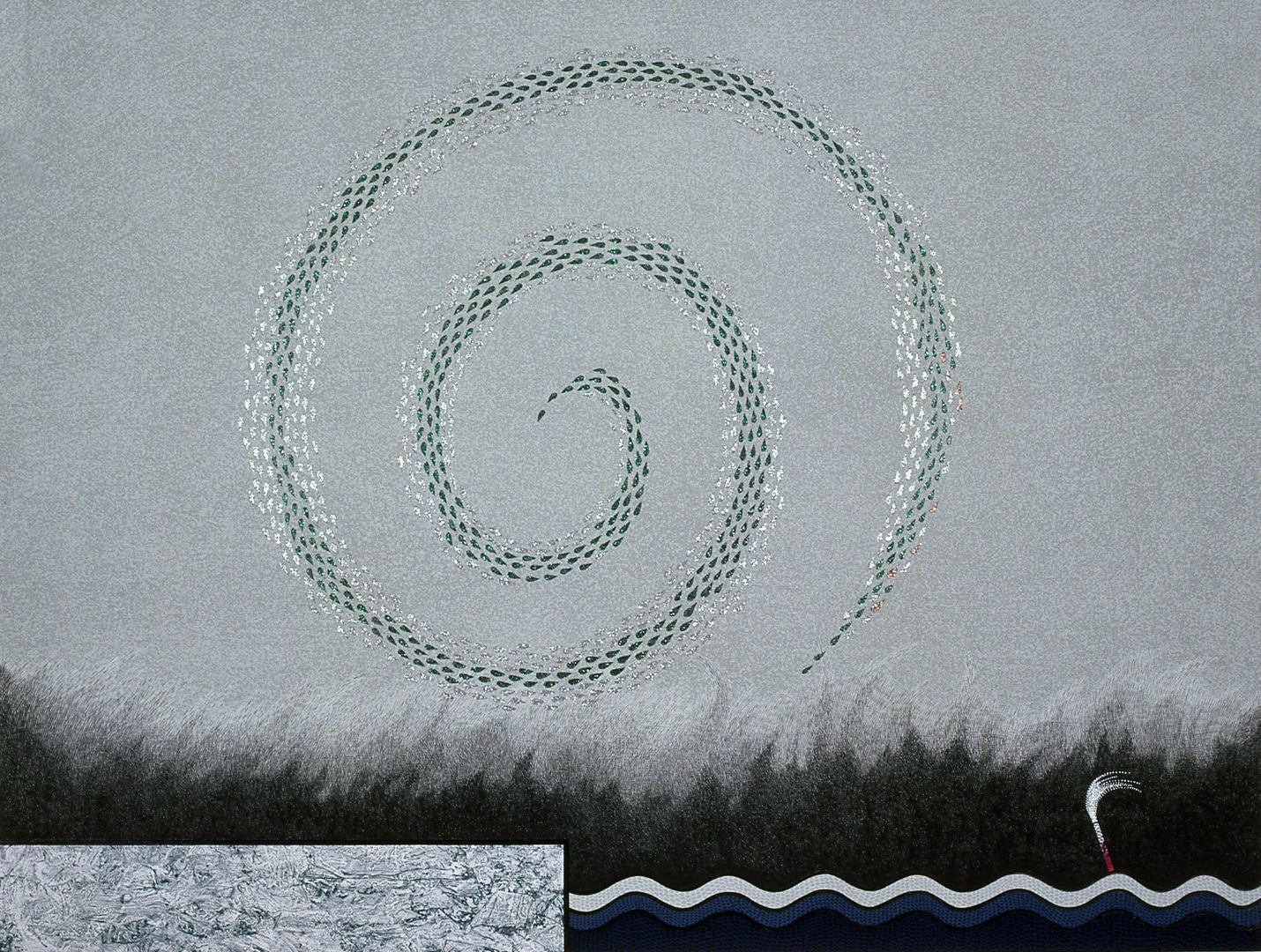
The allure of these tapestries by Visca lies entirely in their imaginative narrative quality—in their capacity to evoke a powerful sense of magical preciousness. They reveal themselves through symbolic and allusive presences—employing a symbology that is elemental yet often cryptic (being private and intimate)—and through narrative hints that disarmingly evoke the world of fables. This narrative quality is not merely a matter of imagery, but of materials and the very texture of the medium, featuring an extraordinary and truly magical variety of components—material, chromatic, linear, and object-based. This sustains a continuous fascination, stemming as much from the overall icon as from the exquisite quality underpinning its “texture”—a texture that varies significantly from episode to episode and from one iconic narrative component to the next, in accordance with the specific demands of the story being told.
Within Visca’s body of work, these tapestries occupy a space between his extraordinary object-constructions—magical, highly precious, and impassioned domestic totems born in the early 1970s around the theme of dolls and fascinating fetishes—and the vivid, fantastical intensity of the concise narrative openings found in the paintings spanning the 1970s and 1980s. From the object-constructions, they directly inherit what I term “manual discursiveness”—that is, a dialogue with materials and signifying objects—as well as a sense of the image’s physical, object-like presence. This presence remains intensely fantastical, however, owing to the imaginative displacement triggered by the extreme preciousness of the materials and the sheer manual virtuosity of the work itself.
Yet, while the tapestries may share certain iconic solutions with the paintings—such as specific stylistic devices for narrative synthesis—they actually diverge from them. This is because the unique richness of their materiality (especially, of course, the textile element) creates a density of presence that, in my view, surpasses the graphic expansiveness often found in the paintings, with their finely wrought mosaic-like arrangements of precious, distinct surfaces. Here, in the tapestries, manual craftsmanship triumphs as an experience of a kind of private anamnesis—an adventure that, through the act of sewing and by retracing paths of memory, constructs a unique world of imagery and materiality. It is a world of constantly surprising, fantastical vividness and persistent magical suggestion, realized across multiple layers of ancient echoes rooted in a primal symbolism of distant emotions—all relived with a sense of magical wonder, like an enveloping, disorienting fairy tale, leading toward a dimension of absolute mastery and quiet attentiveness to ancient senses and lost magic.
The fact that these tapestries are hand-sewn is essential to their expressive nature; yet this manual work is neither merely executive nor repetitive—it is, I would say, heuristic, and at times almost ritualistic and devotional. To sew is to seek out and construct one’s own magical, fable-like realm; it is to tap into layers of memory and to take sensory, sensual pleasure in materials, objects, recollections, allusions, and fantastical projections. The work is naturally slow, for every step is purposeful; each move identifies an element that contributes to the narrative—a story shaped not only by the final resulting image but also by the very journey of affectionate, passionate handwork undertaken to define that image.
Thus, it is not merely a fantastical image, but a genuine fantastical journey; one finds traces of this in the richness of every mark, every transition, and every element—be it fabric, object, or stitch. The final image—in its richness, which is often strikingly evocative—encapsulates and elevates this vitality of craftsmanship; here, the act of making becomes a genuine experience of dedication to an ancient manual ritual—one redeemed from lost, atavistic depths and re-emerging from layers of distinct, personal childhood memory. In this sense, the anthropological roots of the motifs play a powerful role in Visca’s tapestries, linked precisely to the heritage of his native Abruzzo—specifically to its proud, archaic rusticity. Yet, Visca clearly transmutes every evocative element of that heritage into a unique realm of unparalleled—and perhaps unapproachable—magic; it is as if he seeks to demonstrate that this realm can now be accessed only through a dimension of fantastic and fable-like exaltation—a magical, subtly sacred sphere that remains inaccessible except through total devotion to the intensity of the imagination.
It is an entirely private, intimate undertaking—akin to someone creating their own alternative horizon. Thus, Visca is not “archaeological” in the folkloric sense—nor is he archaic or archaizing—but rather magical; he achieves a kind of unreal preciousness that offers a sense of satisfaction (primarily his own) that is both fantastical and magically sensual. If one looks for an internal dynamic across more than a decade of work, one can observe—I believe—a greater “totemic” concentration in the earlier tapestries from the 1970s (which were, incidentally, executed on a massive scale), contrasted with a greater narrative inclination in the later ones. These latter works are more modest in size and engage in a kind of dialogue with Visca’s painting, whereas the earlier pieces bear the stronger imprint of his previous experience with mixed-media object constructions.
Take, for instance, the theme of “landscape”—a recurring motif in both groups of works. In the earlier pieces, it is more enigmatic and mysterious, whereas in the later ones, it unfolds into a fantastical narrative that, while essential in form, is certainly more discursive in its description of various elements. In any case, these are objects of extraordinary preciousness; they transpose the image to a realm where that precious quality—at once material and iconic—becomes magical and fantastically immersive. Here, the defining qualities of Visca’s imagery are heightened—qualities that, it should be noted, circulate with equal evocative power across the various creative phases he has traversed and those he has pursued simultaneously.
For Visca is an artist who works freely across different modes of making, all driven by the same impulse toward a kind of fabulous displacement—an impulse he realizes with varying degrees of intensity depending on the specific creative avenues he is exploring at the time.
Roma, August 1986
Enrico Crispolti
Coherence and the spirit of the age in Sandro Visca’s work
Coherence and the spirit of the age in Sandro Visca’s work
“In Visca’s works there is no anecdotal appearance, there isn’t any narrative development, there isn’t allusiveness, there isn’t eclectic citation: everything is collected and is highlighted in the physical and transparent representativeness of the superficial elements and in their construction never conceptual nor naturalistic but dreamy in the immediate communicativeness of a sign that clearly delimits the symbols of the environment, individualized by candid and eyes that make it essential. Even the materials and warm elements soft, intimate, with a mixture of multi-material, with textiles, collages, paintings, that always depict the candor of a serene and reassuring environment cultured in the imaginary of the primary iconic playful, fairytale-like symbols.
These are the icons of the discovery of the world with an inner genius’s eyes that are still innocent and uncontaminated who focuses on images of the young, timeless landscapes of clear essential references, of sky arches, night scenes, leaves, flights, clouds, prolfiles of houses, waves, zodiac signs, lightening bolts which are sewn onto tapestries acquire redundancies, colourful webs, dense pigmentations, rich and polychromatic weaves until arousing a sensation of dream of which brightness creates distances and takes away a weak foundation but without lacking centrality that is in contrast with the daze and nomadic feeling that runs around the complexity of a contemporary world. That It is as if Visca cultivated one of his primitive discoveries of the world in his simplest permanencies and rarified them without a cultural median with the nihilistic crisis, that takes away security to those who face a dynamic vision of the disbanding of social and anthropologic history, to uncover under and beyond history the reassured profile and the intimacy not unassociated to the environment. The game of the imagination of the inner eternal child in us knows how to anchor a vision such as this with few yet solid points of reference in the two-dimensional figures that come from the rereading of the intimate landscape of earlier discoveries. The detail of elaboration however does not have the simplicity of the rediscovery of a fairy world as seen by a child or by an adult that chooses this vector according to the graphics of a cartoonist or of and an advertiser. In fact there is a hand crafted knowledge that attaches itself to minimal and uncommon forms, to show the vagueness and the cure of who has already discovered small worlds found in daily life, these small worlds are “parallels” because they are seen with a close warm look. Thus the image presents a new dimension that escapes us, and nevertheless this image is always magically present for those who have the aptitude to indulge it as soon as one latches onto rëverie. From here on out we can find the dreamy sense of ever present objects in the small works that you recall from memory, in the participation to the corresponding environments but without the desire to make it the setting, in the tension of the minute and sweet presences of everyday contemplation without the analytical reflection of the intellect, but the direct gathering of the symbol that remains deposited in the imagination. More than the will to make a representation of a lost game, of the innocence of a look that is no more ours, there’s the anchoring of the icons of the never ending childhood’s landscape, that the civilization can’t erase without loosing the warmth of the tactile and visual of a sensation’s intimacy of a colored world, forbidden, fairy-like that links us in harmony to nature before the intervention of any reflective thought diaphragm.
Is that the reason why Visca made a thorough isolated research? We rather think that he found his own path to reach his own answer to central problems of the cultural-artistic climate of our time.
Even if, in the passed years, Baj represented a linguistic reference for Visca related to his rich multi material chromatism and for his lines of the two-dimensional representation of icons, he did not leave any clues about the historical or chronicle-like suggestions of the emblematic events, in the season of ideological engagement. At the sunset of ideologies Visca continues to show continuation and coherence for the exemplification of his fantastic worlds in the simplest and most essential visions of permanent moments endowed with an affectionate gripping power toward primitive signs, that however continue to over step time and space. Somehow Visca actually answered, not like an isolated person, the central problem of an age of doubtfulness and dismay, looking for not an escape or for a spurious realism of ideologies involvement in unreal magical universes but looking for the finding of the eternal images of the memory that make us able to recall, from the complexity of an ungovernable present, the graphic signs of our time of what worth to escape from an indefinite wandering, not finding them in a ephemeral history but in the simpler and essential occurrences. He did that aiming to that warm world that participates in the primary signs of life and of the environment that just the ones who nursed the disenchantment for the certainty of the iconoclasts knows how to discover again with pure eyes primogenital experiences infancy of life and of every birthing civilization.
That is what the post-modern stream tried to do when, while the great ideological narration of “Modern” collapsed, they wanted to find, through eclectic mixtures of earlier and latest seasons, a new virginity of quotation taken away from the concomitancy of meaning of a historical and social binding clause continuity. But, while the Post-modern walked that way through the dominancy of transversal and instable complexity between different icons that had to regenerate the meaning of consumed semantic models (like in the case of Meyer Vaisman who adopts a multi material language comparable to ours but with the highly imaginative plot of his tapestries), Visca, otherwise, propose a dominancy of primary icons form the space less and timeless anthropological imaginary that works like an analytical element’s attractor, elements that are rich, complex, diffusive, redundant that show the self-consciousness of a contemporary crossing, of a magnetic and plenty reality while it rules their direction, leading them to elementary models of the purity beyond history. With this inverse path, Visca suggests apparently an isolation; truth be told it is a coherent overturning of the search a way to reestablishment of meanings to the lack of foundation of the post modern age to which he fully participates suggesting just a more direct searching of uncontaminated images that prevailed over disorder instead of humoring the most influential vein of the dominancy of the complex on the original simplicity.”
Nerio Rosa · 1991
An alphabet of twenty-four signs
An alphabet of twenty-four signs
It must be said right away that every man would love to have the look of the mature Sean Connery—the very look that Sandro Visca carries with him with such calm and serenity. But I, in particular, would love to live within the clean, attentive, and rigorous order of the studio where he draws, thinks, and shapes his works. An order that stands in stark contrast to the chaotic, pseudo-creative frenzies of so many manic, phony studios—and to that depressing, disheartening ideology of creation at all costs. A creation supposedly born, by necessity, from cluttered rooms, littered floors, and walls smeared with pointless “creative” marks. The space surrounding Visca is simple and clear; his tools are cherished, protected, and arranged according to their own inevitable hierarchy.
An order that establishes a sort of aristocracy: the noblest tool is the one currently in use. And, as such, it discreetly holds sway over the others. Waiting to give way to needle, thread, and leather, the pencil sits in its rightful place. Later on, the gouge, the burin, or the drill will take the lead, shifting this fluid social ladder of tools once more with functional precision. I do not know if Visca will appreciate the comparison, but his studio vividly reminded me—down to the last detail—of a vast garage in the far north of Canada, where a young woman lived, apparently alone. We had stopped there due to a breakdown in our camper.
She kept all her tools in immaculate order—every conceivable type of screwdriver, drill, and level… She reminded me of Calypso bringing the necessary tools—which she clearly owned and kept—to a despairing Ulysses as he sat by the shore, unable to depart. A solitary goddess poised at the boundary between the human and divine worlds. I find myself wondering now what motionless journey Sandro Visca is preparing for from this command deck—so geometric, uniformly luminous, and genuinely inhabited. And since journeys require maps and paths, it seems to me that these three rooms serve as the setting for evoking and representing worlds to be visited, not conquered.
To be loved, not possessed. I have become convinced of this regarding travel and maps—even if my conviction may not align with Visca’s original intent. Yet, the very idea of travel integrates a powerful, definitive sense of the possibility of living—and, with it, the gentle, confident attitude that setting out is worthwhile. That it is worth pursuing signs, currents, and mountain silhouettes. And if that is worthwhile, then life itself is worthwhile. Another appealing aspect of Visca is his calm awareness that, while things could be infinitely better, there is no point in screaming, thrashing about, getting agitated, or casting meaningful glances heavy with “indignation.”
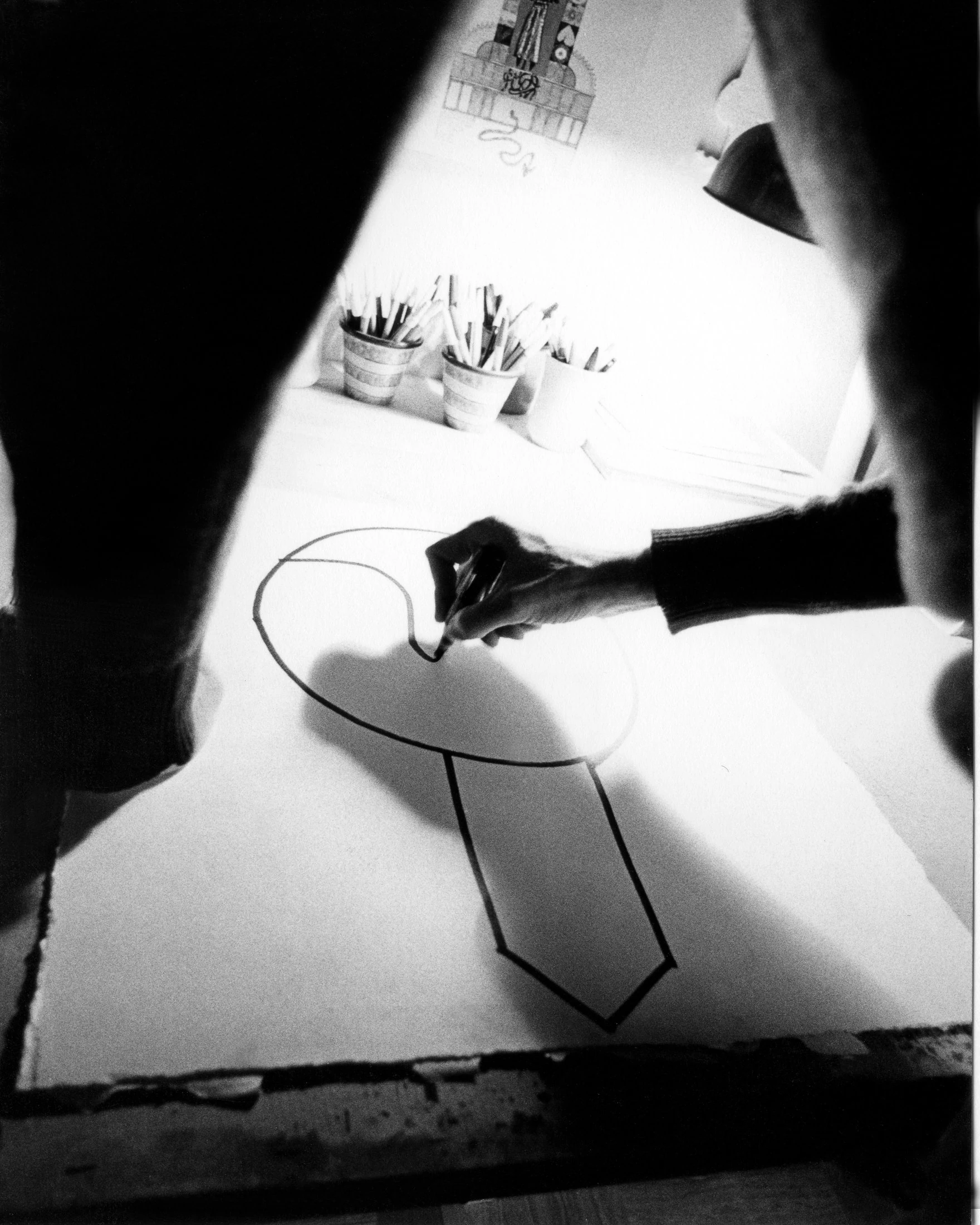
The task he has set for himself is to trace—for himself and for others—lines of escape and emergency exits; to open doors and windows that have too often been left shut; to layer joyful, positive adjectives upon other joyful, positive adjectives; and to carefully map the contour lines of a land that exists only in dreams. It is a matter of moving—heroically, in a sense—with calm and silence, revealing (rather than ostentatiously displaying) the infinite combinations of happiness. A meticulous explorer deeply engaged with the geographical and human realities of South America, he knows full well what Atahualpa Yupanqui sang in his desolate “Camino del indio”: “Travelers, there are no paths; the path is made by walking…”
And so, his journeys, his maps, and his graphic and sculptural works contain moments of discouragement, sudden sadness, and tiny, atrocious details (Borges’s “minuscule ignominies”). Just as certain despairs, certain foretold suicides, and certain deadly silences inhabit the colourful, sun-drenched pages of Márquez, so too—amidst the stars, the whimsical bronze asparagus, and the typographic lightning bolts—one encounters a lost bird, a hooked claw, or a fire that consumes only itself. In Map and Mirror, Sir Ernest Gombrich describes the complex cultural phenomenology of the map, identifying it as a hybrid form suspended between the alphabet, painting, poetry, and “simple” representation.
Thus, swamps are drawn as swamps, complete with invasive vegetation; forests appear as dense clusters of trees packed so tightly the ground is hidden from view; and stylized cities are reduced to a bell tower, a bridge, and a gate. Sometimes, one even encounters a shadow, a river’s reflection, or the ajar gate of a vegetable garden. Yet, alongside these, there are numbers, measurements, scales, and names. Consistently, Visca’s maps possess the quality of a text written in a simple, clear alphabet comprising just a few symbols. By repeatedly examining the images he has painted, etched, stitched, cast, and embroidered (for Visca embroiders, too), I have counted around twenty-four hieroglyphs.
It seems to me that he writes using twenty-four symbols. They suffice for him. They suffice for me. I will not list them all here, but they are so pleasing and so recognizable—and it is such a delight to encounter them again and again across different images, recognizing them in their constant metamorphosis—that one feels compelled to compile a sort of ultra-concise dictionary, or perhaps a vocabulary. Angle: sometimes it looks exactly like the Angle—the one found in middle-school geometry textbooks. With its neat little loop folded back at the top, at other times it actually emerges from a circular arc—though if you look closely, that arc becomes increasingly “arc-like,” and Elementary Geometry dissolves and vanishes, allowing the arrow to finally take flight.
Yet the Angle, without warning, easily transforms into a sail set at a slight slant upon a sea that would have delighted both Klee and Euclid. Lightning: this is the typographic bolt. It is the quintessential lightning bolt with zigzagging sides and a sharp tip piercing the sea—the bolt of the child and the hero, the bolt of weather forecasts. Sometimes it descends from undulating clouds, cleverly layered in shades of blue; at other times it rises from below, emerging from chimneys or drifting away from schematic, “lightning-like” flowers. It can be pink, bronze, or black, or simply made of air—cut out like a negative shape from the parent cloud, as seen in Piccole Tempeste.
The asparagus: unequivocally a vegetable. Exegetes who strive to imbue it with Freudian-phallic connotations must reckon with its absolute, immaculate vegetal nature—the brownish-green hue of its tiny leaves, its dazzling stalk, its russet and violet tip. Yet it appears sometimes alone, sometimes in a cluster with its brethren—some a bit barbaric, clad in leathery scales like one of D’Annunzio’s cataphracts. Others appear wooden or Germanic, or glide sinuously like their own reflections upon the oily waters of a harbor. They seem impassive, silent, and almost arrogant. Yet one encounters some that feel a powerful pull toward a distant bronze star and stretch out to reach it, emerging obliquely and inquisitively from beneath a blanket of mathematical waves.
One encounters a veritable clan of them in “Asparagi,” yet in the “Garden of Forbidden Fruits,” the asparagus reigns as King (on the chessboard). These vegetal creatures—so archaic and elemental, yet delicious to eat—remind me of the anecdote recounted by Brillat-Savarin in his Meditations on Transcendental Gastronomy: the story of a good-natured prank played on a Canon who took immense pride in the asparagus he cultivated in the garden behind his church. Under the cover of darkness, his friends harvested the real asparagus and replaced it with a collection of well-carved, realistically painted fakes, which they would “grow” taller night after night—leading up to the final, wooden, mocking banquet.
The real ones had already been amply celebrated at another, more private banquet to which the Canon was not invited… Spiral: right-handed or left-handed, slender or rendered baroque by a whole population of signs and colours, it stands alone or accompanies other sisters. It may emerge from a sort of chimney or, rather, from the conical spire of a French castle, attached by a small grip—a hidden hand holding it in place, preventing it from flying away. Yet at other times, it is the very path of the Uccellino (Little Bird—see entry) that drags it along in racemes and interlacings of a calligraphic and piously scholastic memory. Uccellino: this is the living creature—perhaps unique, yet almost always present—in Visca’s maps.
It is a little bird that falls somewhere between a partridge and a quail, between a magpie and the sad hen—the one that, to be clear, “returns to the road…” once the rain has stopped. Sometimes it is multiplied into a flock aiming for a heroic, one-way exodus, or returning after yet another migration. At times, curious and alone—half-hidden in the scalloped green of a meadow embroidered with openwork (though the blades of grass are somewhat cruel)—it waits for the hunter’s attention to wander. But the next moment it has landed—perhaps dead—killed by a ruse in the Ambush of a bronze disk suspended on four gleaming claws. Like in García Lorca’s “Hunter,” where “four doves go through the air, flying and carrying their four shadows”—already dead.
What it represents to its creator—or companion—I do not know. Yet from this defenseless and indestructible creature—at once fearful and fearless—there emanates a steadfast will to survive, to see, to understand, and simply to exist; a quality I would not trade for the Eagle, the Pelican, or the Phoenix. Star: almost invariably pentagonal yet lacking true stellar symmetry—a bit misshapen, with unequal rays, tossed there by chance as an option of astronomical Creation. More graphic and childlike than scientific or celestial, it establishes around itself a gentle yet inexorable gravitational field that draws in coloured dots, wisps of smoke, the hopeful heads of asparagus spears, and other stars.
One could go on with this dictionary—this lexicon of Visca’s individual signs—for I find such pleasure in recalling them after having isolated them from their original world, having “pulled them down” and arranged them in a non-alphabetical order. What moves and captivates us are almost always the invisible forces at play between these symbols, between these words. A star leans toward an asparagus spear; a spiral stirs up an intense green wind among a cluster of asparagus stalks that sway in the breeze—stalks which, were they not rooted in the ground, would all be airborne right now. A star—perhaps a starfish (or merely the reflection of a star)—floats upon a bronze wave, while nearby stands a tip that is sharp yet rounded, glossy yet not hard, alluding to the depths of that sea.
It alludes to the dangers—but also the wonders—of navigation. Yet there is another curious presence, one that is concealed, rendered transparent by its own self-deprecating humor. Here and there, you encounter curious forms of perspective: some tables sketch it out in one corner, only to promptly forget it in the next. Sometimes, a pedestal begins to articulate the names of its moldings with a precision reminiscent of a schoolchild—cyma reversa, fillet, scotia, torus—but then it stops there, perplexed, mid-stroke. Elsewhere, you see windows—openings in a skewed cube that would have delighted Pavel Florensky, seeing his “Inverted Perspective” still enjoying a rare but steadfast following among us non-believers.
Here below lies, in my view, the School—and what Visca thinks of it. Listening to him, I was surprised to find that—unlike almost every high school teacher I have ever met—he never spoke ill of the school. To be sure, he would smile into his beard, understanding the infinite weaknesses of that fragile creature of ours—the School—which is forever on the verge of drowning. At that moment—though this is merely my own fanciful interpretation—the Little Bird seemed to me to embody the School. Crouching low to avoid being shot, becoming cunning and swift to avoid capture, alert and patient to avoid ending up in the oven. Constantly on the brink of extinction, yet never vanishing from the atlases.
Sandro Visca did not slide down that almost inevitable slope of reviling the School, of condemning it, or making it a target for abuse. Those few references to the draftsman’s craft, the sparing mention of perspective, the awkward yet pompous profiles of the vaguely architectural pedestals, a faint echo of a classic colour contrast—all this led me to suspect that Visca was a patient, ironic, and kind teacher. The sort of person whom, upon running into twenty years later on the street, you would stop your bicycle to ask: “So, have the Asparagus grown?”
Genova, May 1995
Ruggero Pierantoni
The great firmament
The great firmament
“It could suddenly happen to any of us; to get lost.One could get lost in the woods, in the streets of a big city, or in front of home in the fog, just like the father of the protagonist of Fellini’s film “Amarcord”.
Sometimes one can lose himself, or while dreaming become worried and on awakening look for something to cling to, something familiar to re-establish the right coordinates.
At times getting lost becomes a desperate choice, an alienating and artificial way of escaping reality.
Other times again, getting lost is a waste, in the rush and foolishness of every day, in the superficiality of relationships and in the lies of appointments and alibis that we invent without stopping for a second to reflect on ourselves.
Walking with your head down is more prerogative than others.It’s a way of getting lost walking, a way of not recognizing what is similar to us and a way of not letting ourselves be recognized by ourselves.
However it could be that finding oneself in front of something beautiful and unusual forces us to stop and look up for that instinctive call that comes from within and that reason can’t explain. A landscape, like a sculpture or a painting, a poem…all of which touch our senses and makes us reflect.
The work of art becomes the pretext to speak a little with oneself, to confront and discover if we are still capable of appreciating what is beautiful, to divide the good and the evil.
So here is the artist, closer to spiritual contacts, that occurs through his spite (because a real artist creates for himself) through what we know about ourselves (and that we are also afraid of) and the other part that is still able to leave us in awe, like a small Pascoliano child.
Sandro Visca’s “Il grande firmamento” seems to put itself in this provocative perspective: to provoke the encounter of ourselves with ourselves that for some time we had postponed but to which in the limited space and darkness of his “cube”, we can no longer remove ourselves.
The infinitely large and infinitely small is the universe and man. Everything searches for its opposite and ends with finding it, according to an unwritten law.
Forced in the disorientating darkness of the “room” between dizziness and equilibrium and looking at the starry sky reproduced by Visca on the ceiling, the onlooker can’t then fall back on himself, find himself even for an instant after having been long lost. It is because the infinite space which appears before his eyes, magnetizing with its luminous points, and the same unknown gulf of his soul that he is afraid to explore, but that his spite unfolds in front of him.Visca’s magic box wants to be a beneficial trap to the unaware visitor that the artist in a fun and not very serious way, more so like a game in an affable way and not at all power-hungry, wants the viewer to look for the sky and discover the wonderful architecture of the stars and get lost at least once in the immensity of space and no longer in the anguish of his limits, revealing his same infinite nature.
We know of Visca’s clear and poetic landscapes where the stars peep out, far away and twinkle like in children’s drawings. Falsely naïve landscapes, immobile unreal, like in a dream of escape, where a look can rest and re-adjust itself from the squalid disorder of urban architecture. Here the provocation is a little lighter, implied in a game of allusions and postponement which is not always explicit.The “birth of an asparagus” purposely put in the foreground of the canvas like on the front page of a newspaper beyond the immobile magic described, apparentely refined to itself. It is maybe the subtle satire of a certain breathless race of the men behind? behind what?, losing sight of the simplicity and perfection of nature that is renewed according to ordered and inevitable laws: in an asparagus that is born like Autumn leaves that fall, or in exact geometry, out of a starry sky.”
In the birth of an asparagus or of the black cube, the same coherence is found.
Daniele Cavicchia · 1995
In itinere
In itinere
“I do not believe,” writes Crispolti, “that the motivational origin of Visca’s interest in tapestry is avant-garde in nature”; yet it is easy to see how this interest grafts itself onto a significant vein of contemporary art research. This lineage encompasses both the revival of the traditional poetics of textiles—exemplified by artists ranging from Cagli to Boetti—and various experimental approaches, from Depero and Bai to the more recent work of Ghada Amer or Louise Bourgeois. Throughout its diverse manifestations, the common aim is to highlight the artistic value—with its strong communicative and social resonance—that textile material possesses the magical power to convey and translate.
The motivation driving Sandro Visca in this ancient practice is, in fact, itself ancient and ancestral; it stems from a familiarity with his own roots and a clear desire to explore the boundary between ontogeny and phylogeny. His aim is to stitch together fragments of memory and history, reconstructing the fabric of life—a complex interweaving of lived experience and ethos—into a sequence of images presented to the viewer as an imaginative vision, yet also as a membrane-like, epiphanic film of reality in the continuity of its relentless unfolding. It is precisely these artistic artifacts—once deemed minor or secondary to the so-called “major arts”—that most generously reveal the profound forces driving the historical evolution of culture. At its inception, this evolution was dictated simply by the gesture that creates forms and produces images—gestures not yet mediated by conscious deliberation, but spontaneous and pristine, drawing directly from the source of productive and creative making that defines the existential nature of man, who is engaged, as Heidegger suggests, in the acts of “building, dwelling, and thinking.”
Alois Riegl, a leading figure of the “Vienna School,” identifies in them the fundamental traits of Kunstwollen—the artistic volition that is inextricably linked to one’s worldview—and, in Alt-orientalische Teppiche (1891), lays the groundwork for a scientific approach to studying an artifact that is as ancient as it is rich in cultural significance: the carpet—a broad term encompassing both floor coverings and wall hangings. These correspond to two distinct techniques: “tapestry weaving (Wirkerey) for wall hangings, and knotting for floor carpets”; the former is the more primitive technique and, in all likelihood, the absolute oldest form of weaving.
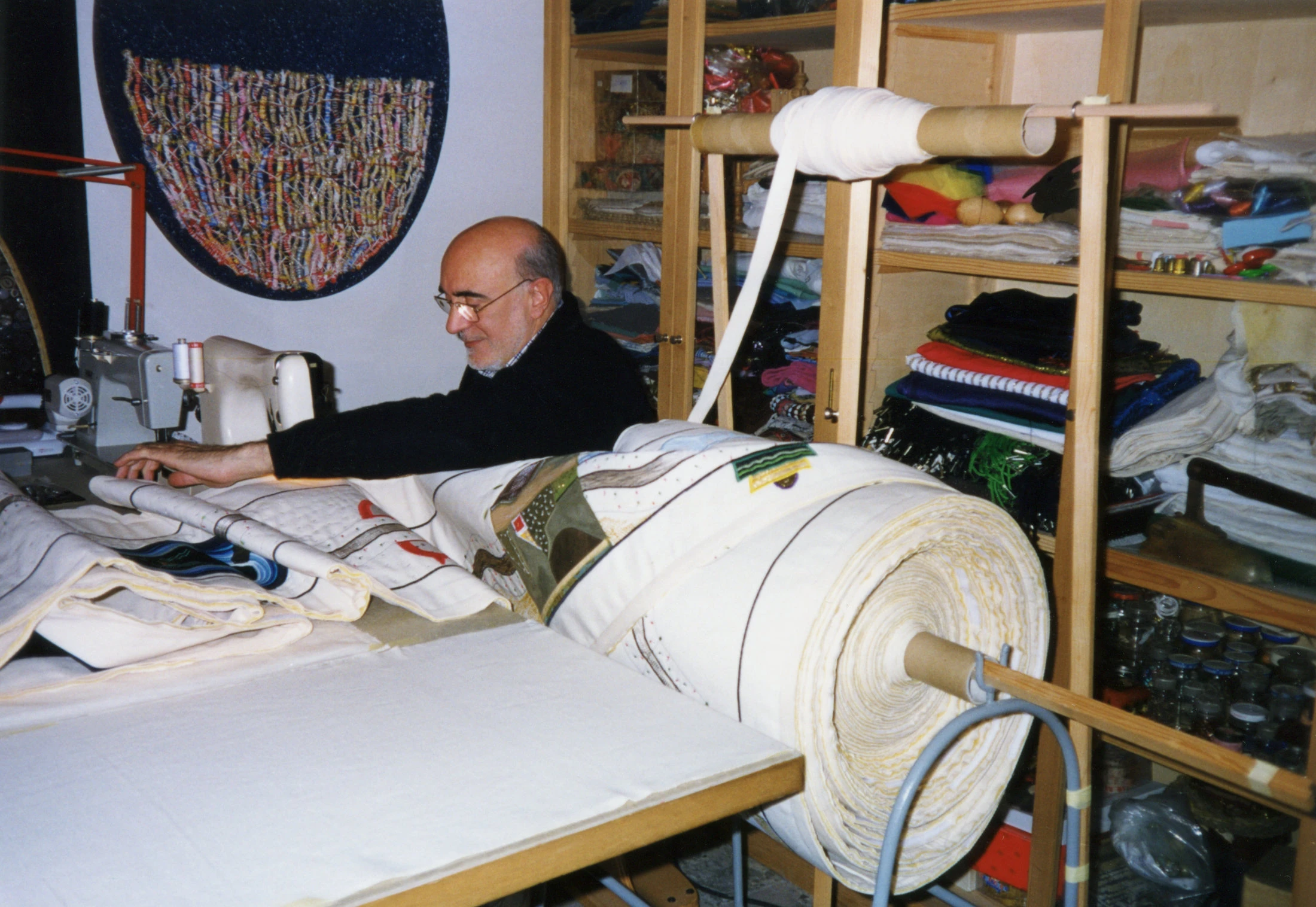
Used “to cover, to protect, to enclose,” these primordial woven products served—as Gottfried Semper specifies in his masterful study Die textile Kunst (1878)—both to clothe the body and to erect temporary barriers against the outside world, thereby creating an enclosed living space. “This latter purpose,” Riegl continues, “was achieved most simply by suspending tapestry-woven cloths at a certain height above the ground—either like a tent over a single pole, or like a hut over two, three, four, or more poles.” Thus, tapestry weaving emerged from the primitive technique of mat-plaiting and spread across all ancient civilizations, with its products characterizing both Western and Eastern cultures—from the Inca of Peru to the Egyptians, the peoples of India, and beyond.
After reaching its peak development in Late Antiquity and the medieval period, this ancient technique—the starting point for Western Gobelin-style weaving—had already spread throughout Central Europe by the 15th century. It was practiced professionally in regions ranging from France and the Netherlands to Germany, whereas in other European countries, it remained largely the domain of rural cottage industries for a long time. In Italy, these two lines of development appear to have coexisted; indeed, as Riegl wrote in his aforementioned 1891 text: “Even today—almost four centuries after Raphael—we find the production of striped coloured fabrics flourishing in rural cottage industry around Macerata… a legacy from a distant past.”
It is within the context of these observations regarding the textile activity of the Macerata province a century ago that we should view the event promoted by the Fondazione Cassa di Risparmio della Provincia di Macerata. Through its exhibition of tapestries by Sandro Visca, the Foundation has once again highlighted a distinctive aspect of its core institutional mission: acting as a sensitive, discerning observer of the art world—attuned both to stylistic evolution and the zeitgeist. Within the landscape of contemporary artistic inquiry, Sandro Visca’s work stands out as a particularly significant variant; it offers a strategically precise reflection of the current art system—characterized by the rapid dissemination and consumption of artistic products—by reclaiming the artwork’s original communicative essence. While conveying a message of profound aesthetic and ethical value, the work is nonetheless accessible, appearing alongside the most commonplace consumer goods.
Assembling the most varied and heterogeneous materials with the most diverse representative contents through sewing and fabric, with a special focus on certain recurring or emblematic images, he composes a sort of metonymic glossary of an imaginative collection of artifacts and memory traces that mark and punctuate the time of life along a path bristling with iconic sediments that the author collects and translates according to a highly personal code of iconic forms, heraldic ciphers, emblems, and symbols, played out according to the subtle score of irony. He thus intends to trace that frontier path where man’s impact with the world has always and inexorably occurred, at the origin of the creative gesture that gives meaning to existence and sets reality apart with symbolic markers entrusted to artistic practice—which, moreover, in our own case, is always functional to the representation of the image, even in its most refined and seemingly gratuitous manner. He thereby reclaims the autonomy of his gesture from that of Burri, whose youthful acquaintance nevertheless remains an indisputably significant moment in his development.
But with his “sewn” signs, Visca, both pedantically and patiently, also pauses to describe the errant nature of the dissociated sign before it becomes form and configuration, before it can acquire its status as an image, when it draws from the enchanted source of original feeling to fuel this slow process that moves, point by point, to the constitution of a fabric, the background against which a possible form can emerge, a volatile idea, an urgent desire to be both representative and imaginative, a metaphor for that far more far-reaching phylogenetic process that has marked the laborious, slow, and errant history of humanity.
Initiating the elaboration and collection of these experiential artifacts, which resulted in the construction of “mental objects” preserved in memory as substitutes for the experience itself, he deploys all the technical strategies of embroidery to translate, through a system of signs, sewn and fixed into the fabric, often humbly following the binding logic of warp and weft, seemingly naive configurations and forms into realities endowed with intense symbolic value, simplified iconic codes yet charged with experience and dripping with ethos, which he has the divining power to unearth, collect, and thus present, along the way. The large tapestry unfurled on the walls of the Galleria Galeotti in Macerata is an extraordinary example of Visca’s work, a sort of synthesis that, while summarizing his research, also betrays a transversal and indirect intention, compared to the immediate artistic one. This intention is revealed by the projection of the high-tech world into a special time, estranged and suspended in the slow pace of artisanal practice, where intervals and pauses are privileged to maintain the speed—more than mental, empathic—of the lightning-fast path of intuition, which captures and connects distant points of space and time, always the artist’s undisputed domain, his private niche, where it is easier to bring to light the kaleidoscopic apparatus of the imagination.
But the artist does not arbitrarily invent forms; rather, he makes them recognizable as participants in a repertoire of images, such as those Sandro Visca recovers and expresses with an unmistakable idol in his sewing, tapestries, and embroideries, both through abstract scores and narrative inserts, marked by intensely warm and sunny colours alternating with others equally pure and nocturnal in their coldness, as well as by soft and supple configurations, such as those assumed by a material of an organic nature and therefore alive, subtle yet indispensable viaticum for weaving and capturing, in the infinite sequence of imaginative representation, certain symbolic frames, such as those that stand out here, in this original storyboard, where the secret meaning of life is jealously guarded, written with the indelible signs of human labor that pairs with the world.
Macerata, January 2000
Paola Ballesi
Little theatres
Little theatres
Happily unusual, in a certain off guard sense, turns out the work of Sandro Visca, artist able to authentically carry out works of art of distinct creative value. The refined manual skill and the indirect and continuous work, stabilize the coherent language that characterizes it, with which undoubtedly one needs to work out. His way of working is very personal and conducted in silence, because Visca doesn’t like the fuss of the better part of the artistic world, but prefers to stay at the forefront and refuses to adhere to contorted mechanisms, often inevitable, for who desires to take on the road to success. He prefers to work isolated, continuing obviously without being in a rush, a singular search that has much to tell, drowning the roots in certain memorial aspects anthropologically recovered and proposed in itineries.
His approach is very interesting since the 60’s until today, with the need of his own imaginative universe, crossing cultural knowledge, without giving space to improvisation. It is an expressly precise position, that in the imaginary it finds a high quality experience. The executive development of Visca, in the technical know-how, is certainly organized. The demiurgic hands of the artist provide, through the appeal of the material used, pleasing epiphanies of an elevated emotional impact. They touch the most sensitive inner chords making known to the user an unreality that in the end draws from the everyday, for itself lives with excellent superiority of spirit. He is however above the labored living, speaking with measured tone, subtly traveling over the evocative paths, where he looks for the traces left from history, approaching magic interest and dreamlike sublimation of the elements with which the images are made of.
His is a dimension full of views, that does not arise with superficiality before the world, he is an artist that with thought probes deeply, almost uncontentably and continuously active in a strain of research towards the truth. To sum up you are before a complex figure of art, much more complex than how it appears in a first impression of the works. If nothing else Visca is unique. He is the testimony to a rituality, one says the mysteries of action that at the beginning has something to do with Gino Marotta, with “recognitions of the personal territories of a collective ethnic that goes beyond the Grand Sasso, towards the dessert.”
The little bird, the star, the asparagus, are part of a larger alphabet of symbols that the artist over the years has created, constructing warm images that are not guilty of excessive decorative projection, decorative meaning an integral part of the approach. In Visca’s works there is a dense content, regardless of the formal structure of the manufactured. When the esthetic aspect seems to makes the user sink into perceptive pleasure, at the same time the decisively ethic argumentations blossom from what is a consistent purpose. I mean to say that in the artistic product an innate sense of deviation is tied to the extravagant, and particularly emotional, sincere revisitation, because nothing unexpected from childhood, to the ideologically clear internal presents the work in the improper contextualization of society. Visca does not know conditions, he isn’t worried about confines, he know how to fly and take flight with poetry.
His work is like an alternative to the numerous expressive trends that rightly let time stand still, short-lived for their substantive poverty. Visca knows art well what art means and he understands the importance of reflection. He is not taken by instinct and does not believe in the emphasized idea of inspiration: art is a process of experiences, an operation that strives for an end. It is the knowledge that in this field you cannot improvise and with commitment he sews, paints and sculptures, learning from history the essential methodology of “constructive” seduction, beyond the theoretic responsibility.
From the various materials that he uses practical analysis interests are born. He assembles them, he makes them communicate harmoniously and with the underlying traditional procedure, searches to redeem them from their daily domestic use, rendering them a via for attempting the absolute. The idea of the nature of the artist under goes different modifications from work to work, it is never a boring repetition, the surprise is always strong, changing one thing is enough to put it back into play. The fairy tale is without an end, shaped in some cartoonish way, widely distributed in geometry that stabilizes the action of space. The togetherness is scrupulously in the mental filing cabinet of images from which Visca stocks up on: he tries repeatedly on the surfaces the various elements until he is satisfied. They are delicately manufactured, able to generate a very light evasive musical background, dressed in Sunday’s best with the minimal of details, he seems to take you on every step, stitch after stitch, sign after sign, application after application, references both the West and Orient.
Visca in this publication presents the recent works in the “Teatrini” theme. Here I am reminded of Ruggero Pieantoni who writes: “..his graphic and plastic texts contain movement of discouragement, improvisational grieves, atrocious and minuscule details..” It is quite true in these last achievements. I already noticed them in a small part during the Summer of 2002 at “Premio Vasto.” They seemed unsettling to me and now having them in front of me in their totality this impression is underlined. Unsettling because behind the vibralite preciousness, iconic and material, you can overwhelmingly understand precariousness and turmoil. The architectonic bodies collapse in the composition, the chaos takes over and those joyous inferences lose a bit of their lightness, the figures appear sometimes collected in the instant of the destruction. But in all that which however is not dramatization, Visca seems to assume a position that unlike in the past has had a display with so much decisive evidence. I see a point of approach that leaves one internally moved, it probably provokes discussion of certain existential principles, always maintaining vital the bewitching interests, of which the artist is a distinguished upholder.
Antonello Rubini · 2003
Inside the sky of memory
Inside the sky of memory
Dentro il cielo della memoria is not only the title of Visca’s latest large stitched work (1.50 × 6 metres), but the expression of a diary-like narrative recounting his actions and emotions as an artist and a human being: a committed seeker of knowledge of the world and its arcane symbols, an explorer of territories, peoples and hearts. Other works thus come to mind. Ricordo di un paesaggio sognato, Voli misteriosi sulla montagna, Fuochi sulla montagna, La grande montagna, Alla deriva sotto un cielo di stelle, La notte dei sogni: titles of works by Sandro Visca, the familiar hearts of the 1980s and throughout the 1990s, which are also something else — practices, symptoms of an iconic syntax that the artist develops canvas after canvas, gaze after gaze. They are traces of a rocky, hidden, intimate path. In 1912 Franz Marc wrote in Pan: “Today we seek beneath the veil of appearances the secrets of nature, which seem to us more important than the discoveries of the Impressionists. Indeed, we seek to paint nature’s inner, spiritual dimension, not out of whim or boredom, but because we see this dimension, just as people once saw above all the violet shadows and the air… It is the age that is like this.”
The age is like this, then, and Visca expresses all the contradictions and suspensions of our own. The artist seems to move between a memory of the world — Abruzzo, the land from which he comes — and a projection among forms of different kinds. His forms are made of fabrics, colours and strata, of estranged matter, of arcane and totemic symbols, of shadows. It is no coincidence, of course, that the extremes readily tell the artist’s story: a total artist, as one would have said in the 1920s, concrete and visionary, rational and fluid. His is certainly not painting in the orthodox sense, yet it is equally inconceivable to define it merely as the formal application of an idea. Different form becomes a creative impulse; form becomes a harmonious chromatic construction. And art, first of all, is always communication.
The new large-scale stitched work, Dentro il cielo della memoria, tells its story through its own narrative and the history of its conceiver and creator. Visca’s artistic practice has been extensively analysed by scholars from different disciplines: Enrico Crispolti and Diego Carpitella may stand for them all, the former an art historian and critic, the latter a world-renowned anthropologist. It is no coincidence that this artist has always been approached through a culture of anthropological, narrative and imaginative enquiry. From the early stitched works exhibited at the Forte Spagnolo in L’Aquila in 1986, looking back to the cloth doll-sculptures of the 1970s, Visca works with and draws us into a world that he translates into icons to tell us his entire story and our memory.
Modern Italian culture boasts a rich tradition of unconventional art forms associated with different materials: naturally, I am referring to the Futurist tapestries of Balla, Depero and Prampolini. But Italian culture also has a deeply rooted tradition of anthropological research, of fieldwork and of applying that research as an intimate and cognitive expression through the apparently simple communicative means of representing oneself to the world. Visca’s journeys so far — from the East to Latin America and North Africa, genuine expeditions undertaken in pursuit of knowledge — are also journeys he makes and has made outside and within himself. In his studio-workshop-forge-den, everything finally happens through a magical solution. Naturally, that high point of our late nineteenth- and early twentieth-century culture comes to mind, when in Abruzzo the figures of De Nino, Michetti and D’Annunzio pursued the same enquiries that underpin Visca’s narratives. The motivating origin remains anthropological.
Visca’s forms are continually renewed. We follow the history of the stitched tapestry through familiar forms from the master’s iconography, revisited with an increasingly concise and estranged syntax: from the asparagus opening the great canvas, to the capital bearing symbols of mysterious flights, the great mountain — his sacred mountain — the clouds and the star, the rippling sea with a boat in the background, the crooked pole with a cloud, itself crooked, and a star within it. Here is the artist’s whole world: the memory that is within the sky and has its own sky.
Memories of the great totems around him — those of his birth in L’Aquila, inevitably his primary formation, and those of his maturity in Pescara — allow Visca to translate Mediterranean consciousness, tradition and ancient mastery into the mature, present culture of his age and of his life of study, research, exploration, knowledge and experience. His stitched works, this latest one in particular, bridge ancient skills and the fantastic, looming mental structures of modernity. His motifs become complex entities, forms that retain their individual and metaphorical identity, at times crossing into narrative horizons describing landscapes, vague landscapes of the mind.
Sissi Aslan · 2006
A metabiographyBetween narrative and interview
A metabiographyBetween narrative and interview
Sandro Visca is certainly one of the most interesting Italian contemporary artists that works with the theme of the imaginary. He was born in Aquila September 19 1944, where he spent his childhood in a house in the outskirts of the medieval city amongst gardens and the smell of musk. At an early age he already showed signs of having a high sensitivity
[“It is here that for the first time I had the possibility to discover that the architecture of a flower and a kite existed, apart from its esthetical aspect it could only fly behind a careful design.
Overall it was the direct contact with nature together with on hand experience and games from childhood that I started to notice the need to express all that I had inside of me that gave me emotion. Following this was an instinctive secret that had always accompanied me towards forms, colours, signs, materials and construction”].
Visca’s sensitivity revealed a true real love for art in the immediate years to follow
[“In 1950, during the post-war years, I was attending the second year of primary school and was already showing a lot of dedication to designing creative drawings with profiles evident of prospective. This gave my teacher, who loved painting and who would never hold her breath to encourage me, a lot of enthusiasm to do better. Once she took us to see the exhibition of Teofilo Patini (1840-1906) held at the town theatre of Aquila, right in front of our school “De Amicis”. I remember that I was impressed by those works of art that were based on themes inspired by the lives of the farmers of Abruzzo ( I only realised as an adult the excessive rhetorical declamatory to which they came from). So I was still a child and those paintings which were so large and of which I had heard my family speak about, seemed to be even bigger to me than they really were. I would be left in awe in front of those paintings that when we were called to return to school, distracted and taken by the emotion, I would remain speechless admiring those works of art, basically to understand how they were actually painted. Only when I found myself immersed in total silence did I realise that I had been left there alone. Going back I got involved in the intricate spaces of the theatre and with a lot of fatigue I was able to return to school even though quite late. I was seriously punished for this”].
In 1951, at the age of seven, he received recognition by winning a regional competition organized by the school that he was attending
[“During these years I was chosen for my graphic capabilities to participate in a drawing competition. A serious competition where one was not able to copy from other books and there were sheets that were stamped by the commission. It was even prohibited to speak with the participants sitting next to you. This was the opportunity to win my first prize with a drawing entitled L’Usignolo. This success was a great start which encouraged me to believe in my capabilities”].
At the same time with what he produced in relation to his scholastic studies, Visca then completed his first paintings autonomously as a self-taught artist
[“I was given his first box of oil paints as a birthday gift, after insisting a great deal at the age of eight . Not knowing how to dilute them, I carefully thought of using the olive oil that my mother used in the kitchen as a solvent and the result was that the little small squares that I had painted, would never dry and consequently they could never be handled not even after many months due to the paint that always remained fresh”].
Finishing middle school he felt decisively directed toward a school specialized in art but met strong resistance from his family that is however overcome later.
[ “Aquila in those years was a deeply rooted provincial city and although it was the capital of the region it did not have an artistic school. Only in 1955 the Scuola Comunale d’Arte (Community School of Art) was instituted, but not legally recognized and therefore my parents did not give me permission to enrol, they wanted me to go to a state school. I tried to convince them to send me to Liceo Artistico di Pescara (Artistic High School of Pescara), but I did not succeed. I was therefore enrolled against my will in the Istituto Tecnico per Geometrie (Technical Institute for Geometry) where there was, yes, a bit of drawing but all technical drawing. Fortunately after two years, the Scuola Comunale d’Arte (City School of Art) was transformed into a state school and I was able to change my direction of study”].
Obviously knowing his capabilities he was enthusiastic to attend a school like that.
[ The Scuola d’Arte opened a door for me to begin and live my first experiences in relationship with the world that interested me and that especially illuminated me on the various aspects of the technology of representation. The possibility to apply my ideas in a wide radius, was by now a realized dream. In the course of my studies, especially in my professional subjects, I always participated with vivaciousness and total dedication always being curious of everything. Of course painting remained a private event because at school it was not taught and therefore, for the thing that I cared about most I had to go ahead with my own steps counting only on my own energy,, furthermore I was forced to face the reality that Aquila was rather lifeless ].
In September of 1961, right before attending the art school Visca had his first personal art exhibition at the Eden Hall in Aquila, exhibiting twelve works of art.
[ “It was an emotional adventure. At that time I painted figurative paintings carried out however with alternative materials of common use. I blended niter-synthetic mixed enamels to putty for wood, that I then worked with a spatula and glued mixed strips and pieces making up a figuration mostly made up of material. My intent since I was sixteen has always been to find a personal way of painting similar to speaking and my own private path to follow”].
That exhibition substantially represented his official debut
[“It was reviewed by a regional paper provoking curiosity and flattering appreciation. I remember as well those of Fulvio Muzi, the most well known artist of the city, that during the exhibit declared that he had to keep in mind the promising quality of a guy so young. His appreciation, and especially his advice were a great help to me”].
Thanks to this occasion I made the acquaintance of the Ciarletta brothers
[ “They were well known people who were part of the history of the city. They lived between Rome and Aquila and during the Winter months I often found myself spending entire afternoons with them at the Sala Eden. Despite the fact that I was only seventeen they considered me almost as equals, and this despite making me feel a bit embarrassed gave me a lot of gratification. I always enjoyed listening to their tales, especially those of Nicola who was a professor at the University of Storia del Teatro (Theatre History) who liked to show his polyhedral knowledge, especially about the history of modern art. He also told me tales of his friends in Rome, often about Monachesi who during the vivacious Roman nights of the fifties turned himself upside down and Nicola would pretend to play him like a double bass. He also told me about Ennio Flaiano , a good friend of his and about Francescangelo for his prestigious activity as a costume maker, not to mention other stories about Aquila”].
but in the early years the most important figure for Visca was probably his uncle Niclo Allegri thanks to him he acquired different important acquaintances.
[“He was my mother’s brother who owned an industrial paint factory in Turin and in that period he was the most well-known Italian collector of the second futurist period. He was a very witty resourceful person who collected almost every work on the market by Prampolini, Fillia, Diulgheroff, Oriani and many others (I later met Oriani in a meeting in Rome). He secretly kept them in a villa in Torre Polluce where he would go on vacation. He was always very considerate with me, in fact in those years he sent me a little cheque each month to help support my painting expenses. One Summer he invited me to the villa in Torre Polluce so I had the possibility to see in person his artistic assets that only later, as I supposed , had been re-valued as it deserved. Often he organized exhibitions with those futurist paintings and once he brought me to Rome with him where I had a meeting Laura and Enrico Crispoli, Filiberto Menna and Ferdinando Bologna with which he had to arrange an exhibition at La Medusa Gallery in via del Babuino. To know these artistic experts was very important for me, as I was attending my second year at the art school, and I remember that I put myself under their assessment with shyness. When they saw some of my works that I had brought with me they were stunned that someone so young had made them, however they said that for my young age I had to wait a bit longer to see the improvements. I was a bit perplexed, but at that time things were like that, good or not, young people were viewed with wariness. Today it is the complete opposite”].
In 1962 at the Spanish Castle in Aquila the first cutting edge international exhibition was held, Altenative Attuali, that included a tribute to Alberto Burri, with whom we will see in later years that Visca was involved in a big undertaking. Naturally an event of that importance could do nothing less than to spur the young Visca on
[ “Aquila had always been a rather closed minded city and in the field of visual arts it never offered real working opportunities to anyone. The only exceptional happy moment that the city had was when Enrico Crispolti and Antonio Bandera organized the first edition of Alternative Attuali. Not only for me was it the occasion to open ones eyes to the world of international art. The Alternative Attuali issues were a big lesson that anticipated the Biennale in Venice that only later awarded the prize to American Pop Art”], and spurred him also in terms of open-mindedness, of problems with the local reality always increasingly more evident, pushing him in 1966 to be one of the devisors of the nickname
“anti-biennale,” in which the catalogue maintains that he “intends to extend the concept of democracy also in the field of figurative art[1] ” and therefore not being considered out of the running by the Biennale Regionale dell’Aquila, causing Remo Brindisi to acquire two of his works for the Museum of Lido of Spina.
[“After the first issue of Alternative Attuali, I had a certain intolerance regarding the artistic situation of my city and I was one of the most active promoters of the protest of the management of the Regional Bienniale of Aquila, that from then on declined. In that period along with a troop of fellow painters and local intellectuals I tried to form an artistic group from Aquila (Gruppo Artisti Aquilani), but because of the general near-sightedness ; for the incoherency and also for the barren problems that arose it all amounted to nothing. From there I began my disillusionment with the Aquilanian environment”].
1964 Visca took part in the founding of “Gruppo 5” (group 5)
[“In those years the presence of Giuseppe Desiato, my drawing teacher, was very important to me. He was a concrete artist, aggressive and was an essential reference for my work and despite me being his student he placed me in the just forming “Gruppo 5” that he had created, although there were controversies within the direction of the school. Desiato, Giuseppe Pappa, Ennio Di Vincenzo, Marcello Mariani and myself made up the group. The intent was to remove the immobilization and the near-sightedness of a lifeless city by proposing reformist works of art of strong expressive content”].
and that which Visca writes in the catalogue of the five, already demonstrates a very clear plan on the search of ideas: “ I love ‘the traces of ripped paper from the successive layers of paper’ because they leave ‘an underlying suggestion in space,’ and this suggestion is carried out only on the canvas and through the canvas[2].” In this period Visca worked hard on the carrying out of works often implicating materials of recovery, veined in dramatics.
[“For a generational fact I lived in the informal style a few years late but it then became useful to me to propose a sort of material figure. At the beginning of the sixties I felt the necessity to underline the beginnings of a shattering of reality that was slowly surfacing. During this period such themes as “Tragedie” and “Crocifissioni” were born to which I wanted to highlight the essential drama of man”].
Paintings of a certain size were alarming from a social reflective point of view
[“They were strongly material works carried out in a time that preceded the strong protest of the seventies and through this work the attempt to bring to light the system of the world that was always accelerating even more. In fact in those years an economy rise began which led to an economic boom. Certain aspects of that period were not very convincing to me because I began to see that the system that was evolving certainly did not correspond well with civilized living”]; with which he kept until November of that same year, in a second personal exhibition in the salon of Le Grand Hotel et du Parc in Aquila. The exhibition is presented in a catalogue from the young Emidio Di Carlo who wrote in an article in the paper Il Messaggero that “The painter moves from the push of the most burning issues that he hears in the news, that first he listens to and then draws on because it can be represented in a poetic manner close to the sensibility of the artist.[3]” After this Visca moves to Rome because in Aquila he was ostracized.
[“After awhile the problems of the anti-biennale subsided and perhaps to keep me in a good mood I was contacted to participate in an edition of Alternative Attuali. Crispolti came to see me in Aquila in my workshop in Via Tre Spighe to choose works to exhibit but after a few days he wrote me a letter in which he regretfully informed me that he would not be able to invite me for that edition due to the refusal by the organizers. Given the fact that I had already had past problems it was not a surprise to me but I still felt deeply betrayed by the city and I decided to close the chapter of Aquila in my life and go to live in Rome”],
Even in Rome, after awhile the city revealed itself to not be inclined to the promotion of those artists that chose to work without shame in full view
[“In those years in Rome one lived in a moment of extraordinary beauty, but it revealed itself to be a great bourgeoisie province where one would do anything at any cost to get what he wanted, one had to have been seen schmoozing in bourgeoisie circles. I never let down my guard, not for morality or for provincialism, because that type of transit was not my way of being”].
and because of this, after a few years Visca moved to Milan, where on the contrary of previous experience he soon got considerable results,
[“At first I began to visit Milan in alternative phases and in a short while many doors opened for me and I got interesting contacts. Well, I had the possibility to enter in the favourable environment of the artistic world. Soon, in fact I also had the possibility to sign a contract for three years with an exhibition gallery,”]
but just after a year he realised that the situation he was working in could be in terms of research, a two-edges sword, so revaluing Giuseppe Misticoni’s invitation (Visca met him during the prestigious exhibition Proposte Uno in Avezzano in 1967, where the artist was exhibiting) to teach at the Liceo Artistico (Arts Highschool) that he directed, he decided with courage to leave everything and move to Pescara.
[“After a year of much determination and without any hesitation I broke that contract which had given me economical security each month and when I had a moment of uncertainness about what to do with my life I remembered G. Misticoni offering me to teach in his Liceo Artistico in Pescara. Teaching never appeared in my life’s plans but in that moment I was focused to gain back my freedom and stay clear of critics and the way the business market worked, so I decided to move to Pescara and, even if I knew I could meet a hard reality, I left the centrality of the big cities. In Pescara the hospitality of Misticoni but also of Alfredo Del Greco, Elio Di Blasio and others comforted me a lot”].
It’s 1968.
[“1968: the political protest was at its height. The world shows severe lack. The western society demonstrated already at that time evident imbalance in the system’s setting and the kind of protest that was occurring didn’t have the sufficient strength anymore to subvert anything. According to me in that moment it wasn’t enough just to raise picket signs just to say no. They needed to suggest alternative plans opposing the system from the inside. We had reached the point where everything that doesn’t work was so evident that it denounced itself. Choices needed to be made and standing in front of that scene, even realizing that you cannot have a revolution with art. I firmly decided to distance myself from the power system and begin to fight it outside of what was fashionable at that time that had already begun to be used as a vehicle to support the art business. Also at school, while the fermentation process of the protest was growing, I was pushing in the opposite direction. In universities they were giving profusely political grades while instead I was applying teaching methods related to the “simulation game”, fighting firmly to improve my students individual skills but always respecting their intelligence and freedom of doing. I was convinced that to oppose this apparatus already so strong and crystallized the only possible weapon we had was improving our knowledge, being able to do whatever we had to do at the maximum capacity level to counterpoint well founded alternatives. Also for that reason, in my work, never losing myself in the maze of the art vogue, I always profused a complete dedication to find my own language ignoring what other artists’ choices were, so I worked the hardest to create an alphabet that was a mirror of my being.
In part I think that I succeeded and even know it’s not a great success but I find my ethical purpose with which I began my adventure as an artist positive from my side. I mainly think that the merit was to walk that path with humility and modesty aspiring always to understand a bit more than a moment before and always working just in the certainty of doubt and, most of all, being far away from the twinkling sparks of success. I have always been convinced that the role of the artist cannot be the virtuoso who is just looking for economic glory but should be one of an individual who concerns himself with world issues, through his own imagery and of the problems that concern the world”].
It’s 1968, as we said, and in Pescara Visca outlines a common line with his previous work and even if he repeated provocative fundamental principles and some stylistic features, arriving convincingly at a language of a magic dream-like impression which he still uses today, adding to it some territorial references
[“When I came back to live in Abruzzo I had lost every possibility to put myself in a decision-making position but I got to belong again to my land which is rich of complex historical-cultural stratification from which I could draw on for stimulation and motivation for my research. Pescara was for sure a very difficult choice because it took me far away from many desirable situations and from economical security but on the otherhand, as I was always saying you can commit suicide just from the ninth floor and not from 50 cm as the world tries to make us believe. After a flight from the ninth floor you are sure you are going to die but after 50 cm in the worst case scenario you can just find yourself hobbling for the rest of your life. I always found it sad, that concept was never mine”].
One of the first people I met in Pescara was Antonio Bandera who, as we saw, was one of the curators of Alternative attuali
[“By now for some time, after a period of official militancy in art, Bandera was involved just in journalist activity in the cultural third program of RAI. He lived in Rome and every Summer he came back to Pescara for some months on holiday. During these periods we would spend a lot of time together and usually in the evenings we would go to a Lido at the seaside together with our friend Alfredo Del Greco (a notable artist of the 60’s) staying out all night until dawn to discuss art and world problems. He had a great consideration for my work and of Del Greco and despite the fact he was out of practice in the visual arts he was always available to give me attention and positive advice. He convinced me even more that the choice to leave the big cities for the country was the right thing to do. Often behind his loud laughs he would say that I was a true nut case, but that I had made the right decision at that time.”]
In 1969 the Teatro Stabile dell’Aquila entrusted him (Visca) with a rather demanding assignment, the carrying out of the set design by Albert Burri for Ignazio Silone’s L’Avventura di un Povero Cristiano, directed by Valerio Zurlini.
[“I was contacted by T.S.A. because in Italy no set technician was available to carry out the making of the set. It was based on a two plastic scorch marks, one white and the other red and a large sack. I had to create three flats, each of a base of 10×7.5x metres in relationship with three little models made by Burri. I went to make the two scorch marks in Milan where the theatre had reserved for me a large area next to the pavilion of the fair. I was only able to finish the work by not sleeping for fifteen days in a row and working without stop both night and day. At that time I was 25 and everything was possible. Instead I went to Aquila to create the large sack near the town theatre. I met Burri in San Miniato because the Summer opening of the show was scheduled to be in a small square of the city. I remember there was a moment in which we had a certain tension caused by an insistent rain that didn’t permit us to mount the backdrops outdoors so we had to wait two days for the rain to stop. During that time Burri was interrogating me about how I was carrying out the work and about the materials I used. While I was explaining to him that the scorch marks were made in part with a burner and in part pictorially, he demonstrated with mimic that he was a little doubtful so he emphasized that instead of using nitro-synthetic paints, I should have used some other colours he used to work with. It wasn’t easy to make him understand my technical choices and the fact that those backgrounds would be seen from a distance of at least 20m. I must confess that I was a little nervous myself about the fact that I couldn’t see the vertical panels yet but underneath I was confident. Finally it stopped raining late in the evening and Zurlini asked me to mount the scenes. Burri, with his inseparable Nikon hanging off his neck, went to sit in the back row. Under the stage there was Zurlini with Giancarlo Giannini , Gianni Santuccio, Zafred the musician and the rest of the staff. Then I joined Burri and when they hoisted the red scorch mark on the background the entire square resounded with wild applause from everybody. Then Burri approached the stage and shielding himself from the light he said that they should applaude the executor and then together with Zurlini he congratulated me declaring his satisfaction.”]
Thanks to that experience a relationship outside a professional context was established where they met on many occasions and spoke of Visca’s work
[“The friendship with Burri started in San Miniato and as time went by, it grew more and more because of our common passion for hunting. The first time I was invited to spend a week with him in his home-studio, in Casenove di Mucignano in Umbria I got to know another Burri. He was different from the misanthropist person everybody talks about. He was very open with me and during the afternoon breaks, right after we came back from the long hunting excursions he started to tell me with passion about the period of his captivity in the Hereford camps in Texas, about his first paintings and difficulties he found in the concentration camp to find primary colours especially red. He also told me with a certain anger about all the struggles and the dedication he put into the search for his missing brother, about Don in Russia but especially about painting, his friends Colla, Ballocco and Capogrossi with which he signed the Gruppo Origine’s manifesto and we also spoke about my work. There was the time of Pupazze (rag puppets) and I must say that he was quite shocked watching my huge rag sculptures set in the square. At last, after long structured consideration about art, he concluded by telling me that the most important thing for an artist is to follow his own instinct ignoring all the rest.”]
Visca continued to collaborate with Teatro Stabile for several years with long permanencies in Aquila, getting in contact with many personalities who were, for different reasons, visiting the city in those years.
[“In that period you could easily find me with the Living Theatre Company of New York and with Stockhausen and Bruno Canino, with Carmelo Bene and Gino Marotta, Piera Degli Esposti, Vittorio Gasman, Andrea Cascella and Gigi Proietti. The city was living an unrepeatable period of pure cultural vivacity and it was the location for continuous excellent meetings thanks to the T.S.A., to the Concert Society of Aquila and to the Accademia di Belle Arti directed by Piero Sadun. One evening at the inauguration of one of my personal exhibitions at the Scalco delle tre Marie of Paolo Scipioni (1974) where we met together almost every evening, Carmelo Bene behind a bamboozling smile once said to me: <tonight I’m going to let you watch my show on the stage with me (!?)>. Despite a consummated friendship that bonded us I thought it was just one of his provocations but that very night I found myself on the stage with him immersed in the flats made by Nino Marotta in the flesh, Nostra Signora dei Turchi as if I was an actor. In those years in Aquila I thought I lived privileges extraordinarily unrepeatable. Pity that everything ended too soon.”]
Le Pupazze belong to this period, curious three-dimensional figures of big dimensions covered with rags (since at this moment the sewing-machine became for him a very important tool) in which <you can find deep down, a certain laughing at reality muffled by the sadness of the real puppets, authentic lifeless golems or weakened shapes in a not so refrigerated wax museum.> (Benito Sablone)[4].
A sharply metaphoric speech that establishes a connection between the inner man with the outer man faced in the early 60’s on a largely two-dimensional level, alternating the mixture of various material with the exclusive use of painting.
For two years in 1971 Visca was the teacher of figural design for Andrea Pazienza with whom he kept a meaningful friendship until his tragic disappearance in 1988. In 2006 the publishing company Fandango published the book Andrea Pazienza Visca about Pazienza’s large production on Visca in which he himself declared: <Over time I always found myself the “victim” of his scathing caricatures and in the unravelling of the sarcastic stories that he invented about me. I must confess though that I always have been secretly gratified by it, also because the most part of the published drawings in this book were done during class or in my studio>[5]. On a leaf on the cover of the same book is written: <the thick black moustache, the stoned look in the eyes and the flowing hair, victim more than the protagonist of these surrealist undertakings. Visca found himself spontaneously catapulted into the young Paz’s imagination. The scoffing comedy, the precocious maturity of his sign and experimental language make Visca one of the most important characters in the extraordinary universe of Andrea Pazienza.>
It is 1973 when Visca meets Gino Marotta. At that time he was passing most of his time in Aquila where he was teaching in the Academis di Belli Arti and he had been studying the deconsecrated church of San Filippo. They met each other thanks to some friends they had in common who made them get in contact with each other because both of them were invited to the Triennial of Milan. Visca was in the section entitled The habitat’s empty space curated by Eduardo Vittoria.
[“In that period Gino was carrying out Artificial Paradise for the Triennial’s garden while I was in Pescara working on building a multi-material structure with a base of 6m for the Italian pavilion. Outside in the garden with Marotta, De Chirico was building his Mysterious baths and I remember him seated right in the middle of his sculpture as if he was a sculpture himself. There was also Burri with Teatro continuo who quickly waved at me and then he ran away and also Hunderwasser which I met as an artist in an edition of Alternative attuali in Aquila and, Sebastian Matta with his Autopocalipse. In short the Triennial of Milan 1973 was one of the most interesting ever. When Marotta found out about my invitation he escorted me to move my piece from Pescara to Aquila to San Filippo’s church in order to send it later on to Milan together with his own works. Infact my structure was loaded together with Artificial Paradise on a big truck, together with elephants, giraffes, flamingos and crocodiles made of pink methacrylic so it looked like an imaginary Noah’s arc and faith’s irony, we left under a torrential storm. Since that moment on a true friendship was born that continued beyond a professional admiration for each other and that has survived even now beyond our artistic careers.”]
Infact Marotta often followed him on mountain excursions
[“Gino discovered the mountain with me and despite his fears he succeeded in keeping up with me wherever I went, on Corno Grande, peak of the Grand Sasso , in a difficult passage rather high up, in cross country skiing and also during difficult stays at the refuge of Forco Resuni in the National Park of Abruzzo. Ever since I was young I have regularly gone to the mountains because other than living the pleasure of the discovery of places that I came across, I was able to elude the commotion of daily life and immerge myself in the noise of silence. My relationship with the mountains helped me to become more introspective, to break down hidden fears and also to remove hidden uncertainties.”]
This was a great passion for which in 1975 Visca carries out his only performative work Un cuore rosso sul Grand Sasso
[“In 1970 while climbing up the tallest mountain peaks, the idea for Un cuore rosso sul Gran Sasso lit up in my mind. A kinetic work that I thought up like an attempt to note a place almost to protect itself. The film was made in 1975 in 16mm for the promotion of the school of dramatic culture in Aquila and the technical collaboration of Teatro Stabile. I especially owe the fulfillment of this undertaking to a group of scapigliati (People belonging to an artistic movement based on a non-conformist attitude and refusal of classical traditions), that together with noted rock climbers from Aquila, succeeded in transporting the big red heart (4x2x1meters) across Campo Imperatore to then hoist it up between the rocky mountain walls of the Gran Sasso. The task was not easy, in fact in several instances it revealed itself to be rather risky and the various technical difficulties that were met during the trip was a great challenge for the technical operator Fausto Giaccone and the staff. The film was accomplished because of the organizational capacities of Federico Fiorenza (who today is the director of Teatro Stabile in Aquila) and especially because of the strong determination of the entire operative group that never gave up in the face of environmental adversity, and in some cases, risky situations. ”]
The intrinsic motivations were briefly explained by the artist to Rita Centofanti in an interview in 1986: “The script is founded on the recovery of the mysterious sense of the magic formula (that is something, more than a thing, that could give something else a result). I start from the alchemic element of the magic formula and from there I construct the action. In this case in relationship to a series of complex reflections on the territory. And it is there at that time that the ingredients, the red sashes, the slow and wearisome walk, the heart that rises, that remains three days and three nights exposed to the elements, the descent to the valley and the abandonment without ever looking back. In the end it is about an action without an apparent conclusion, and that does not propose a solution. The aim is to lay out an open mental framework (in this case with a kinetic effect) in front of that which one can elaborate, certainly behind my precise “design,” the mysterious content of the opera through a real thought and real analysis.
In 1974 Visca realizes his first sewn tapestry, with the intention of a greater exquisite poetry, operationally chosen, and from that moment it often resorts to his way of doing things and in the ten years to come he holds a personal exhibition of only tapestries in Aquila in 1986.
[“I made my first tapestry in 1974 and I exhibited in that same year in Pescara in a personal exhibit at the Laboratorio Comune d’Arte “Convergenze,” in which I was a part of, directed by Giuseppe D’Emilio. From that first experience I decided to dedicate myself also to that type of work in the span of ten years, given the laborious execution, I was able to complete about twenty tapestries of small and medium dimensions without ever displaying them. Gallo Cedrone’s publishing house, interested in this work, arranged to publish them in an elegant monograph called Cuciti, with text by Enrico Crispolti and Tito Spini and for the occasion an exhibit was promised to me at the Spanish fort in Aquila. ”]
Crispolti in his writing emphasizes, to avoid suspicion, that “They are in reality paintings made up of material, and certainly not decorative deductions.[6]” This topic greatly interests Visca, but of which he by now has a precise opinion
[“They are in reality true paintings of material, and certainly not decorative deductions” This problem often hits Visca but he has a precise opinion of his own about the matter.
[“I don’t believe that decorative aspects that sometimes people find, belong to my work. I understand that my exaggeration in details could seem decorative but if one pays close attention and evaluates the cross reference of materials that I use one can note that my intention, also in the evident manufactured kitsch encoding, is to inoculate sharpened points of sarcasm and mixed irony and in some cases the grimace’s metaphor and of laughable nastiness. My goal is to insert in my work something overly sweet and stupid just as certain aspects of life can be. In the end this is an operation that has the tendency to mutate everyday life where objects and situations that are filtered in manifested irony are suggested through metaphors in fetish and simulacrum signs. Certainly when the pictography of the materials that I use presents itself more forced than usual it is easy to mistake the intentions, but my “gymnastics” has always been tight to punctuate constantly on the fulcrum between illusion and the objective relief of things in relationship with the reality of the world. I’ve always been dealing with that problem since my first rag sculptures. I’ve always challenged myself to push onward further and further to see how far I could vault on the trapeze without a security web under my feet. In my work I could for sure choose a less risky path to walk down , to line up with what was in fashion, living better and with less struggles but I have to say that easy things never have satisfied me, not even when I was young and I was handling the hard rocky reality of the Gran Sasso.”]
1978 is a special year for Visca thanks to an expedition in South America that he arranged and that greatly enriched him
[“ Since I was a boy I had always had an instinctive attraction for South America and particularly for Peru. I can’t tell you why, maybe because I belong to the Latin culture, maybe it comes from the books I read or from many analogies with my country or just because I always fantasized about the Andes mountains. I always had the desire to visit that far away land until when, in 1978, gathering all my energy I decided to leave for an adventure in those territories so sought after. A year before leaving I tried to improve my knowledge about Peru and its profiles: social-economic, historical-political, ethnic-anthropological and environment. Then I planned the journey in technical details: , clothes, photographic material, maps for moving about and studying all the paths. It wasn’t easy to organize, also because I couldn’t find any support from anyone at the Peruvian consulate. Just the Italo-Latin-American Istitute of Rome saved me. Its president Carlos Fernandez Sessarego revealed himself to be a kind and affable man as typical Peruvian people are and he also appreciated my true interest in his country. He later gave me precious advice and military maps to photocopy that later I found really useful. For several months I often travelled through Peru with various and adventurous means of transportation: on rickety truck beds together with Peruvians, their animals and their merchandise, driving through back road carrettere beside creepy cliffs. On many occasions we found ourselves walking mountains of 4000m on foot or with aged and run down vehicles. The only comfortable means of transport was the train that from Cuzco Department, takes you to Puno on lake Titicaca crossing the Andes at the height of 5000m, the highest railways in the world. My experience in Peru was somewhat touching and it had a nice conclusion (also thanks to the collaboration of Giancarlo Papini from Livorno who was with me for the entire journey) after we had gone up to part of the Rio of Amazon from Iquitos into the Amazon Forest of Peru. A year later in that territory the movie director Werner Herzog made his masterpiece Fitzcarraldo. After I lived in the flesh the problems of this country, of campesinos and of the indios, and after I touched with my own hands the precarious social-economic condition of that territory I realised that Che Guevara was just a great poet instead of a great revolutionist. Hoping to find political consensus and help for his armed revolution from people who were resigned to living in that circumstance in a rarified reality was hoping for too much. Travelling across Peru I realised for the first time how much our western culture was responsible for that tragic and shameful inequality between continents but also how much Che Guevara was right about his political position. That trip enforced more the opinion I already had in the 60’s that in practice the western society should have deviated from that road chosen to reflect on the social problems guaranteeing a respectable life to the people of the world. For sure that adventure I experienced anchored my political position even more toward my work and, over all, my choices. I never thought that the world should stop because it has the right to go forward as it always has done but without avoiding to cancel our dignity. That could have happened if at the end of the Second World War we had the capacity to look behind and understand where to remove the real codes with which encode the mechanisms to refound a new platform for our existence. Following this other challenging travels gave me the opportunity to understand how much serious responsibility we have towards the world like the journey to Venezuela where I travelled thousands of kilometres across the Great Sabana from Canaima to Roraima until I reached Brazil or when I came to know the Tunisian desert and other adventurous travels in distant lands. From that trip I collected almost 4000 photographs which the ethno-anthropologist Victor Von Hagen (who had years of experience in Peru behind him searching for the Incas.) whom he knew about through a common friend. He was a Hemingway-like character and he lived on lake Bracciano and when he was in front of my photographic material he proposed that I publish a book about it with him. I immediately accepted with enthusiasm but because of scarce technology of those years and of my absence due to my two year work commitments taken previously, Von Hagen passed away so the book that I had layed out with much care was never published.”]
In the 90’s and at the beginning of 2000 he worked with more of a marketing intent on objects, with frequent foray into sculpture also making scenic backgrounds. One of these is Il grande firmamento (“the great constellation”) exhibited in the Ex Gaslini in Pescara in 1995
[“Carlo Lizza, who was the President of the Ente M.P. at that time, assigned me to make a piece to be inserted inside the Summer manifestation program of Pescara, suggesting that I make something with disestablishing content. I already had in my notes some ideas for such a piece as that, so after some studies and adjustments, I accomplished the project for Il grande firmamento. A visit from Ruggero Pierantoni, with whom I had the possibility to evaluate my project choices and exchange opinions proved to be quite stimulating. The piece consisted of making a big scene setting on a base of 10m x 10m and 10m high preceded by an entrance in front of this room-like area with smaller dimension. Later we had to reduce the dimension of the piece for economic reasons. Our goal was to disorientate the visitors making them enter inside this huge black box totally darkened and through a series of devices, produce a sensorial disorientation that would make them look at the only visible thing: a starry sky. The sky in the dark was highlighted because the stars were painted with fluorescent paint and lighted with a dark light (Wood’s light). The sensation for those inside, trapped by the dark, was mainly of uncertainness. Leaving a lighted environment and emerging oneself in complete darkness and losing all perception of space and balance because of the inclined floor, the visitor was forced to look for orientation and a point of reference out of the necessity of not getting lost. In that situation the only reference was the sky. Inside the dark big room there was an extra suggestive element, the disarticulated music by Karlheins Stockhausen and by Krzysztof Penderecki which almost drew the lighted points in the sky. Set to all these elements our aim was to conduct the visitor through a series of unpredictable situations, to raise his glance up in the air and make him reflect about how precarious, uncertain and little the reality that we are living in is.”]
Between 1995 and 1996 he was busy carrying out 2 large anthologies in Camerino in the Palazzo Ducale and in Aquila in the Experimental Contemporary Art Museum; both of the catalogues are equipped with selected critical anthology. The one in Camerino is presented by Ruggero Pierantoni who sharply notes “his paths, his maps, his graphic and plastic texts contain moments of discouragement, spontaneous sadness, atrocious and tiny details (<the tiny ignominies> by Borges)[7].”
More over as a true lover of cooking in 1999 Visca wrote a book about cuisine from Abruzzo with great success
[“As a passionate and enthusiastic amateur cook I decided to write a book about my regional kitchen, Abruzzo. L’arte di far cucina (The art of cooking) it was also just like spurring those cooks for consumers, sponsored by the market that just required diversification. I want to declare that my knowledge of this subject doesn’t want to elevate itself on a scientific level; I just want to take credit for the fact that what I did, I did with a true enthusiasm and genuine passion toward what, according to me, is not a very minor form of art and as well as all my friends for whom I have cooked for many times can agree with me on this. So I hope that my readers can take from this book the same pleasure I had in writing it, and as a painter illustrating it.”] (Visca)[8]
From November 1998 to December 1999 he made a tapestry sewing all along 34m where, in a certain sense, he displayed all his imagination encoding the measuring of the tapestry by Bayeux
[“In itinere (Along the path) was a very singular work …for the fact that I have never used tthat much time and dedication, an operative span of one year, to accomplish this sewn work. The idea came from reading some ancient manuscripts of paths which had a real determining importance in Abruzzo for their social, cultural and economic articulation. From reading that I understood that the ancient wool paths began from a point but after territorial complicacies they ended in another point highlighting the fact that they were not just simple walks but deep cuts of life. Those ancient paths, containers of lived lives, have been emphasized until today by some still living characters that, despite their advanced age, pushed me to seriously meditate about a multitude of evident assonances with our short life spans. In fact, my tapestry In itinere starts from the mystery of a sky and then after the unwinding of 34m ends in the mystery of another sky. My goal was to demonstrate, through the narrow track crowded of events, how short, precarious and mysterious our little existence can be, even told in the 34m work of art.”]
In those last 5 years he worked on the theme of the teatrini (puppet theatre), mainly pieces of little dimensions which “were sometimes ironic and sarcastic and sometimes tragic and they constituted an experiment that shows that our actual landscape that we live in is already ruined for several aspects, and also from different profiles severely unstable and insecure.” (Visca)[9] .
In the catalogue of my last personal exhibition in Ofena I affirmed that: “they are disquieting because behind the vibrating iconic and precious material you can find overbearingly precarious and turbulent: the architectural bodies collapse into the compositions, the chaos imposes itself and those easy and joyful deductions lose some of their lightness and the figures sometimes seem to be caught in the instant of their destruction. But in all of that there’s no dramatization. I think that Visca takes a position that he has never showed with such decisiveness in the past[10]”
This is the path that Visca has taken so far, now looking behind him, he confirms and develops his critical position to an extreme maturity especially in respect to the current art system
[“ In the 60’s after I made my choices and my definite position, there are few things that I regret. I paid a high price coming back to Abruzzo and leaving the market and its economy because I could only fulfill just 60 percent of my projects. That thorn will always hurt me because in an artist’s life the most important thing is to carry out his ideas. All that remains theory doesn’t really matter. However I must say that my inner and outer conflict always gave energy to my work and improved my conviction that the truth doesn’t exist but not searching for it would have been a big mistake. Today I can say with much serenity that after many years of passionate and dedicated activity I still sense the mental energy. I feel as if I were organizing the beginning of my path today. The role of an artist never was the one of a revolutionary because you can create revolutions just with weapons but it has to suggest a thought, an idea, a way to walk, a fracture. It seems to me that modern art since economy has become a measure for everything even politics (in the name of the institutions they hang or take down pictures, dismount and set up…), differently from the previous times in the past, unfortunately it has mostly lost it’s function as a filter for social problems and no longer gas a true role in propositions and disagreement. Today the legitimating systems of art are blatantly evident. To create a renowned artist you need three firm points. A critic who theorizes his point of view, a millionaire collector who is ready to buy art for an outrageous price and a museum director who puts an official stamp on it. If we have those three passages it’s possible to transform anything into an important thing and if you are connected to politics you can go even farther. Today the art system is founded on the visual disorientation. It comes from those repetitious and boring works that acclaim the right to come from the nihilist revolution by Duchamp and Dada that made sense at the time but don’t anymore. The neo-avant garde believe they have to shock. I think that there is no one or nothing to shock. Today I believe that the only astonishing icons that can shock us are those of international television that transmit war scenes represented by mangled bodies of men women and children burned without names. Art should be a bit more knowledgeable, that real art of the artists form the turn of the century, what a coincidence, they are still popular today. Today anything that suddenly becomes important after awhile becomes exiled into the forgotten to give space to new commercial finds. In the 60’s the art situation changed all over the world and there was recognition from American culture. It was a very important change but at the same time it brought consequences that we can notice in the 80’s and the 90’s until today. Art is just a consumer product more then art for arts sake. Just think about the history of American abstract expressionists like Pollock to Calder until Rothko who were the last to pass it on. Despite their high value on the market, they committed suicide. They were convinced of an idea of a more pure world and cleaner and of a different function of art. Unfortunately their strong resistance to homologation didn’t ever have an outcome. Today many artists who reached success and million dollar price listings, work for an ignorant public who is easily impressed. They are works without any content. The mass media flirts with those artists who know how to shock the audience and the collectors buy those works not because they want to have a piece of art with content but just because they want to speculate on it in the immediate and because its listed price go up really fast. Prestigious magazines make catalogues for the godfathers of art like they were racing horses and they are put into categories with numbers on their chests with good grades or killed like they were lame and never recuperated or substituted. Usually the committees who direct those classifications are made up by international advisors who base their judgment on the work’s economic success, on the evolution of the artist’s career and the economic prestige he has achieved. The majority of the artists who work today are aligned with the system far from an ideal and their goals are to be the protagonists and to have economic success. I think I belong to a marginalized minority that isn’t certainly projected in this optic cone because I am convinced that art should be freedom or nothing. When in 1968 I decided to abandon the power of the market mechanism I certainly did not think that today we would have arrived at this situation, but I understood for sure where the art business machine would have gone so I decided to escape from this oppressive yoke. The symptoms of what was about to happen , despite being 25 years old with a bit of success, I foresaw this with a certain insight and if I had to go back in time I old would surely walk down the same path. I want to say to my friends and to all those who misunderstood my isolation and my choices that nevertheless I am an optimist and I keep on hoping for the same things. In one word, I wish the world would realize that we are altogether on a starship that should sail away from that fake reality that brings us just a disgusting glossy advertisement of success. We need to create an inside world and choose to live without the bureaucracy power that only means oppression. The hope is to regain our creative capacity adapted to living in a modern reality closer to values and to the needs of our human measure”].
[1] Realità figurativa d’Abruzzo. Rassegna regionale di pittura scultura e grafica, L’Aquila, Palazzo Bonanni, 1966. p.1
[2] S. Visca, S.t., in “Gruppo 5”. Desiato, Di Vincenzo, Mariani, Pappa, Visca, San Benedetto del Tronto, Spazio Espositivo Gran Derby, 1964, p.1.
[3] E.Di Carlo, Sandro Visca il pittore che racconta, in “Il Messaggero”, L’Aquila 7 November 1964
[4] 4 B. Salone, Galleria d’Oggi: Sandro Visca, in “Nac”, #34, Milano 1 Aprile 1970, p.20.
[5] S. Visca, Lo studente fuori-classe, in Andrea Pazienza Visca, Fandango Libri, 2006, p.9.
[6] E.Crispolti, Gli arazzi, in Sandro Visca. Cuciti, L’Aquila, Forte Spagnolo, 1986, Edizioni del Gallo Cedrone, L’Aquila, 1986, p.18.
[7] R. Pierantoni, Un Alfabeto di ventiquattro segni, in Sandro Visca “1974-1994”, Camerino, Palazzo Ducale, 1995, p.20
[8] S. Visca, Abruzzo-L?arte del far cucina, 1999, L’Aquila, Edizioni GTE, p.10,11.
[9] S. Visca, S. t., in XXV° Premio Vasto. Il seconda Novecento in Italia. Riferiments forti, in care of E. Crispolti, Vasto, Palazzo D’Avalos, 2002, p.103
[10] A. Rubini, S.t., in Visca. Teatrini, Ofena, Comune, 2003, Edizioni Tracce, Pescara, 2003, p. 13.
Antonello Rubini · 2007
The golden shadowFor Sandro Visca, a “total” artist
The golden shadowFor Sandro Visca, a “total” artist
To immerse oneself in the work of an artist of true worth—one who, time and again, fundamentally reinvents art—is to delve into the dark, damp roots of inspiration, to discover and distill the mysterious sap of growth, and to celebrate, as a bold burst of joy, the new buds that were, are, or will become colour, along with all the blossoms destined to bear fruit. These are enigmas, questions, and epiphanies that crowd and stud his entire life—and above all his work—like the mimicked stars of a vast summer firmament. Regarding Sandro Visca—a sixty-three-year-old native of L’Aquila long resident in Pescara, a man with a cosmopolitan heart and a boundless outlook, celebrated far and wide as one of the most gifted and vital talents of his generation—I am fascinated by the many qualities and virtues that converge in him: his fearless journey and, above all, the rigor he brings to every choice, all consecrated by a pure, secular faith in art.
There are so many things I would like to ask him each time we meet, if only to better define the coordinates of his ongoing journey—his iter. Yet I shall limit myself to summarizing them in a single point: the capacity he has always possessed to caress, cut, stitch, and glue—in short, to make art explode like a destiny, rather than a mere activity that is pseudo-gnomic yet merely decorative. As one nuance follows another, and tracing the course of his years and fully realized projects, what strike me as decisive—much like the chapters of a biography—are the various, rhythmic stages of a life spent entirely in becoming (even in art) nothing other than what he already was or wished to be. These stages coalesce and harmonize into a single, unprecedented, unwritten novel: the Novel of Matter. And this endless, transparent novel—come to think of it—is in reality the one true path, question, poem, language, and mystery that has bestowed, assigned—indeed, inflicted—Modernity upon Art.
And certainly not just recently—if it is true that, as early as Baudelaire’s time, establishing Correspondences among all this was a near-revolutionary act, and that engaging with tradition—admiring its Beacons—meant celebrating and retracing, time and again, sub specie poetica, visions such as a “river of oblivion, garden of indolence” (Rubens), a “deep, dark mirror” (Leonardo), almost a “sad hospital filled with whispers” (Rembrandt), “mighty phantoms against twilight backdrops” (Michelangelo), or a “carnival where, like butterflies, / so many illustrious hearts wander, ablaze” (Watteau)—though all too often also the “nightmare filled with unknown things” (Goya); in short, an echo propagated through a thousand labyrinths… Within the labyrinth of form and matter, the modern artist—as we know—loves to lose himself precisely in order to find himself again: “Perhaps this has always been the case, yet today there is so much material—as much, I believe, for poetry as in times past.” – Boccioni wrote—and swore—as early as 1907 in his candid, mocking, and fervent Futurist Notebooks: “Form changes, and artists, having inherited the religion of form, have become ridiculous conservatives.
The world is beginning a new era and demands substance. In other words, Art must become a function of life rather than holding itself aloof in disdain… Proof that artists have failed to keep pace with this process of transformation lies in the fact that, while scientists study and create while pulsating in rhythm with the universal soul surrounding them, artists create dead things—works speaking a language unknown not only to the masses but even to the few. It is impossible that the era of art has ended and the era of science begun—that humanity no longer has need of song. There is always infinite joy and infinite sorrow, laughing and weeping. What will be the formula that sparks human inspiration?”
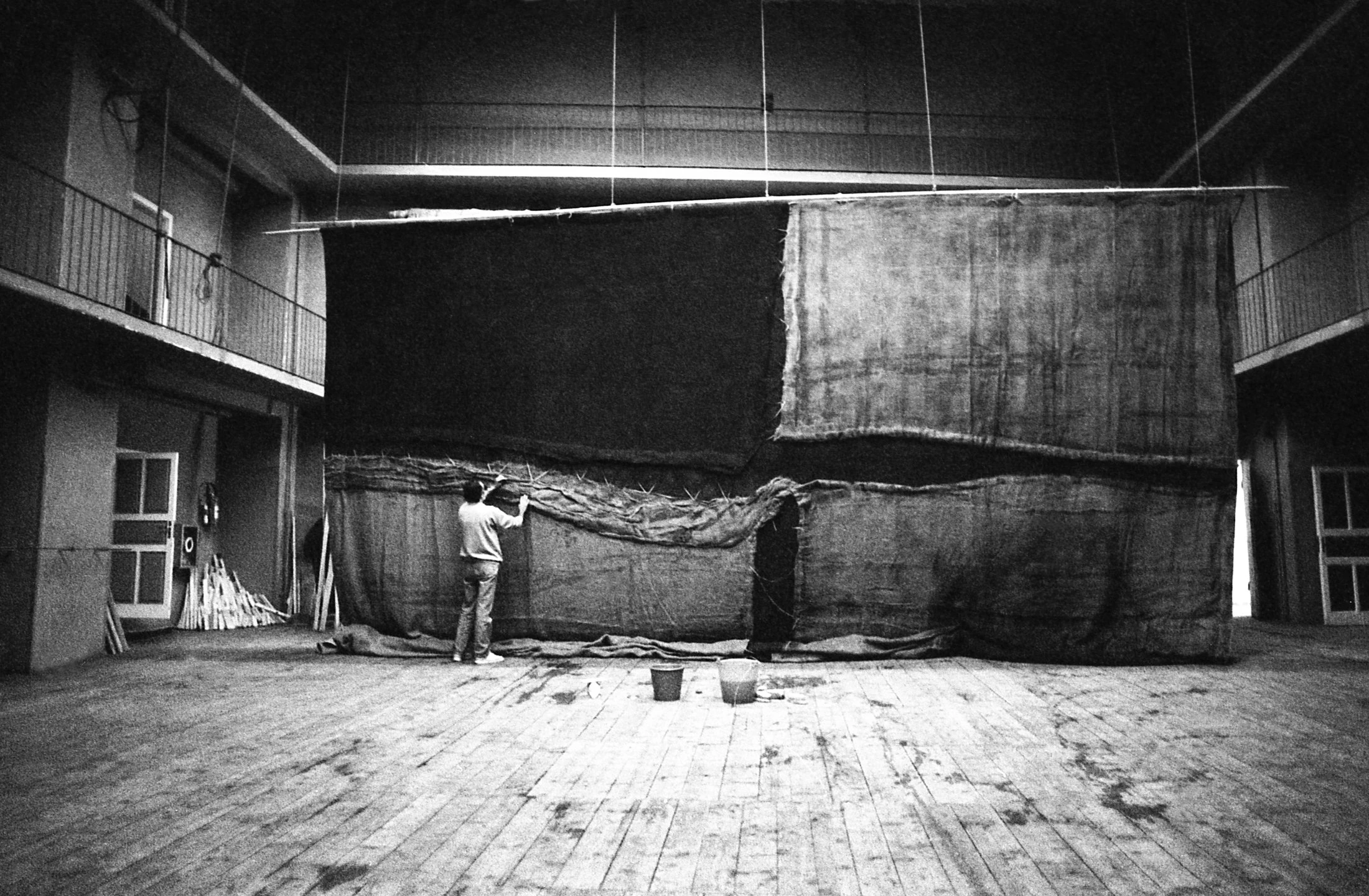
Form changes… Yet, looking back today at the astonishing and discerning trajectory of Sandro Visca’s work, one is never struck by the slightest hint of conservatism—of a “religion of form” or of stylistic tropes in the sense of passéisme or mere cliché. Visca has always sought—first within himself, then outwardly—the cosmogonic matrix and the synergistic fluidity of this change: that perpetual movement known as Art, which demands metamorphosis, depth, and imaginative precision—demanding, indeed, a religio (a sacred devotion) to form in fieri, to the act of communication in progress… He never rests on his laurels, never contents himself with his achievements—whether minor or major—nor even with those deeply internalized emotional milestones that are so rightfully his own.
Form preserves Form only by renouncing it, by putting it back into play—forever inseparable, infused into every shadow or light of its own time. Indeed, Sandro Visca has always studied and created while pulsating in tune with the universal soul surrounding him… That is to say, with his materials, his fibers, his essences—his elements: understood in the literal chemical and physical sense. And this has been the case since his beginnings and his early studies at the Art School in L’Aquila, around 1961. The air is naturally crackling with the torments and trends of the era, all in full, turbulent swing: Tom Wesselmann with his snippets from advertising signs, Schwitters and Merz’s great collages, New Dada, Arte Materica… Yet Visca seeks—and already finds—his own path of fervent counter-trend.
The Crucifixions cycle dates to 1964: “a line of inquiry pursued through collage; the colour is vivid—as vivid as the issues at hand—dripping and spreading into stains,” notes Emidio Di Carlo; “the line is clean and brilliant, tangibly etching a human story relived to the point of agony. The figure, however—scorched, torn apart, crystallized—hints at dissolution: it reflects a taste for matter, a contemplation of plasticity itself (a new question posed to reality?), and of the need for a new spatial component and composition.” It is within this partial dissolution—this sfumato-like, darkened surge of recomposition and even figurative rebirth—that a constant thread of his work reveals itself: one that is simultaneously material and iconological… This inevitably leads us to consider his relationship with Alberto Burri.
It originated in 1969 during his artistic collaboration with the Teatro Stabile dell’Aquila. Looking back at them today, the photos capturing both men grappling with the aforementioned setup and assembly of the gigantic stage sets for the production of L’Avventura di un povero cristiano (The Adventure of a Poor Christian) by Ignazio Silone—directed by Valerio Zurlini in San Miniato, precisely in 1969—are deeply moving and spirited. I was contacted by the T.S.A. because no scenic workshop in Italy was available to create those sets. The project involved two plastic “combustions”—one white, the other red—and a sack. Three backdrops, each ten meters wide and seven-and-a-half meters high, had to be created based on three small sketches by Burri.
I went to Milan to create the two combustions, where the theatre had reserved a vast space for me in one of the Trade Fair pavilions. I managed to complete the work by going without sleep for fifteen days straight, working ceaselessly day and night; I was twenty-five years old then, and anything was possible. One is reminded of the splendid, lyrical prose that Leonardo Sinisgalli—a poet as well as an imaginative and highly skilled art critic—dedicated to his friend Burri in L’età della luna (1962). He described visiting Burri at work in his studio—a shimmering, blackened, smoky yet sublime space; an almost arcane yet futuristic Sibyl’s grotto… In that half-buried room on the Via Salaria, Burri awaits us in a T-shirt, his eyes bright and cat-like.
He lives like a tramp, a madman hidden by the nettles. He fires at two touching lead sheets set against the corners of the walls, or shatters the bottom of a bottle. Hanging on the walls are tattered flags, mourning veils, foul-smelling undergarments, and medal ribbons. There is a drum of bitumen in the room, along with sacks of plaster, needles, fine points, and broad brushes. A soldier of a lost war, he neither whistles nor sings. He sews; he burns. Naturally—for this is the true aim of art—the relationship and artistic collaboration evolved into a human connection, a bond of mutual esteem—friendship, in other words. Thus we find Visca and Burri—both avid hunters—immersed in their cosmogonic hunting expeditions across Umbria or Abruzzo, ranging from Burri’s studio in Casenove di Mucignano to the splendid chestnut woods of the surrounding area… I came to know a different Burri.
He was different from the misanthrope everyone spoke of. He was very open with me; on afternoons off, after returning from long hunting trips, he would speak passionately about his time as a prisoner in Texas, his early paintings, and the difficulties he faced in the camp in sourcing his first paints—especially the reds. He also spoke—with a certain anger—of the immense effort and dedication he poured into the search for his brother, who had gone missing in Russia; yet, above all, we discussed painting and my own work. And what Visca unfolds before our eyes—rapt and tireless—is truly a “Novel of Matter”: he takes that matter and saves it, reshaping it not through artifice, but through the primal, ancestral yearning of Art… Inert matter… to be stitched, burned, consumed… And then there is that vital, eclectic—even encyclopedic—relationship with these materials: from the metal workshop of his formative years to his vast tapestries… And that stubborn, sublime desire of his to “recover colour through materials”… And, above all, to reclaim Art Informel through figurative forms… Thus, when he began his deeply felt Crucifixions series in 1964—depicting the fourteen tragic human moments of the Stations of the Cross—Visca once again displayed his characteristic trait of veering off the beaten path, changing course, and avoiding ideological implications—or the erasure, obscuring, or stifling—of his fertile creative dawn.
While the entire materico movement (all of Burri’s epigones, in short) posited matter as the sole logos and ethos—the ultimate, crowned goal—of their expressive inquiries, Sandro utilizes, sublimates, and selects the scraps and slag of matter (reclaimed paper, fabrics, rags, PVA glue, enamels, welded iron) to reassemble, weave, mold, and sow anew neo-humanist figurations. And where, ultimately, the human—no, not the post-human, that residual and torn drift exploded from within—remained firmly at the centre of the work, indeed transfigured into a new, defining outcome. From the black—Visca seemed to tell us, a perfect, original, and liberated pupil of the finest Burri—light is reborn, implodes, and rises again… From the scorched lacerations of the social fabric—and of creative matter itself—new colours emerge miraculously: new because, like Proustian time, they were first lost and then rediscovered with even greater intensity.
His collaboration with cinema opened up a different perspective—one that was kindred yet varied: Zurlini’s film based on Silone… And above all, Un cuore rosso sul Gran Sasso (A Red Heart on the Gran Sasso), which Visca created in 1979–80 at the height of a period of bizarre, fertile aesthetic seclusion in his native mountainous Abruzzo—a landscape rugged, ancestral, and apotropaic, embodied in stone like an immense tectonic monument, a secular and gigantic sanctuary of the heart, a porous mausoleum of Nature. And let us consider—mutatis mutandis (for here it is not the peak of Gran Sasso that looms, but its sister mountain, the Maiella)—the splendid description that D’Annunzio, in The Triumph of Death (1894), intones regarding a summit raised up from its own precipices—rooted and flourishing through the atavistic strength of its own traditions, and a kind of ineffable furor anthropologicus: “His land and his people appeared to him transfigured, lifted out of time, possessing a legendary and formidable aspect, heavy with mysterious, eternal, and nameless things.”
A mountain rose from the centre—like an immense primordial stump—shaped like a breast and capped with perpetual snows; and a shifting, melancholy sea washed against its crescent-shaped coasts and promontories sacred to the olive tree—a sea upon which sails bore the colours of mourning and of flame. Roads as wide as rivers—verdant with grass, strewn with boulders, and marked here and there by gigantic footprints—descended from the heights, guiding the migrating flocks down to the plains. Rites of dead and forgotten religions survived there; incomprehensible symbols of long-fallen powers remained intact… Like an immense primordial stump… This fascination the mountain holds for the artist takes us truly far afield (perhaps to Roccatagliata Ceccardi, to Jahier, to Dino Campana, to a certain Rèbora, even to poor Antonia Pozzi!): yet with Visca, too, it is not merely a matter of a—shall we say—nature-oriented experience, but rather of a human ascent, of a soaring, oxymoronic anthropological immersion… “upon the unbaptized mountain” and its phalanx of images—to use the words of the great Welsh poet Dylan Thomas. And every descent from the summit ultimately celebrates an oxygen-rich fresh start—a return, a re-gathering in the valley along the rivers and the roads, however hostile, of Reality.
“In the work of Sandro Visca, fetishes and taboos emerge and manifest themselves, alongside the pristine restoration of highly sophisticated spells,” writes Gino Marotta—surely with these grand tours across half the globe in mind—“along with fierce, impassioned explorations of the emotional landscapes of an ethnic collective that reaches beyond the Gran Sasso toward the desert.” Elsewhere, he would describe him as “the Saracen, an enchanting exorcist,” and a “wry, privileged decipherer of arcane and distant mechanisms of thought.” Indeed, Visca can certainly attribute one of the most interesting chapters of his life—and thus of his art—to his long journeys through the Andes, Peru, and along the Amazon River. Naturally, one is reminded of the lyrical light found in Pablo Neruda—at once sweet and harsh, unredeemed and pure—which is perfectly reflected not only in his famous poems but perhaps even more so in certain prose pieces and diaries. There, the powerful South American landscape seems to rise up and transform into a rugged, wildly imaginative artist capable of painting and sculpting—using its own colours and forms—every stretch of land, every gorge, gulf, or horizon wall. Consider, for instance, the unique, internalized mural of L’autunno dei rampicanti (The Autumn of the Climbing Plants): fleeting and yellow, Time—which beheads the leaves—advances toward the other side of the earth, heavy, making the fallen foliage crackle.
But before departing, it climbs the walls, clings to the curled tendrils, and illuminates the silent climbing plants. They await its arrival all year long, for it clothes them in crinkled textures and bronze. It is when autumn recedes that the bindweeds deck themselves out, brimming with joy, seized by a final, desperate resurgence. A time fraught with despair; everything rushes toward death. That is when you forge the dark fury of the climbing plants upon the damp walls. Motionless blue spiders, violet and yellow scars, blood-stained medals—playthings of the North winds. Where the wind will shape every intricate pattern, where the water from the clouds will complete your work. Nature, too, invents its own glorious, supreme palettes!
Fetishes and taboos… Ethnic collective… We must imagine and respect that younger Visca—of 1970 and thereabouts—happily attuned to and connected with this profound life choice: including, fortunately, the associated political choices, which were—and remain—human choices precisely because of that nature. “In those years,” he told me—his tone hinting at a long-held, affectionate unease, an impulse that was deeply felt and embodied, certainly, yet not entirely shared—“categories always had to be part of an alternative proposal… I preferred reclaiming certain layers of experience… A progressive reclamation, mind you, not an archaeological one… I aspired to explore, rather, the relationship between the inner self and the outside world—the true, internalized necessities of living.”
Perhaps—why not?—even taking one’s own culture as an example; …and stepping outside the mechanisms of the Market, or the Power of Criticism, in order to save myself.” Crucial, then, was the refusal to fully surrender himself to the entourage of galleries and trendy critics—asserting instead (first and foremost within himself) a yearning for creative freedom and existential peace: the decision to teach at the Academy section of the Pescara Art High School, starting in 1969, sustained and sheltered him like a productive oasis. His relationship with young people ultimately prolonged his own youth, enabling unexpected collaborations and exchanges of emotion and expression.
His 1972 encounter with a student like Andrea Pazienza—the brilliant illustrator and cartoonist who, in just a few years, became the icon of a generation before burning out just as quickly—speaks volumes about certain illuminating, fateful junctures that were both artistic and existential (the Pazienza archive reveals that Sandro Visca—the beloved, caricatured teacher featured in dozens of cartoons—was, in fact, the “real-life” figure most frequently drawn by Andrea Pazienza…). It was a time when people were finally emerging—albeit battered—from the immense, hegemonic, and ultimately coercive weight of ideologies. Their timely and inevitable decline—a process of disintegration, corruption, and implosion—fostered and gave rise to a subtle yet intense need for different forms of solace, stylistic elements, archetypes, and goals.
Trend followed trend, and one of them was Nature—an eternal return to it as an arcane, primordial Alma Mater. Yet for many, this was a sincere need, an urgent desire for introspection—to listen to oneself as, above all, an Anima Mundi. Sandro Visca was… …immediately among them, and with such depth of analysis, such demands, such fervor and rejections. Thus, the naturist creed purified and redeemed souls still aching from the sterile malaise and terrifying skirmishes of too many avant-garde movements—and, even more so, from the inexorable, terrifying war within a poisonous, factionalized civil and political landscape… Ultimately, 1968 had betrayed its own dreams and needs; the 1970s turned dark and mournful—the “Years of Lead,” as they were called.
And they weighed down and killed just like lead. With the Autonomi movement’s P38 pistols and the police’s reactionary smoke bombs; the Red Brigades; and the kidnapping—followed by the grim, delirious execution—of Moro: a tragic, futile holocaust for a System that remained ignobly unchanged—if anything, further accelerating its consumerist impulses and tendencies, the pseudo-democratic dictatorship of Capital… Pasolini thundered and warned, yet ended up a corpse—beaten, bruised, and mangled—in a dump at the Idroscalo in Ostia, on the far outskirts of Rome (a place he had always loved), following one of his sordid, habitual homosexual trysts. It was at the hands of the very Ragazzi di vita—the street urchins—he had idolized that Death finally came to him.
Yet, in truth, he had already prophesied—and, as it were, filmed and poeticized—it all; he had lived through a visionary nightmare that allowed him to intuitively grasp and suffer every new crisis, as well as the scenarios of an entire planet—frighteningly teeming and in its death throes—with its unstoppable Third World raised to the second and third power, exported as an endemic virus, colonized into a necessary anti-hell, a condemned purgatory. …and functional to the system: The Fifth Sorrow is knowing that, one sweet morning, billions of living beings will wake up—just as they have every morning of their lives—beneath the simple sun of a future Europe, amidst its mulberry trees and primroses; or beneath the profound sun of India, amidst the sublime stench of cholera hovering over little bodies naked as spirits; or beneath the brazen sun of an increasingly modern Africa, against the backdrop of the green of death that will frame life’s furious gift; or beneath this sun at Fiumicino—a river sun that turns the smell of mud into a celebration of wretched Latin immortality… Each one dreamed of, and sought out, the antidote that best suited them.
Everyone fled from themselves toward themselves, deep within themselves: and so came a time of deeply moving, poignant mythologizing of Nature. The West, as we know, moves in waves of fashion: witness the craze for the books of Tolkien, or Hermann Hesse and his Siddhartha—with that India evoked and invoked, and a nirvana that no metropolis could truly afford itself, beyond mere literary games or symbolic flourishes… “It occurred to no one to question the wisdom of the Permanent Centre of Love when it declared that all contact with the rest of the universe must be rejected. Activated… a word written in black letters that bled red ink…” —so raved that great, intoxicated sage of Jack Kerouac’s making in a strange, unprecedented, and biting science-fiction story from those years, cityCityCITY— “ACTIVATED—you’d see it scrawled on the walls of the hyper-sterile restrooms in cityCityCITY, accompanied by lewd drawings.”
Moving from one state of displacement to the next, toward the other side of the globe, Sandro Visca instead quietly continued his work: the task of being, of listening to his inner self, and of actively becoming an artist—the creator of a healthy, innate desire for expression. He, who had never chosen the metropolis, nor—deep down—ever truly accepted it; …nor the sham liberal-democratic dictates of consumerism, or—worse—the rebellious alibis and grim utopias of “dictatorships of the good,” of the dreaded or seductive forms of “real socialism”… His new phase, spanning the heart of the 1970s, commands admiration and enchantment with works that possess a masterful naivety—uncorrupted and blossoming with almost alchemical imagery; never stale décor, but rather a deeply felt, life-giving horizon of enchantments, suspensions, ethereal voids, and analogical intrigues—an inexhaustible iconography and a polychrome tapestry of the soul. Or perhaps—who knows?—it is truly the woven, varied, and finally deciphered map of the Permanent Centre of Love… Yet, regarding this dear shaman who stitches together words and fabrics, we are also interested in his relationship with the modern classics of the 20th century (and even the late 19th: think of Jugendstil, Klimt, and the Vienna Secession, or the fairy-tale, neo-medieval allure of William Morris and the entire Arts and Crafts movement, among others): the Second Futurists like Prampolini and Depero, certainly; but above all—alongside his connection to Burri—figures such as Fontana, Afro, Mirko, Cagli, Munari, and many more—from the Italian “abstractionists” of the Forma 1 group to the practitioners of performance art, Body Art, and Land Art (such as Christo)… Just as we are intrigued by the infinite possibilities for the “theatricalization” of images and installations that Visca constantly proposes and opens up—or, one might say, unfurls—en plein air… “It is the spectator who makes the work,” as Duchamp theorized—and iconoclastically proclaimed.
Yet, with Sandro Visca, the artwork continues to choose, single out, and instruct its viewer—indeed, it seems to catechize them, to engage in a dialogue in unison… Much like his teatrini (little theatres), which ask the viewer to bring them to life, to converse with them through sensations, thoughts, and images—refracted and shielded—of the soul. Or, going back further, like that Pupazza—the true “counter-daughter” and smiling, dreaming princess (mirrored yet distinct, joyful yet pacifying) to the terrible Ubu Roi: that absurd, metaphysical, anguished, and satirical figure, dumbfounded amidst our ridiculous and atrocious modern history, who emerged and reigned throughout the 20th century, from Alfred Jarry onwards… Visca’s teatrini—conceived in 2002—are unsettling yet entertaining, acting as an exorcism that transcends any mere sense of poised, “precarious” grace: The Little Theatre of Love, The Little Theatre of Flowers, Oriental Little Theatre, The Little Theatre of the Kingfisher—and even Aparago Posing, The Histrionics of the Strolling Player, Secret Cupboards, Fall of a Character, Extreme Rescue… “Unsettling”—as Antonello Rubini rightly observes—”because behind their vibrant, iconic, and material preciousness, one often forcefully senses precariousness and unease: architectural forms collapse within the compositions, chaos asserts itself, and those seemingly easy, joyful inferences lose some of their lightness; the figures appear, at times, caught in the very moment of destruction.”
Yet, in all this, there is no dramatization…” We are reminded of the lighter, more inward-turning James Hillman (the renowned psychoanalyst and Jungian scholar—a fierce critic, as is well known, of Western rationalism’s culture—who insists on identifying the psyche with the archetypal image, replacing the concept of the unconscious with that of collective memory). He constantly invokes and mourns the Puer aeternus within us—that figure we risk losing or exiling elsewhere: …the figure of the Puer aeternus is the vision of our primal nature, our primordial Golden Shadow, our affinity with beauty, our angelic essence as messenger of the divine, as a divine message.
(…) The Puer, then, personifies that moist spark within any complex or attitude—the original dynamic seed of the spirit. It is the vocation of things to attain their own perfection, the vocation of persons toward the Self—to be true to themselves, to maintain contact with their own eidos, which is a divine creation. The Puer offers direct contact with the spirit. If this direct connection is broken, the Puer falls with broken wings. And when he falls, we lose the urgent, burning sense of our purpose; instead, we begin the long, processional march through the halls of power toward the sick, hard-hearted Old King—a figure who often wears a disguise, making him indistinguishable from an infirm Wise Old Man.
Material cosmogony, chromatic weaving, formal displacement, emotional architecture… How many operations converge and harmonize, coexist and even rub against one another in Visca’s works—in this continuous, stubborn act of shaping and perhaps reshaping himself, of seeing himself reflected, To become passionate, yet also to transcend—to rise above—sheer matter! The poet Sinisgalli was right—here engaging with the work of Lucio Fontana: “His work is entirely marked by a sense of joy—a wild, almost gruesome sort of joy. He wanted to bring the sky into our rooms… I see him as a kindred spirit in his anti-rhetorical, anti-mystical calling. It was necessary to stand in the way of the academics, the purveyors of pompous convention.”
His ‘concepts’ are hindrances, obstacles, barriers. They had a tremendous deterrent effect. They frightened the philistines. In the spirit of joy… Bringing the sky into the rooms… Impeding one’s stride… A deterrent effect… As it happens, on the eve of one of the darkest years in our history—1976—at the Venice Biennale, Sandro would apply his characteristic flair, passion, and creative spirit to the reconstruction of Lucio Fontana’s environment. Through these delightful yet restless little theatrical scenes, Visca draws us into—and immerses himself in—a veritable metaphorical parade, or a motionless dance of objects. If the motto of Marc, Kandinsky, and the Blaue Reiter group in 1914 was no longer to copy the world but to “make things visible,” now objects themselves become absolute protagonists, invigorating emblems, and humanoid ambassadors; and this symbolic objectification seems the only conceptual and expressive antidote to mass dehumanization… There were so many—far too many—things around during those years of intriguing and intricate emancipation of the modern from the modern, within and beyond modernity… Abstract Expressionism, Tachisme, Art Informel, Action Painting, geometric abstraction, Op Art, and, naturally, a deluge of Pop Art (Rauschenberg’s “combine paintings,” Lichtenstein’s dot-filled, comic-book-style canvases, Warhol and his obsessively repeated screen prints of selected images and mass-media iconography)… In short, almost everything had already been done or attempted: from the manifesto “DADA DADA DADA, a clamor of rippling colours, a meeting of all opposites and contradictions”—that is, from Tristan Tzara’s “Dadaist disgust”—to Giacomo Balla’s “object-holding sculptures”; from Dubuffet’s self-portraits in blue and red ballpoint pen to the utopian fascination of… …L’Hourloupe, to the sarcastic series of Generals, Modifications, Meccani, and Ladies by Enrico Baj… Nor should we forget—from roughly the same period—Vladimiro Tulli’s Alchemical Lyricisms (how could one overlook his Poisons in Pink and Mattress or The Severed Rainbow?), or Luzzati’s delightful, theatrical Mozart—and, even more so, the allegorical, joyful Theatrical Fantasies of Daniela Remiddi, with their puppets, masks, and costumes possessing an immediate, polychrome vibrancy… Looming—or rather, poised to explode—was the success (at once deserved and orchestrated) of the Transavantgarde; its champions—from Chia to Clemente, Cucchi, De Maria, and Paladino—guided by the intuition of their critic and “prophet” Achille Bonito Oliva, “transcended the ideology of linguistic Darwinism (…) reclaiming the value of manual craftsmanship and subjectivity, and restoring the categories of painting, sculpture, and drawing.”
Cultural nomadism and stylistic eclecticism govern the work of refounding art based on the Mannerist principle of quotation… But these were already the games and gambits of the late 1970s… Youthful movements and generations succeed one another rapidly, and each seems in a rush only to dismiss and replace the one before it… Yet the 1960s were certainly not easily filed away—neither here nor anywhere else! In Italy—aside from the solitary, celebrated achievements of the great guiding lights (from Burri to Fontana, naturally, from Capogrossi to Rotella, etc.)—there had emerged, especially in Rome around the cafés of Piazza del Popolo (roughly between 1959 and 1968), a brazenly young, tempestuous school of painters. They were somewhat maudit—outsiders—and chafed against every tradition, even that of Modernism; they lent their energy to a talented, rapturous, and vaguely hedonistic homegrown version of Pop Art. Everyone knows the names—ranging, with various nuances and distinctions, from Schifano to Festa, from Angeli to Ceroli, to Mambor, Kounellis, Tacchi, and Pascali… Paola Pitagora—who during those years went from being a promising, tormented actress for Bellocchio (as well as the mainstream, beloved Lucia Mondella in the TV adaptation of The Betrothed) to becoming the fiancée and muse of one of them, Renato Mambor—recounts, long after the fact, in the diary-like, novelistic pages of Fiato d’artista (2001), those anxious dreams—reckless as the trajectory of their speeding superbikes—and that carefree, burning, anarchic bohemian life lived amidst the full, clumsy rush of the economic boom. …economical, with poignant, lucid touches: “But why didn’t you get together with a director or a producer?”
I found myself being challenged. Of course, it would have been easier for me—given that those ‘masters of pain’ presented a vision of reality that often clashed with my own vital, everyday need for growth—to simply walk away. Yet, without realizing it, I was drinking a most precious nectar from them: that of free, unconstrained creativity. “Of the arts—the useless ones,” wrote Brecht. To my eyes, their works truly sprang from a lack of necessity—not even the necessity of Beauty. One did not simply exclaim “Beautiful!” before a painting or sculpture; instead, one had to overcome a sense of disorientation, for they were experimenting with a different version of Beauty, a different language.
Fascinated, I gazed at that iridescent wheel, striving to understand; yet, if the word Avant-garde holds any meaning, it is only today that I can truly appreciate their work. There, then, is Sandro Visca in 1969—smiling, mocking, and slyly self-deprecating—with his emblematic fabric figures. These were hand-sewn with undeniable craftsmanship and then played with; as Nicola Ciarletta suggested, they created a “caricature-like and hallucinatory effect, reminiscent of Godard (the filmmaker closest to the origins of theatre).” Yet it is the aspect—and the dividing line—of the humanization of objects (and perhaps the reverse) that enables the most interesting conceptual acrobatics and archetypal interchanges.
Ciarletta continues: “As a modern artist, Visca knows that man today (and by ‘man’—needless to say—we mean woman as well) is ‘reified’; that is, he has become interchangeable with the objects he uses. (This interchangeability between man and object found its first visual interpreter—forgive my insistence—in Picasso). Yet Visca also knows that, in the past, a figurative artist was considered a maker of objects, and that the journey to being regarded—on a par with poets—as an imitator (and thus, let us reflect, an interpreter) of human action (which requires development and movement) was a very long one. It is, therefore, based on this dual awareness that Visca comes to conceive of painting—which is vision (and aspires to be a vision of human actions)—as theatre, which is and has always been vision (as the very word reveals)”… And Benito Sablone—speaking as an ironic yet sorrowful poet, like all of us in our perpetual quest for new forms of balance—will discuss the dual nature of Visca’s hand-stitched pupazze (effigies). Ultimately, these figures “do not wish to be taken seriously, yet they constantly threaten to rebel against their own creator due to their inherent, potent irony; thus, they become—in a secondary phase, and only after sweeping away every lingering aesthetic myth—profoundly serious and dramatic.”
It was precisely in this way—solemn yet joyful, structured yet anti-mythic—that Sandro managed to combine, or perhaps harmonize, Creativity, Necessity, Freedom, and Beauty… Not to mention the felicitous—and contradictory, hurrah!—anthropological-cultural implications; and above all, the so-called “magical metalanguage of Visca,” which sociologist Luigi Fraccacreta identified and acclaimed (back in the early 1970s—specifically during a major solo exhibition at the Pace gallery in Milan) as a journey through the alchemy of the inner self. Visca’s work ultimately reveals a new model of veneration: the objects depicted are simultaneously and reciprocally both “internal” and “external.”
In the world presented in these works, the head, the heart, the autonomic nervous system, the womb, the cloud, the underground, fire, golds, silvers, and reds acquire a complex syntactic value derived from the alchemical process—that is, from the transformation of the researcher-observer’s deep Self through the act of research itself. And the constant, precisely, is this rare and endearing quality of honest mockery, of festive ethics—a very serious yet gentle and docile “joke”: “The result is a festive, playful horizon of images (and indeed, Visca speaks to me of reclaiming a ‘lost festivity’), where the play,” notes Enrico Crispolti in 1985, “is not a form of liberation that ends up being alienating, but rather an act of evocation, invention, and the probing of possible, vitally significant connections.”
The goal is imagination as a power capable of constructing a richer world—one distinct in its animistic density, where every sign is therefore also something other than itself; where every element present not only alludes to a deliberate symbolic figure but is also charged with further imagery through the intensity—I would call it the expressive ‘decor’—of its own texture, always sumptuously rendered and thus never inert… It is certain that Sandro Visca—even back then—increasingly established and distinguished himself as a “total” artist; and this, more than a mere event, shines to this day as an absolute miracle. To articulate his merits or attest to his talent, critical analysis—with its mere, flawed measuring of styles and stylistic devices—perhaps no longer suffices; what is needed, rather, is the felicitous, synchronous voice of a poet, the wise ritual of a happily post-Rimbaudian illumination, or even the lavish, efflorescent chronicles of the rarest, most sincere Gabriele d’Annunzio—more Abruzzese than Roman, more nostalgic than progressive, more earthy than sensual, more elitist than worldly—more in love with the extravagant fabric of art, with its silken, cabalistic colours, with every imploded weave or creative material that retells inspiration, clothes it, furnishes it, contemplates it, frequents it, inhabits it, seduces it, undresses it, and penetrates it with the dense love of Language, with the unprecedented, daily courtship of words—at once serious and impertinent, lucid and evanescent, archaic and exquisitely timeless… … I know that all things are an emanation of the one, infinite, and eternal substance; and that earthly man is the image of man …celestial; and that the universes are reflections of the One.
The dryads have fled, along with the oreads, tritons, and woodland spirits; yet for me, the sylphs still sigh in the breeze; the undines weep in the falling waters and lament in the deep voice of the sea; the salamanders stir and sparkle in the fire; and deep within caverns, gnomes guard treasures the sun never saw. A journey—motionless yet swirling, pliable yet tough, moldable yet stony, metamorphic yet inductive—governs this “gentle and sure attitude” (as Ruggero Pierantoni notes). From this “command deck—so geometric, uniformly luminous, and modestly inhabited”—it circumnavigates the entire world to be visited (as well as all possible worlds) across a tapestry thirty-four meters long and fifty centimeters high. It does so with a fantastic grace and relentless precision, with an elegance and awareness that truly recall certain unforgettable parables by Italo Calvino—his Tarot cards or The Castle of Crossed Destinies, his Invisible Cities, his Marco Polos (figures of yesterday and always, but above all, of tomorrow).
It is no coincidence that in his final, profound essays on knowledge—specifically the now-legendary Six Memos for the Next Millennium (Lezioni americane), published posthumously in 1988—Calvino singled out “Lightness” as the paramount virtue for the New Millennium. He did so precisely because, as Fabio Pierangeli observes in his insightful monograph (Italo Calvino: Metamorphosis and the Idea of Nothingness, 1997), lightness “triumphantly opposes a reality that has become heavy due to a slow process of ‘petrification’…” …began in the post-war period.” Petrifi-cation—a concept noted by Calvino but existing outside of historical contingency—also represents evil; it is the most delicate phase, the knot that remained tangled in La giornata di uno scrutatore (The Watcher).
Calvino immediately clarifies that we are dealing with a metaliterary context by drawing a parallel between myth and the “method to follow when writing.” By allowing “images from mythology” to shape a discourse on literature, one can avoid being captured by the petrifying gaze. Yet, “one must not rush with myths; it is better to let them settle in the memory.” Calvino is undoubtedly drawn to the lightness and the nobility of the gestures with which Perseus completes the slaying of the monster, cleanly severing its head: “He is supported by the lightest of elements: the winds and the clouds.” These are images of grace and delicacy that foreshadow the metamorphic process in which the first step is the transformation of the monster’s blood: “from Medusa’s blood a winged horse is born—Pegasus”—so that the “heaviness of stone can be reversed into its opposite.”
Our agile, tenacious, and strong—because so incredibly light—Visca has always engaged in something truly similar, and equally, inexhaustibly joyful; he is a metamorphic artist like no other, an original investigator, and an honest, patient alchemist of his own imagination… Truly moving from blackness to white, from nigredo to albedo—to that final, clairvoyant goal and stage of every work that coincides with life, refracting and summing it up. Yet with an artist of the total and the absolute like Sandro Visca—powerful yet weightless, swirling yet seemingly concentric, a synthesis that is also primal like a metaphysical Unmoved Mover—the weapons and customary tools of art criticism fortunately seem blunt, even limiting. Perhaps more fitting and wise is the soaring, eternal intuition of the poet: the understanding of a pain that, once translated and metabolized, returns to nourish us, establishes and roots the well-deserved contrappasso of a smile, and fights and takes risks for a true happiness—auratic, mental, and only subsequently, satisfyingly creative.
In every atom or cell—or atom or drop of water—there lies, ultimately, the imprint, the essence, the scale, or the memory of the entire world, the very formula of life—or so biologists, physicists, and scientists swear. In every painting or installation, tapestry or effigy, miniature theatre or collage by Visca—at once solar and lunar, like a Golden Shadow—the joyful wager of art, the arduous harmony of existence, and the nature to which we belong and which claims us, baptizes us, and forges us into men (forever new yet ancient, successive dawns that set yet remain inextinguishable) languish, steep, reawaken, bud, and are born as if by Caesarean section. We are poised, tightrope walkers between the mirrored realms of sun and moon—much as Dylan Thomas divined and explored through the sheer transparency of words—images surprisingly kindred and here readily superimposed, though in truth merely conceived upon the maternal womb of art: So that he who now learns the sun and the moon from his mother’s milk may return—before lips flare and bloom—to the bloody room of birth behind the wren-bone of the wall, and fall silent; and the womb that bore the beloved childlike Light—or the blinding prison—for All Men may open wide at his arrival.
In the name of all the dissolute, lost upon the unbaptized mountain in the heart of darkness, I pray to him.
Roma, March 2008
Plinio Perilli
There is a photograph showing the artist Sandro Visca at work with his sewing machine in his studio in Pescara. Visca is a Pescara resident by adoption; he has lived there since the late 1960s. He was born in L’Aquila, but by the time he moved to Pescara he already had experience in Milan behind him: a considerable artistic and existential baggage that, when one is mobile and travelling, one tries to lighten.
Sandro Visca is not an artist afflicted by performance anxiety or psychological disorders associated with career ambition. When he arrived in Pescara, he was a young man ready to redraw maps for himself and others.
Visca is an artist of beauty.
The decisive tranquillity of his gait, as I remember it from those distant years between the late 1960s and the early 1970s, struck me deeply: it had the ability to conquer space. His stride was at least twice the normal length, apparently slow yet capable of covering an impressive distance. Visca was slow, but he arrived first.
Perhaps Andrea Pazienza — his pupil at the art school, who dedicated splendid drawings to his teacher, collected by Fandango a few years ago in a volume entitled Visca — would certainly have found a correspondence between Sandro Visca and Strider, Tolkien’s character in The Lord of the Rings, before he revealed himself as Aragorn.
But this slowness that gains space, that makes room for itself, becomes an aphorism of his work and of his professional position within contemporary art. It is accompanied by a particular “detachment”, an elegant “distance” from excessive public visibility, and a kind of — as I remember — moral firmness, almost a certain “ethical roughness” that was decidedly out of step with those years.
Visca thus arrived in Pescara around 1968 and, as the artist himself reminded me in a letter some time ago: it seemed to me the ideal city in which to pursue my work in complete freedom and far from the temptations of success.
Yet the slowness of that “great stride”, the detachment, moral rigour, ideological distance, elegance and refined, meticulous “making” of his works — I remember his beautiful tapestries and dazzling stitched works — soon came to be seen as out-of-circulation currency by Pescara’s community and by the artists themselves. Afflicted by severe forms of provincial self-promotion, they nevertheless expressed an underlying admiration.
He is seated at a sewing machine, putting fragments together. An ancient man, reassembling what has been broken.
His “slowness” is a barrier of “resistance” to art’s compulsive chatter and to the enticements of the market, which he came to know well during his Milan years. The time spent making allows thoughts to wander, a leisure of the mind, while the needle seems lightly to pierce and awaken the artist’s own body. An industrious “shipwreck”. Some of his works, touched by the slight relief of embroidery, can be conceived only under particular conditions of light, so that they too escape the glamour of contemporary visual culture.
Antonio Marchetti · 2010
A rebel. Today, just as in his school days. When the defining mark of his existence already seemed clear to him: he would dictate the rules himself, shouldering all the risks of such a decisive choice. Sandro Visca is a man who deals in no half-measures; his life and his art reveal the same bold, clear-cut character. And they speak of a stature that is truly lofty—in every sense. An imposing physical presence, the intensity of his history, the magnetism of his works. In the force of the impact, the disruptive message, and the precious nature of the manifatturawork that intertwines art and craftsmanship. One cannot simply call them paintings. Perhaps they are not. Visca’s creations are an indictment, a cry, a taunt, a thrust—at times violent—a punch in the gut, a bold provocation, an expressive gamble.
They never leave the viewer indifferent. They stir the soul and leave a mark, yet are always illuminated by an element of lightness that translates into hope. A tiny point of light, a touch of gold leaf, a suspended thread, a feather, or a woman’s breasts serve as a raft promising salvation to a humanity sorely tested by its—inherently human—inability to change course. Sandro Visca’s works seem to hold multiple lives: fragments of sacred vestments and scraps once belonging to a different whole come alive in a new story, telling a different tale upon the stage that hosts their performance. It is the vindication of textile materials, which don a regal air to sketch a world shattered into pieces, yet never condemned by a final verdict.
The escape route lies right there, within the narrative itself. These are works of absolute perfection, complex in both their material construction and their meaning. Immense expressive power pours forth from a soul that is passionate, proud, and—above all—free. He never bowed to the dictates of the market, of success, or of the “right” circles. He never crossed the threshold of the temple teeming with merchants; instead, he preferred to observe them from afar, maintaining a natural distance from the commercial contamination that has, over time, proven detrimental to art. It is a shift toward spectacle over creativity, appearance over substance—a destructive equation for the social value encoded in the artistic message.
He made his choices—sometimes at a personal cost—and forged his own path, fearlessly pursuing his ideas. His strength lay in his willingness to take risks, but also in his ability to forge bonds with the land, with nature, and above all with the mountains—a connection as vital to Visca as the earth’s bond with the sun. More than mere attraction, it was a profound sense of belonging that led him—a native of L’Aquila—to experience “his” Gran Sasso as something sacred, envisioned and beheld with the eyes of the heart. That same mountain was the centerpiece of a performance—a film shot in 1975 that, many years later, following a meticulous restoration, was acclaimed as a special event at the 54th Venice Biennale.
“A Red Heart on Gran Sasso” was no ordinary film: the men in the procession, bearing a gigantic heart upon their shoulders, represented an attempt to leave a powerful mark on a beloved landscape—to defend it against a reckless assault that was violating its integrity and beauty. “Asfaltata” (paved over)—the term currently used to describe a crushing defeat—perfectly captures the events of that time in a single word, when a pour of bitumen dealt a death blow to the mountain and the very idea of the common good. The construction of a useless road at Campo Imperatore was a deep wound, an affront to nature that Visca experienced as a collective failure—an outrage perpetrated right before everyone’s half-closed eyes.
The devastation was profound, and the resulting anger found a fitting outlet in that red heart—as large and heavy as the damage inflicted upon the mountain. It was carried to the summit by the strength of legs and arms determined to share the sense of rebellion that Sandro Visca expressed through the language and tools of an artist. It was the expression of an environmental consciousness in its infancy—unknown to most, yet already sensed and recognized as an urgent commitment to be embraced. Indeed, it was already taking shape as a battle, and that was the first trench Visca dug to defend the mountain—one of the things he held dearest and never tired of exploring.
His 1978 journey to South America was memorable and powerful, both emotionally and artistically: captivated by the Andes and enchanted by Peru, he sought out the essential nature of life and non-negotiable values in those lands—such as the sacredness of the Peruvian Amazon’s natural heritage. An avid traveler who shunned the standard formulas all inclusive and tour operator packages, Sandro Visca always sought out sources of professional interest and personal growth in distant lands. And he did so by constantly forging bonds—with people and with the places where he chose to live for extended periods—a precious resource in times governed by online connections that are ephemeral, false, and terribly hollow.
Human relationships, by contrast, are demanding and not for everyone. Much like Visca’s works, which speak to the attentive consciences of living souls—souls capable of grasping and embracing the jolt that radiates from his art. His is a call to reclaim critical judgment, to refuse to succumb to ignorance or apathy. The theatre of existence offers a spectacle that is at times revolting, yet looking away is not the solution. It takes courage, and he never lacked it. Sandro Visca always threw himself wholeheartedly into the fray—whenever an old, rusted mold needed breaking, whenever it was time to innovate, or when war had to be declared on a world that neither knew how nor wanted to honor art.
When it was necessary to restore the truest—and only possible—meaning of being an artist. He never stood idly by with folded hands.
Lanciano, September 2018
Licia Caprara
Drawing is (almost) everythingVisca: unpublished works on paper
Drawing is (almost) everythingVisca: unpublished works on paper
N.B. Titolo e nome come nella parte in italiano
Incipit
“But let this be as it may, what design needs, when it has derived from the judgement the mental image of anything, is that the hand, through the study and practice of many years, may be free and apt to draw and to express correctly, with the pen, the silver-point, the charcoal, the chalk, or other instrument, whatever nature has created. For when the intellect puts forth refined and judicious conceptions, the hand which has practised design for many years, exhibits the perfection and excellence of the arts as well as the knowledge of the artist.”.
Simple Past
It is Giorgio Vasari who leads us with these words to the consideration of drawing as the basis of creating art, with theoretical explanations linked to practical considerations that concern both invention and the artist's experience and knowledge. Far from being an imitation of nature or an external model, invention springs from the world of inimitable ideas and is the immediate translation of these, in a mutual influence of concept and practice. Because, to say it with the Arezzo-born historian and painter “by drawing on paper, you fill the mind with beautiful concepts, and learn to represent all the objects of nature, without having to keep them always before you”. The drawing, a creation endowed with expressiveness, both intrinsic and direct, reborn after the fall of the Roman Empire and the darkest periods of the Middle Ages, in the climate of the general 'awakening' which characterised Humanism and the Renaissance, went on to gradually acquire a role of primary importance, becoming enriched over time with unusual executive procedures and surprising formal results: no longer the hand-maiden of the work of art, but a self-contained and consummate work.
Thanks to the masterpieces included in the history of works on paper, it is increasingly easy to become acquainted with an artistic creation from its inception and move away from the idea of temporariness and urgency where for centuries drawing and works on paper have been relegated, compared to the three great arts: painting, sculpture and architecture.
Present perfect
In the art scene of the second half of the 20th century, at the end of the first decade, the Informal or art autre, which had held sway in the post-war period in Europe, the United States and Japan and which had repudiated form, both in the figurative and abstract sense, through sign, matter and gesture, moved towards its progressive and inevitable decline, with the fading of the very reasons that had determined it.
The experience of the Informal in Italy “preserved traces in both the abstract and figurative art of the following decade, practised also by the generation born in the twenties which, having matured around '58, inherited the contrast between abstract and figurative formed immediately after the war in the field of traditional techniques. This led to the neo abstract and a new figuration, differently mannerist, in which opposition becomes more institutional than dialectical”. The sixties, in particular, with a changing social scene and booming economy, saw accelerations in all sectors, heralding in a fervent creative season in the visual arts, in which the radical revolution of Lucio Fontana and Alberto Burri – recognized, among others, as masters by the artists of successive generations – opened new paths for wide-ranging experimentation in multiple directions with previously unimaginable outcomes. These are the years in Europe and overseas of New Dada, Pop Art, Nouveau Realism, Poor, Conceptual, Minimal and Performative Art, years in which traditional painting experienced a profound crisis and became increasingly marginal, pushed out onto the fringes and displayed only in exhibition contexts which were not part of the traditional artistic circuits.
At the same time, drawing was taking on new vitality, with the use of materials almost unimagined a few decades before. In addition to contributing to the achievement of their individual style, this activity was for many artists of the period a constant and private practice, of whose process and outcomes they were the first and sometimes sole spectators. Through drawing, the world of the intellect acquires a phenomenal consistency and becomes the mirror of a repeated speculative attitude on the part of the creator with himself, freely verifying with it the path taken and acquiring an ever-renewed awareness.
The transformations of the second half of the 20th century, according to Enrico Crispolti, “considered from the point of view of a typological evolution of drawing compared to the previous two decades, suggest a greater desire for the direct immediacy of recording of the sign, predominantly more full-bodied, and as if aimed at a greater iconic-formal synthesis, and greater design acceleration, in a spontaneous and immediate prevailing of the «research» design on the drawing as an accomplished work”.
The prevalence of the drawing in these years, seen by the author as an “phase of research”, instantaneous and without academic restraints, implies a series of experiments connected to contemporary artistic movements, of techniques which, in addition to those in vogue for centuries – pencil, charcoal, Indian ink, blood and so on – can be traced, among other things, to Polymaterialism, and to the use of collages, paints and synthetic glues. Moreover, always quoting the author, it is clear that the artist “more than ever invents his own technique and his own style according to a sort of inner dictation”, which seems to guide his hand on the white page as if responding to an internal monologue, a stream of consciousness. These procedures are known to writers, in primis James Joyce: the similarity between drawing and the word would seem to have a “genetic” basis. Reducing drawing to a mere phase would in part restrict the aesthetic and linguistic autonomy of which it is a manifestation: in fact, every artistic realisation qualifies as “research” in the overall process of a practice that within it and in its unfolding requires pauses, rethinking and revision.
Imperfect indicative
The year was 1961 and the young Sandro Visca had not yet completed his art studies when he was invited to take part in the Biennale Nazionale del Disegno to be held the following year in Recoaro Terme. Visca presented two works. It was not only the testing-ground for the 'exercises' he’d begun in his younger days but also a direct encounter with the work of internationally famous artists of different generations and languages. From then on, he stopped exhibited his drawings, although in the following years he developed a corpus of vast proportions, put together through assiduous invention and experimentation of executive techniques.
Some periods saw Visca working frenetically on his drawings, others, less so, but the work progressed constantly over the decades. Drawing has always been an inescapable activity for Visca, a hotbed for ideas and the inner furnace from which he extracted the glowing metal to transform into the many and diverse works on paper that are threaded through his whole artistic life, without explicit design values and totally autonomous and self-contained. It is an ongoing practice, necessarily kept private, bringing assonances to his pictorial, sculptural and environmental work thanks to similar morphological and syntactic modules and the use of common materials.
It is fascinating to pause a moment on the threshold of Visca’s atelier, which reminds the observer of an alchemist's room, to admire a myriad of 'objects' and materials placed neatly on the shelves of the cabinets, clearly visible through the glass, seemingly fixed and unmoveable, there forever, but ready for use. These multi-coloured objects are Mirabilia – fabrics of different textures and weaves, hard plastic buttons, mother-of-pearl and ethereal, delicate feathers and rolls of precious lace. This cosmos of colours is essential in the artist’s imaginary world: not all these things will be used in the work, but their presence induces thoughts and conveys the certainty of infinite possibilities in conception and concrete practice. It's a bit like drawing – the first action in the construction of the work, the pen strokes, the plain-coloured backgrounds; it crystallizes the idea on paper or sets off a process of growth. Similarly to the materials, chosen on an impulse or because they return repeatedly to the gaze, each drawing, responding to a sudden intuition, is an unconscious part of a mental and operational process that is revealed as it is made, experienced by the artist without any kind of conditioning. Carlo Pirovano writes that “research becomes even more stimulating when from close investigation on the executive process in the strict sense (always useful, moreover, so as not to lose the concrete relationship, en amateur, with the object of art in its concrete, physical individuality) we move on to consider the overall functionality of the drawing activity in the elaboration of a poetics in a general sense and, more specifically, in the modus operandi of individual artists, in the daily organization of their work and in the consequent establishment of a certain personal or group «identity card»”.
Visca's unpublished works are therefore a pronouncement of poetics, his identity card built up over the years and resulting in an original personal vision, fully inserted into the artistic congerie of the second half of the last century and at the same time narrative of specific figurative and spatial topoi and history of material structures and colour choices, in addition to the various operations carried out on paper and their change over time. The large number of these works constitutes a real Collection, a cornerstone of all his achievements, almost as much as his paintings, essential for the understanding of the multifaceted intellectual and operational process that characterises his whole work, thus showing it in its articulation and development. On a semantic level, these works on paper focus on the real, the present and spring from the artist's vast cultural heritage, sensitivity and interests. We must discard every naturalistic motif and pure abstraction, so that the story that emerges is striking in its variety of components, where the single plain page is approached by sequences organized according to affinity of language, always highlighting an inexhaustible inventive source progressively tending towards a centred figuration, after an initial period of clear informal ancestry, on recurring visual entities, in a relevant aesthetic synthesis. These works reveal the acquisition of a pertinent vocabulary, with sometimes enigmatic, sometimes disarmingly clear combinations, a lexicon to be found throughout Visca’s production, that lives with it in a relationship of contemporaneousness or precedence to the large paintings and sculptures, and with differences attributable only to the supports and dimensions, while the characteristics of the spatial approach and, sometimes, of the materials chosen for the compositions remain unchanged. Visca has bestowed the utmost care on a vast series of works on paper, a fragile element by nature, albeit of substantial weight and thickness, ranging from the bonding of paper sections for the collage areas, to the layering of tissue paper to roughen the surface, to the insertion of strips of fabric, textile 'blends', coloured threads and microscopic objects, also used in his paintings. The inks, graphite, pastels, temperas, markers and paints give these works their peculiar characteristics born of complexity of thought and execution, far from being impromptu sketches or mere notes. A harmonising element always to be found in all of Visca's work is his attention to detail, which naturally demands a considerable deployment of time and energy, in particular in the case of the tapestries, which the artist has been working on since the early 1970s. The necessary slowness of this particular form of art attenuates an instant intuition and conveys a shrewd weighing up of expressive codes and compositional interrelationship. It is clear that no interpretation of Visca’s production can afford to ignore these unpublished works, which enrich the exegesis of all his works and unequivocally reveal the lifeblood that has fuelled and supported his passionate vocation to art, in search of a personal and recognisable language, from the macro installations to the micro works and indeed every particle or infinitesimal minutiae of his activity.
Visca Carte inedite 1961-2019 is, therefore, a once-in-a-lifetime opportunity to view and enjoy these works created in over fifty years of activity and thus far hidden to all except to their creator, a surprising graphic diary characterised by a disenchanted and ironic vision of reality and vigorous expressive energy.
Present
The poetics of the Informal, with a highly personal touch, informs Visca's youthful but already unique drawings. Drawn in black ink with broad flowing strokes, they portray female figures that fade and break up into the background as in Figura 1 of 1962 and in the Nudo of the same year (figs. 2,3), in which layers of tissue paper ripple the surface. This immediate freedom of sign is represented by a first attempt with controlled and invasive strokes, where the figuration is almost lost within sharp, strong lines that fill the page (fig. 53). In this initial season Visca combines black ink with colour, with which he accompanies the sinuous lines, a colour of a fluid nature like that of the gouache, sometimes diluted watercolour, sometimes of a thicker texture with a resulting vibrant effect (figs. 4, 5). In the two Ritratti di Norma of 1963 (figs. 6, 60), earth is used to give colour, that is, matter replaces pigment, and this practice is common to all of Visca’s production – that of considering matter and materials as colour. With this portrait, the artist works within one of the main genres of art history, but the faces he depicts already denote a break with every academic scheme. Ever since 1963, along with the female subject of these initial works, Visca has portrayed situations taken from present reality, flashes of modernity that have impressed him.
These are the works whose subject is the Vajont disaster, as revealed in the titles. One of these works creates a strong emotional impact in the sign and chromatic frenzy (fig. 7), while in others there is a more placid atmosphere, thanks also to the presence of a graphic style to be seen from now on in his language – that of hatching, in black or another colour, characterised by simplicity of execution (figs. 61-63). In these years there is an urgency on Visca’s part to feel part of his times and to interpret them through art, as in the work Disaster C45 of 1964 (fig. 69), in which acrylic colours and a full-bodied brushstroke next to areas of the paper with evident layers of tissue paper, in an atmosphere of dramatic tension, recall another great tragedy.
At the same time, the range of contents has been expanding since 1964 in a series of works dedicated to the theme of the Crucifixion which, far from any religious reference, investigate the complexity of the symbolism of the cross, analyzing contemporary “martyrs”, so created by their estrangement from what the artist calls “the human measure”, which he has always intentionally sought in his work. Exemplary in this sense is Crocifissione n. 25 of 1965, a work in which there is an implicit accusation for the rampant commodification of the human being, thanks to a socio-economic system that destroys all human values. Here, the woman shows a voluptuous but deformed body; she is headless and has a disproportionately large hand; the figure is placed in the centre of the page and still reveals elements of the Informal. At the same time there is the heart – from this period onward an icon of Visca’s artistic language (fig. 10). In the Crocifissione of 1966 the theme is instead traced back to the cross in the centre of the white page, with splintered hatching, neutralizing any emotional reference and dwelling almost exclusively on the signifier (fig 11). Visca has placed various hearts in the centre square panel on the sheet, giving the effect of a display case, thus precluding the composition of real display cases on pedestals, in which he places objects of all kinds.
In Senza titolo of 1966 (fig. 81) there are numbers which stand out along with the heart, a hallmark of Visca's poetics, his signature almost, which in many works is a graphic equivalent fully inserted into the composition. In Moda and Personaggio compresso of 1967, the female subject is placed within a mechanical interlocking shape, along with compositional elements out of context, introduced specifically to clash with the meticulous veracity of the entire representation (figs. 84, 85). In Regina of 1967 with its totemic form and La sposa of 1968 (figs. 12, 13) in a familiar stylization, assonances with the contemporary pictorial works can be noted which herald an interest in three-dimensionality which will successively prove to be of great importance in the Pupazze or rag sculptures of the late sixties. In these two works the body is broken down; in the first it is not entirely evident because of the precious mantle that covers the figure – in similar subjects in painting rendered with precious fabrics – while in the second the destructuring is visible in the forms, also enriched with tiny floral graphics as if they were fabric. In these years Visca created works using a sparser technique, desecrating both the upper part of the female figure and the whole body or in specific anatomical parts, in the recurring dialectics of the outer-inner. The figure portrayed is often central and exclusive on the page, or contextualized in ghostly situations, quite distant from reality, caricature-like signs that distort the image. In other, later, alienating figures, in a close relationship with the pictorial works, Visca’s procedure is to zero out the ordinary canons of representation and reconstruct subjects from his fantasy world, placed on the plain field or formed by tiny non-linear hatching (figs. 98, 100).
Visca’s usual modus operandi, that is the multiplicity of ideas put into play derived from the “exquisitely cerebral and generative powers of the mind – to put it with Jeffrey Schnapp – to translate its visions into hand-crafted images, convert the invisibilia into visibilia”, is directed towards a figuration characterised by originality and variety. The drawings, in ink, synthetic paints, collages of printed matter and material and plastic insertions, become the focal point of the project in the development of an increasingly individual language in constant evolution. In this decade, the spatial layout changes, with the entire surface of the page covered with vibrant colours, or the placing at the centre of material elements or painted symbolic icons (figs. 17-21). From now on, right across his works, Visca includes sewing; seams replace glue, with stitches joining paper and other materials. Stitches outline textures on the surfaces and different seams orchestrate images, designed meticulously, as if drawn in pencil or charcoal, thus performing the dual task of merging paper and cloth sections as well as organizing them on the page. If the drawings, paintings, sculptures and environments sometimes evolve from the initial idea, as a result of an idea related to the subjects and actions accomplished, Visca already has in mind the composition of the work according to a lucid and all-encompassing project.
His versatility is expressed in various ways, including in the ten tablets that make up the work Pensieri presso Amiternum of 1970 (fig. 99), in the format of a concertina booklet, with pages numbered from one to ten, in which a real story is woven, a kind of reportage of thinking in the archaeological area of the same name. Drawn on laid paper with graphite and pastels, the work reveals quick strokes and an almost elementary execution; the story, narrated with short phrases inserted in the drawing, is a contextualised and progressive theatrical action leading up to the final pronouncement: “a heart will be burned”.
It is indicative of Visca's modus operandi, of the slow maturing of his thoughts about the work, and it is clearly linked to the performative action of Un cuore rosso sul Gran Sasso of 1975, and to the related video. His climb up the mountain path accompanied by his companions with the heart borne shoulder-high, a sculptural sign of great effect, is already anticipated in this storyboard, with the difference that the red rag heart will be abandoned on the majestic Abruzzo mountain, where the elements will dissolve it naturally in their own time. If we compare the booklet to the video we find other similarities: the scenario of an essential and living nature, its recognition and the subtle conviction that man is responsible for its destruction. A tremor of contrariness animates Visca in the face of the age-old but ever-present problems such as the relationship of man with nature and the destruction of the environment, also in a cultural sense, and he is driven to express strong aesthetic warnings, prompting an ethical reflection and the re-creation of portions of lost beauty. In the considerable critical literature concerning Visca, the roots of his work are sometimes said to originate in the traditions related to his land of origin with its various stratifications; we, however, do not subscribe to these interpretations, as these roots do not belong to a concrete place, but to vast 'regions' of the imaginary whose geographical location stems from the ability to create forms and languages. The artist's heritage of symbols has a more complex origin based on the eloquent composition of the work, the iconic value of the subjects, the suggestion of "out of key" elements – to quote Luigi Pirandello – identifying with an iconic mythology built up by Visca starting with the drawings, and in his painting and sculpture.
The allure of Visca’s works, of a never indulgent lyricism, lies precisely in the presence of kitsch elements within the unpublished and other works. With an infallible sense of space he places these elements in such a way as to destructure the entire framework, in a jarring halfway-house between dream and reality. It is precisely the fine line between the dream and the concrete, in the balance between the levity of the dream and the harshness of reality wherein lies the enchantment of these unpublished works and the particular aura that they and all Visca’s works emanate. The decisive years for Visca in the formation of a specific figurative vocabulary were the seventies. New contexts such as landscapes and their components – grass, flashes of lightning, starry skies, clouds, trees, a bird resembling a kingfisher, storms – singularly stylised and vaguely unreal, began to form the principal characteristics of his work.
There are multiple correlations between the works on paper and the rest of Visca's production, for example between Paesaggio of 1973 presented at the Milan Triennale, a large wooden structure, with engine-driven volatile material, with multifaceted and brightly-coloured fabrics, displayed in small boxes and cases in succession, and Paesaggio interno-esterno of 1974 (fig. 111) on cardboard, in which the drawing explores the two categories described in the title, or in other works on the concepts of concave and convex, or high and low.
Notturno, of 1976 (fig. 22), is an emblematic work, being a reflection on space, with an overall poetical quality thanks to the image of the firmament realised with printed paper over black cardboard, also an integral part of the work; the firmament returns in later works, such as the memorable tapestry In itinere of 2000, installed in the same year at Palazzo Ricci in Macerata – an extraordinary metaphor of life that begins with a starry sky and ends with the same.
After the Pupazze, an apotropaic fetish and reification of ideas matured in the drawings, in 1974 Visca invented a new word in his alphabet, testified in a drawing of the same year entitled Nascita di un asparago, a subject reiterated from this moment on in other unpublished works of the following decades. This vegetable, known in the Middle East since the dawn of history, with highly meaningful associations, became the matrix of many of Visca’s creations on paper, paintings and sculptures. Its slender form, standing erect, or swaying horizontally in a black sea, is the rotating fire of various colours, the tree illuminated by moonlight, the protagonist of a dangerous sunset, a thought of the sea and the tower house of a city dedicated to it. From 1974 until the late 2000s, the asparagus formed an integral part of Visca’s production, as a germinating element losing all reference in the various contexts to its real identity and always becoming an element of the composition. It should be noted that this subject and all the others chosen by Visca, such as lightning or trees, eschew any form of camouflage, but stand as symbolic icons necessary for the expression of an imaginary world capable of recreating reality, which finds its initial manifestation in drawings. For example, in Tempesta, of 1978 (fig. 26), the rain becomes the subject of hatchings on the white page, wedged between bands of colour, geometrically squared and positioned at the top of the sheet, while in Tempesta sul lago of 1991 (fig. 35), there is a swirling motion of lightning from the leaden sky.
The tree, present in many of Visca’s landscapes, is the sole subject in a refined series of drawings dated 2004 and later: it is a strong presence, related to fire, the sea, the desert, flowers, water and night in a broad idiom that synthesises the variety of grounds and textile colours used, in a texture of subtle volume that seems to raise the drawing from the page. The Teatrini on paper belong to the second decade of this century, already created in painting and sculpture, where the fantastic characters born of the visions of the artist, incisive and sharp and sometimes dynamic, seem to emerge from the scene to take on independent life. Of these, we have the Teatrino sulla montagna of 2008 (fig. 148), in which the stage is framed by a proscenium made of soft drapes, perhaps a sky at night that descends from a 'hat' of lace. Entities of precious woven fabrics stand out in another of 2013, and in a later one of 2015, they form the material for a bird’s nest (figs. 151, 152). The scene, not real but imagined, includes both unique subjects and a multiplicity of 'things' united by mysterious reasons that live in the author's mind, vivid with colours, feathers, ephemeral things, of which the theatre becomes the container par excellence. From 2009 onwards, all of Visca’s production focuses on what can be called a suffered poetics of the fragment, a bitter and heartfelt 'song' to life in its infinite precariousness, an inevitable 'song' to recompose on the scene what has been lost. The exhibits 'recovered' with infinite care, inventoried one by one with a number and a letter as if they were to be stored in the display cases of a museum, precious 'relics', recreated minutiae on minutiae, detail on detail, go to recompose a lost universe: here, in a language that never tires of fascinating and surprising, Visca's work has the strength of a redeeming catharsis, transcending the event itself and restoring to Art that extraordinary power of creator of humanity and beauty.
The cadeaux, dated between 1995 and 2008 (figs. 153 – 161), are devoted to beauty and here Visca sets out his iconic idiom, the evocation of a past time, the colours and the ever-present materials.
Epilogue
“To think is to ponder, to weigh up; to judge is to measure. In addition to numbers, we add or subtract figures in space, time spans, degrees of force, and even the words of a language, as Hobbes noted, because by adding names we affirm, by adding statements, we syllogise and demonstrate; by subtracting the implicit statements from the conclusions, we discover new truths; by adding and subtracting laws and facts, we achieve right and wrong: every thought is a calculation. The rapidity of operations in the artist's mind hides his instinctive computations which provide harmony and proportion”.
Rita Olivieri · 2019
Visca — the “threads” of the work
Visca — the “threads” of the work
“Art is freedom or it is nothing”, Sandro Visca said a few years ago summarizing, in a few peremptory words, one of his central ideas on art. Today, with a backward glance over his work, it emerges that the concept of freedom has been his compass for all his artistic activity. Visca has proudly distanced himself from fashions and schools that guaranteed legitimacy, and deliberately opted out of the system and the market, placing himself in voluntary isolation so as to focus entirely on his own language, thus responding fully to his true nature and enduring goals.
From this standpoint, with his disenchanted eye, Visca has explored the world and is indeed still observing it, in a demystified vision devoid of idealizations, while capturing a fragmented reality which has abandoned the human dimension. What is left for the artist, if not the daily freedom to choose to return to the human dimension? What’s needed is an incessant creative movement that connects life to art, where the mind guides the hand and plans out the weaving of visions.
Poetics of the fragment
The splitting of the wholeness of the world into a myriad of fragments is an aspect of Visca's conceptual elaboration belonging to the most recent years of his production; it reveals a profound knowledge of the disintegration of the values of humanity and the rupture of the social fabric. Thick cracks run through reality as he sees it, causing fractures, some due to natural causes, others due to rampant globalization, in a system of unparalleled acceleration. In Visca’s eyes, existences and objects, having lost their identity as a whole, are in constant flux, either due to time that erodes, or the increasingly widespread presence, to quote Giorgio Agamben, of "a man without substance”.
There is a clear critique of contemporary nihilism, conveyed through the language Visca uses, and the reconsideration of the role of art today, in an attempted reconstitution of a work that survives these disruptive forces. The foray into nothingness that Visca performs around himself is influenced by a fruitful imagination and artistic planning in which both the constant recovery of fragments and the search for a stable unity of what is lost emerge. But the coveted wholeness of reality, of what can become whole again, is not the final destination for the artist, even when attempting to crystallize and stratify various levels of existence and particles of a life that is no longer. It is rather the restructuring of a precarious partiality that has the fragment at its core, the iconic power of his works. The fragment is a part of fresco painting that has survived the collapse of a wall, it is the portion of a torn canvas, a precious find and a sign of memory, it is a theatre frozen at the moment of collapse in a set of vague illusions, dreams and dissonances, resolved in ironic expressions of play and bitter awareness.
In the celebration of the fragment, almost always placed at the centre of the composition, as evidence of its discovery, the residual nature of reality acquires an almost solemn form in Visca's work, also including elements of trash and a deliberate evocation of the "ugly". The conceptual dissonance that underlies his work never manifests itself in language and he treats both the representation of an excrement, or the word that names it, in the same way as a classical theatre immobilized as it collapses.
Every aspect of reality and accompanying reminiscences of culture and figural images have an equivalent weight, and if reality, considered in a broad sense, can never be entirely reconstructed after the fracture, the artist, as a new creator, brings together all the aspects of the surrounding world, even the most critical ones, on equal terms, treating each element as fundamental and indispensable to the layout of the work.
Having therefore ascertained that Visca's job is to reconstruct, the action is a result of a destruction not accomplished by the artist himself, but recognized by him and at the same time denounced. The two poles of equal strength, the pars destruens and the pars construens, interact, the former in a veiled way as analytical evidence and a starting point, while the latter manifests itself in the space of the composition. Visca finds what is fragmented, and presents it in the work, informing the viewer of an implicit "fracture" and in some cases making it visible as the real subject.
Exhibiting what remains is a sort of tacit redemption against time and human behaviour as well as a return to memory and the persistence of memory. On the other hand, an art of ruin, art depicting decay and destruction is a recurring feature of the work of many artists of the late twentieth century and beyond. Without going into names and individual languages, generally the "ugly" is part of the contents expressed through a language that is also performative and causes a traumatic reaction through which the viewer is invited to reflect and partake of the perception that the artist in question has of his times. This is not part of Visca's poetics, as there is no trauma in his works, rather an alienating effect provoking questions, but with the equilibrium that derives from formal knowledge. The challenge he sets himself, with the materials that will become his work and which at the same time are the hallmarks of his expression, lies in the pursuit of harmony. Ethical implications form the foundations of the aesthetic transformation, in an interdependent combination that places reality and art in conversation, rooting Visca's work in the present day, as the bearer of an original vision of the world.
The textures of language
The visual solicitations that Visca proposes, the paradoxes, the barely perceived indignation, the provocative ironies, the desecrations and the utopias come to life through the textures of his language, fabric textures that weave the story, together with elements of an industrial poly-materialism. Fabrics from distant memory, refined and poor fabrics, sumptuous and eye-catching, soft and raw, brocades and satin, of different thicknesses, cotton, linen and carded wool are the components of Visca's paintings, for which the stretched "fabric" also functions as a support. They provide extra-aesthetic values as a founding part of the work, a heritage of shared individual and collective memories, together with exquisitely aesthetic values for the intrinsic pictorial nature of the fabrics, the resonance that the colors emanate, with the tactile sensations evoked by multiple warps and wefts, in which the work can be seen and "touched" simultaneously.
The wefts of thread on the fabrics draw and superimpose shapes, fringes and tangles, creating architectural rhythms and planes, refined textures in which the needle has replaced the pencil or the brush.
The slow action of sewing, a characterizing part of the construens, unites the fabrics in a dynamic set of shapes evoking ancient artifacts; meticulous attention is paid to detail and to the thread, the drawing tool. The time of conception differs from the realization; this ritual work has long processing times, with few changes in the development of the work compared to the initial project. The hand on the fabric becomes that of a creator of visions, actualizing what the mind has conceived and chosen in the Visca’s vast archive of fabrics and objects. The fabric is a non-amorphous material, already in itself characterized by the quality and consistency of the fabrics, by the hues, the decorations and the different way they behave in the light. In over sixty years of activity, Visca has got to know all the secrets of natural and industrial yarns so that he can already see the particular effects he wishes to create with his materials at the moment of the conception of the work.
Emerging from the stories are anthropological values and reminiscent evocations suggested by the variety of materials used by Visca, always evoking a strong pictorial presence. The space of the picture is the place assigned to the fulfillment of multiple narratives, starting with the one featured in the composition, and subsequently recalling those suggested by the creation of the artefacts.
Sewing, this magical design of stitches on the canvas created by Visca, highlights connections, determines breaks and resonates with domestic stories, religious and institutional customs. The work and its final image conjure up more lives than the thread has sewn, where a fragment of fabric acquires other dimensions.
The works
It is in the poetics of the fragment that Visca's work expresses its energy and vitality, as if the painting were constantly regenerating itself and following its own path, independently of the harshness of the ideas, filling the dissonances found in reality through language. The various textile components within the work are numbered or have letters, or both, and are referred to a submerged heritage of archaeological traces, mostly resulting from various thought processes. The inventory initials affixed to the front of some of the works created in this period are the title of the paintings and sculptures themselves, assuming the function of an ontological entity achieved through the linguistic and numerical signs. There are striking analogies in Visca's work with the executive methods used in the creation of traditional handicrafts, not determined by geographical places, but belonging to a common heritage of actions. When there are no acronyms to complete the work, the titling is entrusted to keywords that can be traced back to the semantic field of the fragment and to the preciousness of the artifact found, such as the word "fragile". This word is placed on the front of the painting or sculpture, as in Fragile 4 of 2020; in some cases, the terms recall actions, or there are letters crossing each other whose meaning is encrypted. It is evident that in the artist's painting, text and fabric exist in osmosis, in an incomparable compositional finesse, two writings united by the same Latin term texere, in which the thread of speech is closely conjoined to the thread of the fabric. The use of the word responds to a constant of the artist's language present in works created in previous times, which primarily responds to denotative functions, such as for example the inscription Ex voto, which gives the title to a 1970 painting assembled with various materials on packing boards, or the enigmatic letters in Internal Landscape of 2004. Both works are exhibited in the anthological exhibition dedicated to Visca and held in 2008 at the "Vittoria Colonna" Museum in Pescara. Visca uses various different signs, drawn from different codes, assimilated into an original compositional grammar, which also includes his own signature made with the same materials as the work and perfectly camouflaged.
In the "fragments", the iconography of the various subjects responds to well-known figures, albeit relived in new forms, in which the loss of any reference to reality is intense and where the disintegrating sign becomes increasingly estranged, losing any element of recognizability. There is a calibrated and intentional abstractive impetus in the essential figurativeness typical of Visca's work, conducted on recurring icons and symbols throughout his corpus of works, such as for example the asparagus, which is striking for the infinite range of possibilities and, sometimes, its complete extraneousness to the context.
Even the steles, or the sculptural showcases in iron and multi-material elements, containers of a world in disintegration, are flashy and indecipherable thanks to the objects within, the gaudy plumage, the things built or found. The work Segnali from 2018 is emblematic. Here the title refers to a map of contents, to a signage of thoughts and images that indicate a path that goes without interruptions of meaning from painting to sculpture, where we can see great versatility and an extensive, significant reference.
Fracturae of 2018-22, a work that goes beyond the usual formats due to its unusual dimensions, declares the fracture of a collapsing world. It is created exclusively with acrylic tempera on canvas and in three staggered parts. In the absolute void of the black background, we can observe a tormented horizon of asparagus at the base, which becomes entropic chaos and is a source of tension in the balance of the work. This work, planned down to the smallest detail, expresses an irrefutable truth, namely that Visca's "painting" always has a common denominator of aesthetic strength, of visual impact that amazes the onlooker even before he has investigated or tried to understand it. The concept of fracture is evident in the collapse of the architectural structure, of the theatrical wings and in the disintegration of the wooden boards, a material evoked to such an extent as to seem real. The artist often plays on the planes of reality and unreality, on what may seem tangible and which is not, in a benevolent deception towards the observer. In Fracturae of 2020, however, the break concerns fabrics of various warps and colours laid out on the canvas, in different thicknesses and shapes.
The asparagus, a recurring symbol from 1974 to the present day – a component of changing realities – is a portion of an articulated mannequin in Theatrical mechanisms of 2020, a painting characterized by vibrant obliquities, dynamisms accentuated on a single level and as a whole, here too in the void of the black background.
The evocation of the scenic box is an almost privileged subject of Visca's pictorial elaboration of this period and allows him to explore unprecedented compositional possibilities, drawing from his extensive and differentiated iconic heritage recognizable figural subjects and others as yet unknown.
In Theatre Z6 of 2020, the spatial textures and the alchemy of fragments of white-on-white yarns, sometimes similar to arabesques, mingling with gold, define cosmic surfaces of absolute lyricism, based on analogous and essential signifying aspects.
Together with the compositional richness of some of the works, we can detect a character already identified in Visca’s expressive grammar, of progressive rarefaction of his habitual icons, in the stringent selection of the "scenic" subjects, leaving space in the work for empty areas which accentuate the spatial dialogue between presence and absence, reality and utopia.
Rita Olivieri · 2023
A flight into Visca’s imagination
A flight into Visca’s imagination
Sandro Visca’s works are distinguished by extreme figural creativity and precision, showcasing a high level of quality and refinement. His meticulous attention to detail, which invites discovery, is a hallmark of his artistry[1]. This masterly skill, bordering on virtuosity, supports his absolute expressive freedom which over the years has allowed him to craft a versatile and iridescent symbolic universe. This universe offers a moral compass across various eras, highlighting his timeless relevance.
This is another reason why Visca’s work continues to be modern and relevant in every era, even today, after a career spanning more than sixty years. His journey, which began in the 1960s, is still highly vibrant and dynamic. Now, at a stage where he can reflect on numerous successes, including exhibitions with an anthological focus, Visca, might I just say, continues to be celebrated as an artist of great significance. Thoughtful and never hurried or worse, improvised in his approach, he remains dedicated to his primary, perhaps even pedagogical goal of imparting a rigorous ethical and moral perspective to contemporary audiences and future generations. His work elicits deep emotional and intellectual engagement, characterised by a relentless pursuit of an evocative aesthetic of beauty that often borders on an obsession with purity and precision.
In 2008, Visca showcased a major anthological exhibition, at the ‘Vittoria Colonna’ Museum of Modern Art in Pescara, providing a comprehensive overview of his work up to that point. The event featured over one hundred pieces created since 1962, accompanied by a catalogue edited by Plinio Perilli[2]. In 2011, Visca’s art film Un cuore rosso sul Gran Sasso garnered significant critical and public attention as a 'Special Event' at the 54th Venice Biennial[3]. In 2018, he exhibited at the Bishop's Palace in Lanciano, as part of the 'Abruzzo contemporaneo, luoghi d'arte' (Contemporary Abruzzo, places of art) contest, an event which highlighted the region’s most authentic and distinctive artistic voices. The following year, 2019, Visca presented a substantial selection of his diverse drawings at the Maison des Arts in Pescara. The exhibition titled Carte inedite: 1961-2019 was accompanied by a catalogue edited by Rita Olivieri[4]. Other ‘original works’[5] by Visca featured in the inaugural exhibition of the Fondazione La Rocca’s new gallery in Pescara, a contemporary art space dedicated to community engagement and artistic dialogue.
Selected paths, therefore, chosen as if they were a collection of poems each narrating a deeply personal vision, detached from the pursuit of easy consensus or commercial intent. What interests the artist is an inner dialogue and personal adhesion rather than broad appeal. He firmly believes that aesthetics should not conform to consumer trends, established schools or fleeting fashions, but should instead follow a logic of autonomous consistency. This approach aims to create a challenging project of civil engagement. The artist remains resolutely anti-rhetorical; in a world that often feels 'reified’, he focuses on a highly symbolic and unusually intense form of expression, one that can astonish and move audiences while firmly taking sides with and fostering continuous, reflective engagement.
The artist’s arrival at the Maison des Arts in 2019 was a significant step in an ongoing collaboration with Fondazione Pescarabruzzo, which began with the publication of one of his travel books in 2015[6].
This partnership culminated with the creation by the Foundation of a prestigious artist's archive, permanently dedicated to Visca. This space is open to scholars and visitors interested in exploring his unique artistic journey. The archive documents various phases of Visca’s career, showcasing works that are ironic and irreverent, intense and introspective, never the same and always perfectly consistent with his artistic vision. It includes pieces ranging from the performance of 'Un cuore rosso sul Gran Sasso' to his paintings, drawings, puppets and sewn tapestries. As Visca often recalls, the idea for the archive was suggested by Enrico Crispolti, who recognised the young artist’s restless spirit during his participation in the Alternative attuali event staged in L'Aquila in the 1960s[7].
Finally, we come to the current exhibition at the Carlo Bilotti Aranciera Museum of Villa Borghese in Rome, once again organised by the Fondazione Pescarabruzzo and a testament to the latter’s ongoing commitment to showcasing art in prestigious venues.
This exhibition, curated by Visca, explores the concept of dramatic fragmentation, prompting visitors to reassess the role of art in today's world. It challenges them to consider the resilience of art in the face of contemporary upheavals, envisioning works that transcend mere temporal relevance. The exhibition's concept of "restart" emerges from the fragment, a minimal, seemingly marginal and disposable entity, discardable despite its energetic force, which becomes instead a new iconic centre along the artist's path of exploration. In his typical manner, this element is expressed through multiple levels and morphologies, which denounce deconstruction and almost embrace the fractures as an invitation to rebuild a more shared human dimension. Now, Visca's appeal appears to focus on the return to a deeply human approach, aimed at overcoming indifference and challenging the radical destruction of values inherent in contemporary society.
In a similar way to Tito Spini, the Artist, now a naturalised resident of Pescara, can be seen as a miracle worker. He skilfully weaves together words, fabrics, and colours to bring to life objects and ritual figures for the "flight". From the lofty heights reached, he examines the future within the folds of history, maintaining a timeless modernity[8]. The narrative presented in the exhibition at Villa Borghese invites us all to embark on a "good flight" into the imagination of a protagonist of contemporary art, whose true significance is yet to be fully appreciated. Nonetheless, his exceptional emotional and participatory capacity is immediately evident to all and he stands as a genuine interpretive archetype of the culture of complexity that defines our contemporary era.
Nicola Mattoscio · 2024 · President of the Fondazione Pescarabruzzo
Fracturae
Fracturae
It is a pleasure for me to present the exhibition dedicated to the works of Sandro Visca, staged in the Museo Carlo Bilotti, a place of paramount importance for contemporary art in Rome, located in the splendid setting of the ancient Orangery of Villa Borghese.
The Museo Carlo Bilotti fulfils a dual mission: on the one hand, it preserves and exhibits the works donated by the collector Bilotti, giving the public the chance to admire selected masterpieces on a permanent basis; on the other, it hosts temporary exhibitions of outstanding contemporary artists, thanks to collaboration with public and private institutions.
In this context, hosting Sandro Visca's exhibition is a real privilege. Visca is an artist who has managed to capture the public's imagination with his enchanting and, at the same time, deeply committed work full of ethical meanings. He explores fantastic worlds by interweaving fairy-tale, legendary and inner-vision elements with joyful irony. Since his early works, such as the famous 'mission' on the Gran Sasso, he has shown an extraordinary ability to communicate complex emotions through a direct and engaging visual language.
What strikes me in Sandro Visca's works is the transition from the intimate dimension linked to his roots to the universal value of themes such as loss, the search for meaning, ecology and landscape conservation. Even in the sphere of political action, one should never forget one's origins as these can provide a moral and cultural compass to better administer the heritage of everyone. Respect for and understanding of the past, including the personal past, makes possible the construction of a more inclusive and sustainable present, promoting a sense of belonging and responsibility for the common good.
Some of the works on show are made up of fragments of different materials stitched together and represent a significant source of inspiration for Rome, often defined as a mosaic of heterogeneous realities that are not always easy to recompose, both from an urban and human point of view. This creative dialogue is interesting in order to imagine a shared perspective on urban development and allows us to reflect on the sense of unity, cohesion but also the great complexity of our city.
The exhibition enables visitors to explore the fascinating world of the artist and to immerse themselves in his creations, offering a relevant aesthetic experience and an opportunity for those who live in Rome and the many tourists who frequent Villa Borghese to become better acquainted with one of the most eclectic masters of 20th century art.
Miguel Gotor · 2024 · Councillor for Culture of Roma Capitale
Visca — matter and the fragility of existence
Visca — matter and the fragility of existence
Just like the human conscience, in Sandro Visca's work, the object achieves its successful outcome, albeit in shattered vitality. Reduced to refuse, it appears evanescent and corruptible, highlighted by a mysterious but equally merciful action of recovery and cataloguing on the part of the Artist.
Within the area of the canvas, Visca's judicious action produces an inextricable juxtaposition of the elements which, in their heterogeneity and simultaneity, altogether determine the work as an event.
It is the internal poetics of this compositional choice which, in the eyes of the observer, produces a convergence of relations, those that are real or those that are simply possible.
The constantly deforming representation, located in an indefinite space and time, in an interesting game played by the surface with the ephemeral, is sustained by the laterality of the creator’s gaze. It is the very multiplicity of details traced by the Artist which stands in the way of an apparent, and pacified overall view.
In Visca's works, the glance is constantly contradicted by the observer’s need for a sense of touch. Running over the surface, the gaze, by probing the grain and texture of the material, manages to find a tactile landing place useful for frequenting the work.
If painting is tension towards the construction of the image, Sandro Visca is a painter who, in pursuit of his very personal investigation into the possibilities offered by different materials, endeavours to ‘give them shape’.
The more the Artist tries to preserve the glimmer of life emanating from the fragment, the more he questions himself on the fragility of existence.
Tactility is not, therefore, a pictorial requirement of representation but, by pieces and fragments, by deconstructing and cataloguing reality, Sandro Visca, starting from the veracity of the material, through the ancient rituality of sewing, reserves for himself, at least in the space and the extensive time of his intervention, the concrete possibility of re-founding our imagination.
The slow progression of the work thus serves to restructure our field of vision. The Artist, with skilful and patient dexterity, creates sewn works by assembling fabrics and fragments of polyvalent materials, skilfully selected, catalogued and preserved. Visca, a nomadic artist and pilgrim, guides us through his territory made up of landscapes, celestial movements, theatrical backdrops and architectures, which over the years have gradually fallen into disrepair. Visca sews on canvas pieces of corsets and precious brocades, while the carded wools allude to the pictorial. Figurativeness is reduced to the essential and oftentimes is agitated by recurring images; the asparagus, an ancient Mediterranean medicinal plant, has been elevated by Visca, since the mid-1970s, to an authentic icon capable, with its figurative and symbolic versatility, of traversing the Artist's production even in more recent years, ultimately becoming, in the work Fragmento di merda (Fragment of Shit) of 2014, the diabolical excrement expelled by a small gargoyle or by a little devil.
If «the stercus experience is linked to the birth of culture»[1], in his scatological game, Visca is aware that order, cleanliness and beauty are based on the repression of instincts and that the mere mention or reading, in stitched letters, of the word shit produces in the viewer the effect of a fantastic and liberating childlike hilarity.
In the gilded third-fire ceramics of Stercus diaboli of 2018, as well as in the sculpture Oro (Gold) or among the flies of the mixed technique of TR-04 of 2017, excrement, sometimes only supposed, becomes for the Artist a critique and judgement on the world where, convexly, base materialism, linked to the human and its corporeity, in a world where the dominance of the economy has replaced kingdoms and nations, becomes itself corrupted by its own golden shine.
The canvas, often of large dimensions, which over the years has opened up singular vantage points on imaginative narratives, increasingly, in recent works, shows the corners of stitched geometries no longer able to contain the static thrusts of the represented architectures. The word FRAGILE heralds to the observer the possibility of collapse.
Once surpassed the 20th century, the theorisation of the end of history produced the affirmation of the present as the only timeline of events. It is at this moment that the Artist perceives the danger of the consummation of his own cosmogony. As Visca enters the new millennium, he seems almost able to sense the progressive shaping of a new order which, swallowing up form and substance, may come to dispense with the necessary relationship between spirit and matter. It is here, faced with the violated and nameless bodies of today's wars, that Visca's theatrics collapse.
From the very beginning, it was matter that characterised Visca's work at a time when, not yet having undertaken his art studies, he was already moving towards a personal idea of figuration. His experimentation with unconventional materials was structured through attempts with nitro-synthetic enamels mixed with wood putty spread with a spatula and rags and patches to nourish and thicken the pictorial substance clinging to the canvas through the use of glues. A relationship with matter, therefore, has accompanied Sandro Visca ever since his early youthful works – including Relitto of 1962 and Rilievo of 1963 – which, with unexpected maturity, saw him cross the field of post-informal poetics.
Here Visca, amidst the magmatic flows of colour, fabrics, rags, jute, nylon, vinyl binders and welded irons, would end up positioning new traces of meaning captured from the world of consumption and mass production. Such extraction was to increasingly involve print and gravure. The lines of a headline or a photo clip are used in the picture as a cue for the Artist to cite episodes of reality. The cycles of Tragedies and Crucifixions in the mid-1960s helped Visca to reflect on the drama of existence. Between Burri and Rauschenberg, from the formless the Artist began to define his own alphabet.
At the State Art Institute of L’Aquila, from 1961, Sandro Visca[2] studied under the Neapolitan Giuseppe Desiato who in those very years – the power of the ephemeral – intervened by elaborating precarious and provisional architectures whose desecrating lyricism constituted a challenge to the worn-out laws of monumentality. In 1961, Visca attended Desiato’s courses and became as prominent in drawing as in the workshop techniques of metal and goldsmithing.
Desiato, who taught Figure Drawing in Abruzzo's regional capital for four years, starting in 1960, ended up, not without clashes with the school institution, by selecting Sandro Visca in order to set up Gruppo 5. The collective, put together by Desiato, was the result of the need to propose new languages aimed at shattering the immobility and closures of the province; Visca's approach, on the other hand, starting from the use of materials, was aimed at recovering a material figuration full of pathos. With «the tear-off sign and that buried by successive layers of paper, [on the canvas, the Artist worked to produce] a subtle suggestion of space»[3]. The encounter with Desiato was, therefore, seminal. The Neapolitan's artistic practice, by «availing himself indifferently of film, painting, sculpture, recovering waste, repositioning rejected objects […] appears in fact to be an ethnographic practice, where artistic actions and means become an integral part of the work»[4].
The encounter with Desiato's Poverism and poetics of the ephemeral allowed Visca, in the fundamental years of his training, to connect with one of the most awkward and radical souls who were then moving the ferment of the Italian and European neo-avant-gardes, including in open protest against the hegemonic powers of the market.
And right from the start, after leaving Abruzzo, Visca himself had a contradictory relationship with the market. Too shy to make his way among the terraces and salons of Rome; too independent to submit to the demands of Milanese galleries; in Pescara, by choice, far from the critics and the market, Sandro Visca was able to freely determine his research and his work.
Already in 1969, on the occasion of the 24th Theatre Festival in San Miniato, the Teatro Stabile dell'Aquila entrusted him with the realisation of the sets designed by Alberto Burri for Ignazio Silone’s L'Avventura di un povero Cristiano (Story of a Humble Christian).
This was a titanic achievement. From three small sketches by the Umbrian master, the Artist had to produce three ten-metre long backdrops each seven and a half metres high. Two combustions, one white and the other red, plus a further large sack. Visca created the two combustions inside one of the pavilions of the Milan Exhibition Centre.
The Artist, then 25 years old, worked non-stop, day and night, for almost a month, to meet the deadline. The big sack, however, was made by him in L'Aquila in the same Municipal Theatre.
Visca only got to meet Burri after the event was over, on the occasion of its summer premiere. The creation of the sets however was only a pretext; their most authentic meeting had already taken place, in Rome, almost ten years earlier[5]. It was, in fact, the emotion he experienced in front of the 'geometries' of the sacks exhibited in the collection of the National Gallery of Modern Art that confirmed to the young artist from L'Aquila the need to continue investigating the possibilities offered by different materials.
In San Miniato, it was, therefore, that yearning which evolved into friendship. Visca and Burri, who were also united by a passion for hunting, visited each other both in Umbria above Casenove di Mucignano and in the mountains of Abruzzo. Among the centuries-old chestnut trees, simple and austere, Burri's house-studio sheltered their conversations.
Intolerant of the limits of the picture’s surface, in those years Visca began to materialise those same female figures he had been evoking on canvas since the mid-1960s.
Having achieved an elementary graphic and pictorial synthesis, the Artist isolated his characters, those brides of his, within increasingly defined portions of the surface. The pictorial portrayal of these first puppets seems to echo Godard-style film editing, especially when, in an attempt to grasp the overall relationship, the observer's attention shifts to the detail: a label applied to the canvas or a detail drawn from his very personal trove of signs – hearts and votive offerings – which Visca was then beginning to define with increasing accuracy.
It was therefore in 1970 that the puppets, having jumped off the canvas, found their hallucinatory corporeity made of fabric. If the art that intends to escape the hyperbole marked by production and consumption, with Burri grasps the possibility of violating the signifying material or, with Desiato, the need to have to bring the artist's body, among the waste, onto the outskirts of the excess, with Sandro Visca's puppets, poor materials and sewing become the medium of an ancient, disturbing and extremely powerful childish game where matter, in an apparently joyful transubstantiation, tries to become body. For the Artist, the work on these large fabric sculptures opened up the soon-to-be definitive possibility of using the sewing machine.
Not counting the suggestions evoked by the construction of anthropoid figures, artificial copies of the human being, which from the blasphemy of alchemical processes go all the way back to the first half of the 1920s, to support the intuition contained in the Czech word robota[6], as in the rag dolls of his sister, seen by Visca as a child, the image of the puppets is first sketched on the fabric, but it is only through the Artist's process that this 'fetish', because of the substance of which it is made, acquires the dimension of a sculpture.
The use of fabric allows the Artist to maintain softness and flexibility of movement; here 'the skin of the picture', while losing its passive support function, manages to assert itself in Visca's hypothesised scenarios, as organised and living matter.
Over time, the choice of stitching, weaving and dissemination of the countless details of meaning within the scenic space of the canvas, have, to an excessive extent lent Visca's work to the temptation of easy interpretation.
The Artist's intention, even in encrypting obvious kitsch artefacts, does in fact turn out to be that of allowing a number of venomous and sometimes mocking points of sarcasm and irony to be embodied in the work in which reality is re-rendered in metaphorical tension under the effect of continuous symbolic interpretation. Sandro Visca, ever since the materialisation of his puppets, has chosen, with respect to the reality of the world, to move constantly poised between allusion and the objective relevance of things, thereby discovering the sense of his pursuit and of his daily progress
So as to rule out any possible misunderstanding, Enrico Crispolti, in presenting the exhibition of Visca's tapestries held in L'Aquila in 1986, cannot avoid stating that the type of production that has characterised the Artist's work since the mid-1970s is to be understood as «fabric pictures, and most certainly not decorative deductions»[7].
Between abstraction and narration, in the suspended time of meticulous craftsmanship, the lightning-fast inventiveness, by way of apt punishment, pays the price for the careful repetitiveness of the gesture useful for the re-production of the idea. In Visca, only the works on paper, developed before or at the same time as the larger works, enable us to investigate, insisting on the same lexical references, the origin of and internal process within the Artist's modus operandi
At the approach of the new millennium, Sandro Visca, by sewing together the most heterogeneous materials, succeeded in producing In Itinere, his largest sewn tapestry, made of fabrics and many other different kinds of materials.
In an attempt to indicate the meaning of life, Visca's work, starting with one sky, in an eternal recurrence, ends in the mysteries of another sky.
Like the Bayeux tapestry, which in its seventy-metre length narrates, in embroidery, the events of the Norman conquest of England, the thirty-four linear metres of Visca's tapestry describe a succession of events, the upshot of the Artist's reflection on the routes of wool, with the many encounters and the many existences.
Ever since he was a boy, Visca has been a frequenter of the high mountains where the pleasure of discovery and silence has nurtured the affirmation of an inner quest. It is here that the magical animism underlying the Artist's work finds its origin in ancestral matter not yet dissipated by contemporaneity.
The immediate legibility of certain outcomes can go so far as to deny the complex stratification of the language: lopsided and different-looking stars, lost or flocked birds, cumuliform clouds and zig-zag lightning bolts are just some of the most recurrent elements.
Puppets, altars and reliquaries for the salvation of humankind, along with other signs of his alphabet, constantly crop up in the Artist's work.
Even when not explicitly stated, the relationship between the works and biography of the L'Aquila artist and the community to which Visca feels he belongs is evident. In 1972, on the highest peaks of Abruzzo, the idea for the kinetic work Un Cuore rosso sul Gran Sasso was born. The film would be shot, in sixteen-millimetre film, only three years later.
The red clamps, the slow walk, the big red heart that despite the adversities of the move, climbs and remains exposed to the elements, the descent to the valley and in a sort of open ending, the abandonment, mark for the artist the attendance of the ritual as recognition and assertion of a vital need.
In this work, Visca grasps and anticipates the most contemporary pathways[8] which see artists ply their trade along the fault line between nature and culture.
With Cuore rosso sul Gran Sasso, by grasping the social function of ritual common to many pre-capitalist societies, the Artist develops a strongly spiritualistic process in which ritual, through the artistic-performing event, conceptually regenerates our symbolic culture, in a segment,
The theme of confrontation with landscape, albeit from a different angle, was again taken up by Visca at the 15th Milan Triennial, where he presented a large wooden structure with acrylic paints, fabrics and volatile material driven by an intermittent electric motor. The work, Paesaggio (Landscape), seems almost able to accommodate all the coeval altars and reliquaries produced by the artist in the early 1970s.
The 1973 event turned out to be one of the most interesting Triennials ever: Burri also attended with Teatro continuo (Continuous Theater) and in the gardens of the Triennial, Marotta's work, Paradiso artificiale (Artificial Paradise), was situated alongside that of De Chirico. In his recollections, Visca is unable to remove the figure of Giorgio De Chirico from the work space, where the painter, motionless, is seated in the centre of his Mysterious Baths as if he were part of it; that same Triennial, however, witnessed the creation of a bond between Visca and Gino Marotta. The two of them were later summoned to Venice, to the Central Pavilion, to reconstruct Lucio Fontana's work Ambiente spaziale a luce nera (Spatial Environment in Black Light). The 1976 Biennial is generally remembered for the artists' reflections on environment, participation and cultural structures. While in the Italian Pavilion, Enrico Crispolti's reconnaissance investigated and solicited the languages of the recent avant-gardes in their attempt to respond to the demand for new social participation which had developed during the long 1968 period of protests in Italy. In reconstructing Fontana's work, in the space curated by Germano Celant, Visca had the opportunity to model and traverse the reflection on the physical and perceptive interactions between the space of the environment and artistic research and on the physical and linguistic encroachments that freed artistic research from a strictly visual monopoly[9].
In truth, from the welded irons of some of the crucifixions, to the boxing of the reliquaries, Visca’s artistic quest has always extended beyond painting and sculpture. In the first case, by trying to subjugate the surrounding environment to the work, and in the second, instead, by trying to contain within it, the factual and aesthetic concreteness of a whole. The exit from the magmatic two-dimensionality of the support and the idea of trying to ‘contain’ and preserve a social and aesthetic whole, direct the possibility of artistic practice towards the environment and relationship.
In 1995, in Pescara, Visca presented the setting Il Grande firmamento. The work consisted in the creation of a large, totally darkened room, intended as a volume with a base of ten metres by ten metres in height, preceded by an entrance of smaller dimensions.
For the beholder, immersed in total darkness amidst the music of Karlheinz, Stockhausen and Krzysztof Penderecki, the only possibility was to look upwards, finding as his or her sole reference a starry sky painted in fluorescent tempera and illuminated by black light bulbs. In the darkness, moving along on a sloping floor increased bewilderment and sensory disorientation. To find his or her bearings, the starry sky remained the only reference offered by the Artist.
Visca's works, which only by convention we call pictures, by evoking a tactile necessity, constantly presuppose the confidence of the crossing, and even in front of the display cases of many of his sculptures, we find ourselves aware of the need to project ourselves inside them. These are small, sometimes very small, miniaturised environments that contain a world in an apparent and degrading evolution process. As in PA-FX1-3B of 2020 and in Teatrino dorato (Golden Theatre), of that same year, but also in The End, of 2017, we should like to find ourselves, like tiny insects, walking through the structures of the tiny Giardino (Garden) or in the awe of the encounter with the rhinoceros in the Ultimo Safari (Last Safari).
While in the current exhibition, the large works on honeycomb cardboard together with some other mixed media and stitched fabrics – JP.09, LP.76 and RP.05 of 2018 and the earlier Fragile 1, Fragile 2 of 2015, which together with the coeval Reperto bianco (White Exhibit) and 851.RI.60, A.009 , N.183.RF which date back to a year earlier, as well as VD.90.R, of 2014 – with a brand new sign, refer us back to the ancient puppets, it is the large work entitled Fracture that offers that sense of perfection of the artist's most recent research.
While in the small format of a work completed in 2020, an assembly of stitched textile materials and carded wool, Visca cannot help but note that Finisce, tutto finisce (It Ends, Everything Ends), it is in the concurrent Fracture, created between 2018 and 2020, that the artist manages to record the exact moment of inner collapse.
By caving in on themselves, the architectures fall to pieces in a disjointed manner and try to visually reach out to the observer. The asparagus, a recurring icon in Visca's figuration, is presented in a tragic tangle where those same elements, once caustically towering, now appear damaged, suffering and shattered.
As if to protect themselves from the collapse, they are folded in on themselves. For the salvation of these fragile existences, there no longer seems to be any chance except for that last breath of hope which stubbornly, in the drama, defines what is human by crossing over the living.
The answer to the dramatic nature of the Artist's reflections is perhaps to be found in the most recent installation work produced by Sandro Visca in 2024.
The work in question consists of three elements, two pictures and a gilded staircase. The first picture, set within a thick baroque frame made of black plastic, features a fracture of a hypothetical proscenium in the upper left-hand corner, with the repetition of the word AMORE (LOVE) painted in black and gold, together with other grafts sewn onto a weathered fabric, while the second picture, in which the ladder rests, bears instead the inscription Teatre de l'amour.
Connecting the two fields is a golden staircase with the word AMORE (LOVE) written on each step in gilded bronze lapidary characters. The type of character used plays at making the expressed concept definitive. With this work, Visca, who has already translated the fractures of the human in the language of his crumbling architectures, seems to offer us, today, the cure of the only balm capable of treating those wounds.
It is up to the spectator, placed before an emotional crossroads, to register either the artist's act of extreme sarcasm or to grasp the assertion of the last possible hope. The only one that remains: LOVE.
[1] Jean Clair, De Immundo, Edizioni Abscondita, Milan, 2016, p.37.
[2] The biographical information is taken from numerous referenced publications and from the many conversations between Sandro Visca and the author, as well as from audio-visual recordings produced and authorised by the artist over the years.
[3] Sandro Visca, S.t., in Gruppo 5, Desiato, Di Vincenzo, Mariani, Pappa, Visca, San Benedetto del Tronto, Spazio Espositivo Gran Derby, 1964, p.1.
[4] In Sergio Poggianella, Giuseppe Desiato: arte e vita in antitesi al mercato, in (edited by) Sergio Poggianella and Micaela Sposito, Desiato opere/work 1958-2008, Edizioni Stella, Rovereto (TN), 2008, p.19. Cf., Gillo Dorfles, Desiato tra materia e fantasia, p.11.
[5] It was in Rome, in 1961, on the sidelines of the first Italian Rothko exhibition that Sandro Visca had the opportunity to see Burri's first sacks.
[6] See Alessandro Catalano (edited by), Karel Čapek, R.U.R. Rossum’s Universal Robots, Marsilio Editori, Venice, 2015. p. 10.
[7] Enrico Crispolti, Gli Arazzi, in Sandro Visca. Cuciti. L’Aquila, Forte Spagnolo, 1986, Edizioni del Gallo Cedrone, L’Aquila, 1986, p.18.
[8] See: Nicolas Bourriaud, Inclusioni – Estetica del Capitalocene, Postmedia books, Milan, 2020.
[9] See: Germano Celant, Ambiente – Arte, in B76 Catalogo generale v. I, The Venice Biennial, 1976, pp.188-195.
Generoso Bruno · 2024
Life and art in Sandro Visca’s In itinere
Life and art in Sandro Visca’s In itinere
The story of In Itinere, Sandro Visca's tapestry, isn't written in any text, it's not a celebratory or naturalistic historical subject but a narration of his own life, a composition where emotions are one with the facts.
In the historiography of tapestry, the first example is the Bayeux Tapestry, also known as the Queen Mathilda Tapestry, worked on linen and dating back to the second half of the 11th century, around 1077. It describes the Norman conquest of England and each scene is accompanied by a brief comment in Latin. Then there are ten tapestries displayed in the Sistine Chapel, with the Stories of Saints Peter and Paul, based on the designs of Raffaello Sanzio (1483-1520). They were commissioned by Pope Leo X and the original cartoons are housed in the Victoria and Albert Museum in London. The seven tapestries by the Flemish painter Bernard van Orley, “Capture of Francis at the Battle of Pavia” (1528-1531), are at the National Museum of Capodimonte. The French painter Nicolas Poussin (1594-1664) dedicated twenty paintings to Moses that became tapestries. They have been shown in various exhibitions, even in recent times, and have thus contributed to a renewed interest in the art of tapestry[1].
Flemish, French, and Italian tapestries prevail, crossing centuries and evolving from a craft form to art.
In Sandro Visca's artistic historiography, tapestry occupies a prominent place where every thread, colour and density, is thought out thoroughly to depict dates, events, and milestones in his life. It's the representation of a narrative that returns from the past and brings reassurance by repeating itself.
The peculiarity of Sandro Visca's work is that his world is enclosed in a personal and solitary frame where reality and subjects are re-proposed with rigour, so that the fabric becomes a story. A story that takes us to Abruzzo. Visca doesn’t discover the landscape, he breathes it, he lives it. It's here that he composes and completes his self-portrait, and the tapestry takes shape, in toto.
34 meters long and 50 centimetres high, the tapestry is made not only with fabrics but with various object elements; the cotton and linen cloth reveals the upper and lower selvage along the length of the fabric. This particular linen-blend fabric is produced in Abruzzo, and the design was drawn in pencil on 20 white cards, collected in an original cardboard box. The entire work, executed personally by Visca’s hand, was started in November 1998 and completed in December 1999.
In this detailed description of the tapestry's objective data, Sandro Visca doesn't explain the complexity of the experience underlying the images but leaves an indelible human imprint of the “I”. The “I”, in Lacan’s definition, “when it competes with itself, achieves increasingly extraordinary performances”.[2] It's the existential “I” that follows its own fortune and digs deep. In his autobiography, Visca describes every step of the way, including failures and fruitless battles. He takes the freedom to rename the realities he's lived, unafraid of being misunderstood; like a hero of the ideal, searching for something he knows he'll find, because the road to the Gran Sasso, the road of his time, gives him inspiration; he doesn't need to look elsewhere.
His tapestry is a rugged journey, but above all, it's long and straight. The road is always the one that leads to Corno Grande peak, even when it's battered by rain.
In the theatricality of the evocative pauses along the path of life – the times, the dates, the stops, the falls and recoveries, the turmoils and awakenings, the colour of his iconic land – the mountain peaks of Cuzco and Puno emerge, blending with the Gran Sasso peak where everything was born and everything began. Art, for Sandro Visca, is reborn and regenerates continuously, it's a precious presence that's cultivated with determination because it represents a part of the search for perfection.
This is part of the historicized but still little-studied artistic aspect. In 1985, at the “Cuciti” exhibition, held in the Forte Spagnolo in L'Aquila, he exhibited nineteen tapestries. Later, in the anthological “Sandro Visca 1974-1994”, he exhibited paintings, sculptures, and tapestries at the Palazzo Ducale, home to the University of Camerino. Other exhibitions of his tapestries were held in the early 2000s. In “Pittura tessuta”, the critic Enrico Crispolti placed Sandro Visca's tapestries alongside Giacomo Balla, Fortunato Depero, and other Futurists. It's certain that this critical annotation confirms how important and deliberate this choice of autobiographical representation is in the tapestry sewn over time, through an original narrative. It’s evocative art chosen for self-knowledge on a straight road while shouting to the sky and seeking confirmation of one's existence. Bursts of images that, in the tapestry, are even more vivid. It's a powerful biography that unfolds in images along a path and never repeats itself. It's the poetics of returning to memories.
The master has chosen the language of embroidery on fabric in a continuous outrivalling of himself, an exercise where his inner Sibyl pushes him forward. A life story unfolds before the observer's eyes, where the fabric gives the narrative all its virtues: softness, roughness, embroidery, colours with shades of yellow, green, grey, orange and red.
In Itinere is Sandro Visca's most intimate work, with a starry beginning, where unconfessed stories close and reopen. The gaze is, as the poet says, “as full as the hours of the day”: trees, mountains, towers, clouds, columns, abbeys, a snake, skies, without end. What tends to infinity is like the unfinished art of the Renaissance. The artist has no qualms about this, but the unfinished is part of every creation, and the work In Itinere reflects the memory and recall of his “enormous time…that has passed”. [3] The tapestries, placed alongside various artifacts like ancient tapisseries hanging on walls, in homes, are forms of mystical art that make one reflect on the totum continuum, which is life. They're the sign that everything marches on, everything is feasible, That certainty lies in inherited things, and heritage is transmitted continuity. Ultimately, it's a way of thinking about time as the irrepeatability of life and, therefore, the affirmation of the uniqueness of art.
With the tapestry In Itinere, Sandro Visca, with his Abruzzese sensibility, a universal artist, affirms his visionary research and inserts his name among the most authoritative in the contemporary history of tapestry.
[1] In her essay, Lucia Meoni (The exhibition on the Moses series from paintings by Nicolas Poussin and some considerations on the new critical fortune of tapestry, “Studiolo”: revue d'histoire de l'art de l'Académie de France à Rome, 2012, p. 303), writes: “[…] we are witnessing a real rediscovery of tapestries with an intensification of exhibitions, conferences, and publications, and the progress of studies entrusted to a growing number of passionate scholars.”
[2] Jacques Lacan, Il Seminario , Libro 1, 1953- 1954, Einaudi, Torino 1975, p. 24.
[3] Sandro Visca, Perù. Donde se amarra el sol, Fondazione Pescarabruzzo, Pescara, 2015, p. 15.
Stevka Šmitran · 2026
Alberto Burri and the theatreThe construction of the backdrops
Alberto Burri and the theatreThe construction of the backdrops
The translation from the sketches into the enormous backdrops, measuring 7.50 × 10 metres and changing in full view of the audience, was carried out by Sandro Visca, a young painter from L’Aquila. The Teatro Stabile dell’Aquila chose him to realise the sets because of the esteem for his artistic work, already known and appreciated in Rome and Milan, his great technical skill, his ability to find solutions to the problems that arose, and his knowledge of different materials. His early work had been inspired by Art Informel and particularly by Burri. An undertaking that would normally have required a lengthy period was completed, owing to the familiar organisational circumstances, in little more than a month and a half, in two spaces used as workshops: the stage of the Teatro Comunale in L’Aquila for the Sacco, and a pavilion at the Milan trade fair for the two plastic works. The first-act Sacco backdrop consisted of four fabrics with different weaves, sewn together and given a patina, Visca recalls, “with an airbrush and nitrocellulose paints, while the two combustions were made in Milan because that was where the industries could supply the plastic sheets, already prepared in the size Burri had chosen”. He remembers that the material was extremely heavy and could only be moved mechanically: two sheets of red plastic for the second act, and one of white plastic backed by another transparent sheet. Supplied by Montedison, these plastics were worked on the ground; he never saw them upright until they were mounted on stage. Describing the red combustion, Visca explains that “with the burner he modelled the plastic, creating a thickness of three or four centimetres of material that emulated the sketch”. As for the chromatic nuances caused by combustion, he adds that “he achieved them not only through painting techniques, but also with shavings of straw instead of brushes, so that they seemed genuinely produced by burning, using nitro paints, the only ones that would adhere to a plastic surface”. He used the same method for the traces of fire in the third act’s vertical combustion, which spread at the upper right and left; at the bottom, he added a thicker portion of plastic with the burner to accentuate its material presence. Regarding the installation, Visca tells me that “since the performance was outdoors, it was necessary to build a wooden backing to support the backdrops, preventing the enormous sheets from catching the air and billowing in the wind; they were secured with ropes to hold them at maximum vertical tension”. At the end of each act, the backdrop was lowered to the ground, manually rolled up and replaced by the next one as it rose: in practice, dismantling and mounting took place simultaneously. [1][2][3][4]
Sandro Visca still vividly remembers his emotion when, during rehearsals, Zurlini had the stage technicians raise the second set before the master: “When I saw the red combustion rise, I realised that under the stage lights it was exactly like the sketch. Then I understood that I had done the work well; the tension disappeared, but I was anxiously waiting for Burri to speak. He had a Nikon around his neck and, from the last row of the stalls, where we had positioned ourselves to assess the effect of the sets, he first took many photographs. Finally, after a long silence, he said to me: ‘You really have done very well…!!!’ At that moment the tension, exhaustion and fatigue of days and sleepless nights devoted to the work dissolved in an instant.”
Before these backdrops, Leone Piccioni observed that “the actor goes out unprotected, exposed: with words and tones he should sustain the enchantment of the pictorial effect that can arise only from light”. Indeed, the production photographs, particularly those by Alberto Burri, showing the performers in monastic habits and the other costumes designed by the artist himself, confirm those words. [5]
In the catalogue text published for the 1981 exhibition in Pesaro, Villa also celebrates the explosive force of the second act of L’Avventura, in the “immeasurable red sun, angry, impetuous and transgressive, pale and of ravenous dimensions, high at the centre above the non-existence and vanity of the scant dialogue of a hoarse literary text, from L’Aquila”. Returning to Piccioni’s testimony, he writes that “Burri, in accepting the theatre’s invitation, had taken it terribly seriously: he fretted, grew anxious, was perplexed; then his frank, popular smile naturally returned to his face when he saw that things were going well”. Tito Fortuni reiterates this point: after the performance of L’Avventura, Burri confided to him that he was “very satisfied with the result” of the sets. [6][7][8]
The actors’ costumes, conceived by Burri, echoed in condensed form the materials of the first set. The monks wore rough jute habits, while Giancarlo Giannini, playing Celestine V, wanted a white tunic, which was moreover “not approved by the painter”. Gianni Santuccio, as Boniface VIII, appeared in an entirely gold costume, contrasting with the monks’ “poor” clothing. Costume in theatre, as this example confirms, maintains complex relationships with the set, weaving a pattern of resonances and effects, here consistent with the tones, situation and visual score of the entire performance. Through costume, Burri interprets the opposition between a poor Church and a wealthy Church devoted to power: sackcloth for the friars and gold macramé for the pope express this distinction directly and effectively. [9]
The performance of L’Avventura and its press reception
The Italian premiere of L’Avventura took place on 3 August 1969, with further performances in the following days in the square in San Miniato, receiving strong public and press approval. Media attention, however, focused chiefly on the literary, historical and religious aspects of Silone’s work. Beyond its historical setting, the story debated, between the lines, an issue of acute contemporary relevance, which resonated strongly within Catholic circles and the Church itself as it passed through a post-conciliar period of tension, unease and bold choices. Critics did not welcome Zurlini’s casting of the twenty-five-year-old Giancarlo Giannini as Celestine V, prompting the director to respond in Il Dramma: “[…] there is no problem concerning the protagonist’s age — think how young Saint Francis was — and the present publication of the text demonstrates it. Youthful fire, the impotent desire to reform the world, disgust for every compromise were in the text… Not one word heard in San Miniato contradicts the age and face of a twenty-five-year-old. Purity, though not necessarily young, is young.” Newspaper reports in Italy and abroad devoted rather brief remarks to the backdrops. Renzo Tian wrote that “Alberto Burri’s sets consist of evocative chromatic effects”; William Weaver noted that “there were three magnificent backdrops by Alberto Burri, who also created the simple, apt costumes”; Monika Von Zitzewitz described the backdrops as “highly evocative” and the costumes as “laden with symbols”; Raoul Radice briefly discussed the costumes, concentrating above all on Boniface VIII: “Gold the tunic, gold the shoes and gloves, gold the cloak and scabbard.” The only performance outside San Miniato took place on 10 August 1969 at the Teatro Comunale in L’Aquila. The production did not travel elsewhere as planned, because Giancarlo Giannini, committed to a film production, was no longer available. The national tour was cancelled, leading, among other consequences, to Ignazio Silone’s announcement of legal action against the Teatro Stabile, which he believed had failed to honour its commitments by giving Giannini a fixed-term contract. Moreover, Visca recalls that the L’Aquila performance was deficient scenically: inside a traditional theatre the sets could not be seen in their entirety, compromising their effect and, above all, failing to respect Burri’s original conception. [10][11][12][13][14][15][16]
Burri decided to donate the three backdrops to the city of L’Aquila, Visca explains, “on condition that a small Burri Museum be established, including not only the three backdrops but also the three original sketches and the material designs for the costumes; in fact, this never happened”. Visca recalls that the sets were placed in a bastion of the Forte Spagnolo pending a permanent display. Then, “as superintendents came and went, they were first deposited, in a state of total neglect and without their supporting structures, among the rubble of one of the Forte Spagnolo’s underground passages, and subsequently moved to the TSA offices. The Combustione Rossa was in a grave condition, and the other two were also badly damaged.” In 1981, the first-act set, restored by Visca, was presented alongside the sketches for L’Avventura at the exhibition Teatri e Scenografie in Pesaro. It was subsequently taken to Città di Castello, where from 2010 it was perfectly integrated into the spacious room containing the Non Ama il Nero cycle at the former tobacco-drying sheds, forming an impressive theatrical wall that echoed the cycle’s nine paintings. In 2020 it was removed during maintenance and restoration work on the Ex Seccatoi and the master’s exhibited work, and was not returned to that location afterwards. [17]
The second-act set is also now at the Fondazione Burri, undergoing restoration, while the third-act set appears to have disappeared.
[1] Sandro Visca (L’Aquila, 1944), a painter with an extensive exhibition history who taught in the Academy section of the Giuseppe Misticoni art school in Pescara from 1968 to 2003.
[2] Federico Fiorenza, a former director of the Teatro Stabile, tells Angelo De Nicola that he “knew Visca’s extraordinary skill and technique in producing his works, his absolute familiarity with material”. See Angelo De Nicola, Dante, Silone e la Perdonanza, L’Aquila, One Group Edizioni, 2021, p. 204. It should also be noted that in those years L’Aquila was a lively cultural centre, led by the Teatro Stabile, founded by Luciano Fabiani, Errico Centofanti and Peppino Giampaola. In music, the B. Bettarelli concert society invited internationally renowned musicians, including Mario Zafred, who later composed the music for L’Avventura. In the visual arts, Enrico Crispolti was particularly active: in 1962 he curated Alternative Attuali at the Forte Spagnolo, featuring a tribute to Burri with a substantial solo presentation of his paintings. In 1970 the Accademia di Belle Arti was founded, an avant-garde institution directed by Piero Sadun, whose teachers included Gino Marotta, Carmelo Bene and Mario Ceroli, and later Enrico Castellani and Fabio Mauri.
[3] Unless otherwise stated, all quotations from Sandro Visca refer to a conversation with the author at his home in Pescara on 19 September 2020. Visca also recalls making works in 1964 with welded materials, burnt plastics and other elements. This experience gave him considerable technical confidence when he began work on Burri’s backdrops.
[4] Photographs of the backdrops installed in San Miniato clearly show their mounting system. Despite being held under tension, the plastic sheets reveal slight ripples, as though traversed by an inner tremor.
[5] Leone Piccioni, Il Medioevo di Alberto Burri, in “Il Dramma”, n. 12, settembre, Torino, 1969, p. 42.
[6] Emilio Villa [testo di presentazione] in Alberto Burri. Teatri e scenografie, cit.
[7] Leone Piccioni, Il Medioevo di Alberto Burri, in “Il Dramma”, cit., p. 42.
[8] Tito Fortuni, Alberto Burri L’Amicizia, Maschietto Editore, Firenze, 2016, p. 18.
[9] Conversation with Burri, cited.
[10] Valerio Zurlini, Un venticinquenne per il venerando Celestino V, “Il Dramma”, cit., p. 54.
[11] Renzo Tian, L’utopia come anima della storia, in “Il Messaggero”, Roma, 5 agosto 1969.
[12] William Weaver, Un Celestino convincente e commovente , in “The Financial Times”, Londra, 18 agosto 1969.
[13] Monika Von Zitzewitz, La sconcertante attualità di Celestino V, in “Die Welt”, Amburgo, 16 agosto 1969.
[14] Raoul Radice, L’avventura d’un povero cristiano, in “Corriere della Sera, Milano, 4 agosto 1969
[15] Si veda Angelo De Nicola, Dante, Silone e la Perdonanza,L’Aquila, one Group Edizioni 2021, pp. 200-202.
[16] Angelo De Nicola, Dante, Silone e la Perdonanza, cit., p. 201
[17] Angelo De Nicola reports information found in the TSA bulletin of December 1969, stating that the three backdrops were donated to the Museo Nazionale d’Abruzzo; in fact, no other evidence supports this statement. See Angelo De Nicola, Dante, Silone e la Perdonanza, cited, p. 197.
Rita Olivieri · 2026