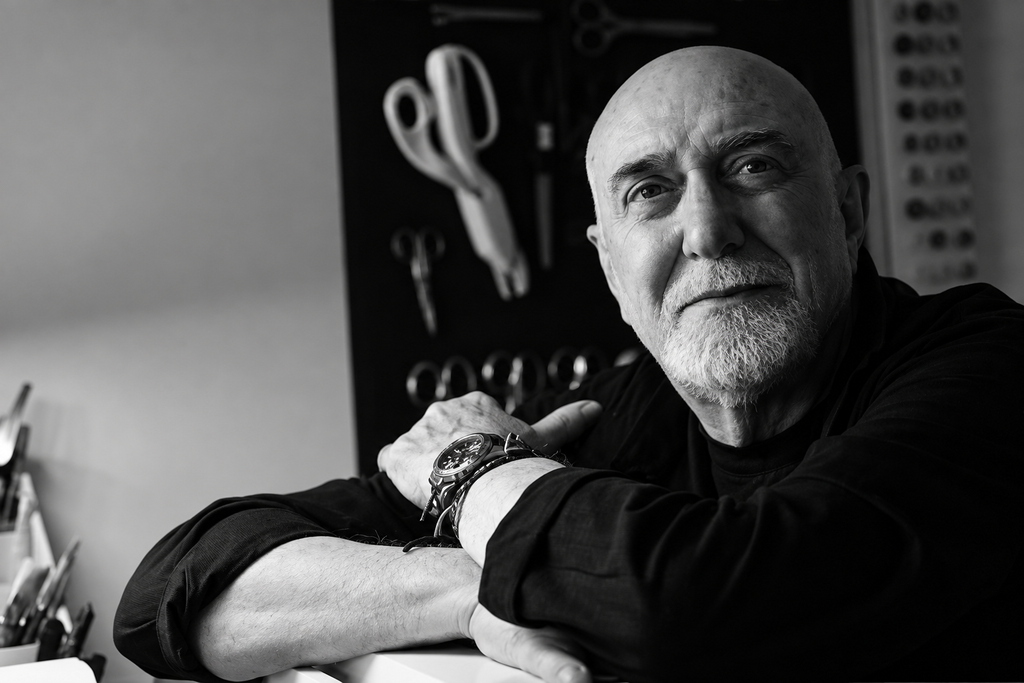
Sandro Visca – Biobibliography
Born in L’Aquila on 19 September 1944, Sandro Visca completed his art studies in his home city.
In 1961, his figure-drawing teacher Giuseppe Desiato, who would later become one of Europe’s leading exponents of Body Art, chose him to form “Gruppo 5”, a group that challenged the status quo and proposed new artistic directions in the otherwise static cultural life of L’Aquila.
In 1962, he was selected for the National Drawing Biennale, Premio Recoaro Terme, which also included Valerio Adami, Felice Casorati, Giuseppe Capogrossi, Renato Guttuso and Giorgio Morandi.
He moved to Rome in 1963 and remained there until 1967. Contact with the capital’s vibrant art scene deepened his research and helped him develop his own independent artistic language; these were years of prolific production and intensive exhibition activity.
Returning to Abruzzo in 1968, he settled in Pescara, where he still lives, teaching painting until 2003 in the Academy section of the G. Misticoni State Art School.
A versatile and multifaceted artist, in 1969 he worked with the Teatro Stabile dell’Aquila as the sole painter and set artist responsible for producing Alberto Burri’s designs for Ignazio Silone’s L’Avventura d’un Povero Cristiano, directed by Valerio Zurlini. Three enormous backdrops, each ten metres by seven, consisting of a sack, a red plastic work and a combustion, formed the sets for the drama’s three acts. The production had its Italian premiere in San Miniato al Tedesco in August of that year. His acquaintance with Burri developed into a significant, long-lasting friendship, sustained by frequent meetings and shared passions, including hunting trips in the mountains of Abruzzo and the hills of Umbria.
In 1975, he made Un cuore rosso sul Gran Sasso, an art film shot on 16 mm: a performative work centred on the artistic sign and deliberately conceived as a collective undertaking, set among ancient rural communities and against the unspoilt landscape of the majestic Apennine massif. Accompanied by the screen-printed volume Un cuore rosso sul Gran Sasso and the artist’s book Per un cuore rosso sul Gran Sasso, introduced by Diego Carpitella and both handmade in limited editions, the film remained unfinished until 2011.
Following journeys to various Latin American countries from 1978 onwards, he reflected on the Western world’s historical responsibilities towards the continent and on the essential need for a culture founded on respect for human beings. This gave rise to the philosophical and political imperative of an art whose central motivation is the human dimension, and of a practice pursued outside the constraints of the market and passing fashions. Created over more than fifty years, his work forms a substantial corpus which, despite its different phases, has maintained a distinctive coherence in its language, content and materials. As Gino Marotta put it, these are moments in which “[…] fetishes and taboos emerge, along with candid revivals of highly cultivated spells and fiercely passionate explorations of the emotional territories of an ethnic collectivity that extends beyond the Gran Sasso, towards the desert”. The materials, predominantly textiles, are aesthetically significant both in their selection and their refined handling, orchestrating the various “pictorial” surfaces, the emblematic tapestries and sculptures, including the Teatrini, through to monumental environments.
His solo exhibitions, held in historic buildings, museums and private spaces in Italy and abroad, include a 1964 exhibition of forty works on the Crucifixion in L’Aquila, curated by Emidio Di Carlo, and a 1970 exhibition at Galleria d’Arte Oggi in Pescara, with a catalogue text by Nicola Ciarletta. In 1973, he exhibited at Galleria Pace in Milan, curated by Lucio Fraccacreta, subsequently at Scalco delle Tre Marie in L’Aquila, introduced by Gino Marotta, and finally at Laboratorio Comune d’Arte Convergenze in Pescara. In 1976, he presented tapestries, mixed-media structures and canvases in Ligamenti d’amore at Galleria L’Oca in Rome.
The following decade saw him present Parole di terra parole nell’aria with Pasquale Liberatore in 1984 at the Centro Multimediale Quarto di Santa Giusta in L’Aquila, curated by Tito Spini. The next year, Fuochi d’amore was shown at Galleria Questarte in Pescara, introduced by Enrico Crispolti, who had followed his work closely since its beginnings. In 1986, he exhibited Un coraçao vermelho no Gran Sasso in São Paulo, Brazil, giving its title to and opening the first Expo Brasil-Italia. That same year, nineteen of his tapestries were shown at the Forte Spagnolo in L’Aquila in the exhibition Cuciti, which travelled to Galleria Questarte in Pescara the following year. A monograph with texts by Enrico Crispolti and Tito Spini was published for the occasion.
In 1992, he created the installation Firmamento di terra in the square in Collelongo, followed in 1995 by Il Grande Firmamento at the former Gaslini premises in Pescara, introduced by Daniele Cavicchia. This powerful environmental work consisted of a completely darkened, walk-through structure whose ceiling was painted with fluorescent tempera and illuminated by ultraviolet lamps. The same year saw the retrospective Sandro Visca 1974-1994, featuring tapestries, painted canvases and sculptures, at the Sala del Diritto Comune in the Palazzo Ducale of the University of Camerino, with critical contributions by Enrico Crispolti, Lucio Fraccacreta, Ruggero Pierantoni and Tito Spini. In 1996, he presented Vessilli d’amore at the Museo Sperimentale d’Arte Contemporanea in L’Aquila, with several contributions published in the catalogue, including texts by Enrico Crispolti and Gino Marotta.
The new millennium began with the solo exhibition In itinere, in which a single stitched tapestry, 34 metres long and 50 centimetres high, was installed at the Galleria d’Arte Moderna in Palazzo Ricci, Macerata, curated by Paola Ballesi. The exhibition was subsequently presented at the Chiesa del Suffragio in Corinaldo, curated by Margherita Abbo, then at the Forte Spagnolo in L’Aquila, and finally at the Centro Culturale Officina in Lucca.
Paola Ballesi observes that “By assembling the most varied and heterogeneous materials through stitching and fabric […] he composes a kind of metonymic glossary of an imaginative collection of finds and traces of memory. These mark and punctuate the time of life along a path bristling with iconic sediments, which the artist gathers and translates through a highly personal code of vivid forms, heraldic devices, emblems and symbols, played out according to the subtle score of irony”.
These aspects, characteristic of the poetics of his tapestries, are also evident in the Teatrini exhibited in 2003 at the Sala Consiliare in Ofena, introduced by Antonello Rubini.
The 2008 retrospective Visca opere 1962-2008, held at the Museo d’Arte Moderna Vittoria Colonna in Pescara, presented works representative of his entire artistic career. It was accompanied by a substantial monographic catalogue with an essay by Plinio Perilli and extensive documentation of his exhibition history and critical reception.
“In every painting or installation,” wrote Plinio Perilli in 2008, “tapestry or cloth figure, little theatre or collage by Visca — at once solar and lunar, like a Golden Shadow — the joyful wager of art languishes, consumes itself or reawakens, buds and is born as if through a Caesarean incision: the hard-won harmony of existence, the nature to which we belong and which calls us back, baptises us and shapes us as human beings, forever made new by the ancient, successive dawns, setting yet inextinguishable”.
In 2011, Un cuore rosso sul Gran Sasso, completed in a digital edition, was screened in Santo Stefano di Sessanio as a Special Event of the Italian Pavilion at the 54th Venice Biennale, curated by Umberto Palestini. “Through media languages and a keen gaze,” he writes, “directed towards the contemporary, Sandro Visca, with his travelling heart, brings a memory back to the surface that celebrates the social bonds connected to the treasure of nature as it is lived rather than threatened. It reconsiders personal biography as a reflection of one’s chosen territory, making it the sensitive place of one’s own self-recognition”.
In 2019, a major retrospective devoted to drawing, entitled Visca Carte Inedite 1961-2019, was presented at the Fondazione Pescara Abruzzo in Pescara. Curated by Rita Olivieri, it featured works created over almost sixty years and never previously shown to the public. Olivieri writes: “It is clear that any interpretation of Visca’s production can no longer overlook these previously unseen works on paper. They enrich the understanding of his work as a whole and unequivocally reveal the vital, primary source that has guided and sustained his passionate vocation for art”.
Visca’s participation in group exhibitions is also significant, ranging from major events in Abruzzo to exhibitions of national and international importance. These include the “Gruppo 5” exhibition in San Benedetto del Tronto in 1964 and Realtà figurativa d’Abruzzo at Palazzo Bonanni in L’Aquila in 1966, when Remo Brindisi purchased works by him for the Museo Alternativo R. Brindisi in Lido di Spina, Ferrara. In 1967, he took part in the first Premio Città di Penne and later in its second, third and fourth editions. In 1968, he exhibited in Milan at Premio Europa 68 and Premio San Fedele at the gallery of the same name. In 1970, he was invited to Immagini del nostro tempo at the Museo della Scienza e della Tecnica in Milan, and in 1971 to the XXV Mostra Nazionale F.P. Michetti in Francavilla al Mare, as well as subsequent editions. The following year, he took part in the I mostra nazionale at Galleria Arte Oggi in Pescara and Estensione 72 at the Casa del Mantegna in Mantua, curated by Lorenza Trucchi. In 1973, he was invited to the XV Triennale Internazionale in Milan, in the Italian section “Lo spazio vuoto dell’habitat”, curated by Edoardo Vittoria, where he presented a mixed-media composition six metres wide, entitled Paesaggio. The section “Contatto Arte-Città”, curated by Giulio Macchi, featured interventions by various artists, including Arman’s Accumulazione musicale e seduta, Alberto Burri’s Il Teatro Continuo, Giorgio De Chirico’s I bagni misteriosi and Gino Marotta’s Eden artificiale.
Also in 1973, his work was exhibited at the 5 Premio Biennale at the Pinacoteca Provinciale in Bari. In 1976, he worked with Gino Marotta to reconstruct Lucio Fontana’s Ambiente Spaziale a luce nera at the Venice Biennale. This was followed by participation in an exhibition in Caracas organised by Galleria de Arte Arcobaleno, alongside artists including Appel, Mario Ceroli, Gino Marotta and Sebastián Matta.
In 1982, he took part in Intimità dell’indagine at the Centri dei Servizi Culturali della Regione Abruzzo in Pescara, which was subsequently installed at the Palazzo dei Diamanti in Ferrara. In 1985, he participated in L’Onda del Sud at the Castello Svevo in Bari, curated by Enrico Crispolti, and also exhibited in the International Biennal print exhibit in Taipei, a survey of graphic works. In 1987, he took part in Alternative Attuali at the Forte Spagnolo in L’Aquila and then in Itineraires Paralleles at the Palais de Glace in Neuchâtel, which travelled to Ontario, Canada, curated by Enrico Crispolti. At the same critic’s invitation, in 1991 his tapestries were presented at the Basilica Palladiana in Vicenza in the thematic exhibition Textilia ’91, in the historical section Pittura tessuta, alongside works by artists including Enrico Prampolini, Giacomo Balla, Afro and Corrado Cagli. In 1992, he took part in the Seville World Expo.
In 2002, he took part in the XXXV Premio Vasto — Il secondo Novecento in Italia, Riferimenti forti — curated by Enrico Crispolti; in 2004, in Omaggio a Francesco Petrarca in Seoul, organised by the Italian Cultural Institute; and in 2006, in Collezione Generazione Anni Quaranta at the Museo Magi in Pieve di Cento. In 2011, he was invited to exhibitions marking the 150th anniversary of Italian unification, promoted by the Italian Pavilion of the 54th International Art Exhibition of the Venice Biennale, at the Aurum in Pescara and the Fortezza Borbonica in Civitella del Tronto. That same year, he exhibited in Viaggi Sogni e trame inattese – poetiche intuizioni dal Padiglione Italia /Abruzzo della 54. Esposizione Internazionale d’Arte della Biennale di Venezia at Galleria Anna d’Ascanio in Rome, curated by Umberto Palestini.
In 2012, he took part in Visioni – La fortezza plurale dell’arte, curated by Giacinto Di Pietrantonio and Umberto Palestini. That same year, at the conference hall of MAAAC, the Museum of Contemporary Art at the Castello di Nocciano, he participated in Corpo- Festival delle Arti Performative, curated by Ivan d’Alberto and Sibilla Panerai, with the event “Il viaggio ascetico di Sandro Visca ‘Un cuore rosso sul Gran Sasso’”. In 2015, he was invited to the XIII Mostra Nazionale TEX d’autore, Fumetto & Arte, held at the Quadrilatero of Palazzo Bufalini in Città di Castello. In 2018, he took part both in Progetto “Mediterraneo – Lo Specchio dell’Altro” at Palazzo Reale in Milan, promoted by Arturo Schwarz and curated by Gloria Gatti, and in Percorsi d’Arte Contemporanea at the Museo delle Genti d’Abruzzo in Pescara, organised by the Fondazione Genti d’Abruzzo. In 2022, he exhibited in Per Alternative Attuali – Sguardi incrociati tra passato e presente at MU.SP.A.C, the Museo Sperimentale d’Arte Contemporanea in L’Aquila, and in MAESTRI e allievi del Liceo Artistico di Pescara at YAG/garage in Pescara, curated by Ivan D’Alberto.
Since the early 1960s, alongside his artistic research, Visca has pursued photography as an amateur passion. In 2015, his photographs were shown at Studio Gallery in Lamezia Terme in the group exhibition Intorno a Burri / Scatti d’autore, curated by Tonino Sicoli and Andrea Romoli Barberini. In 2019, he was invited to Obiettivi su Burri – Fotografi e foto ritratti di Alberto Burri dal 1954 al 1993, curated by Bruno Corà at the Ex Seccatoi del Tabacco in Città di Castello. He contributed twelve photographs dating from 1969 and 1978 and, as part of the exhibition, was among the speakers at the study day entitled Fotografia: opera e/o documento?
His book Donde se amarra el sol was published in 2015, drawing on the diary and photographs of his journey to Peru many years earlier. He considers the country a “multifaceted monument to the world”; in the book, writing and images “paint” a natural, human and artistic landscape of undeniable fascination.
More recently, from March to May 2023, he presented a selection of his latest works in the solo exhibition Inedito 2014/2022 at the Fondazione La Rocca in Pescara, curated by Rita Olivieri. The exhibition inaugurated the exhibition programme of the F.L.R. Foundation, established to promote and enhance modern, contemporary and avant-garde intellectual and artistic activities.
Most recently, in 2024, the Fondazione Pescarabruzzo of Pescara promoted a major retrospective of Visca’s work at the Museo Bilotti, Aranciera di Villa Borghese, in Rome. Curated by Generoso Bruno, the exhibition ran from 12 October 2024 to 12 February 2025 and attracted 35,000 visitors.